


Growth and Body Composition in PKU Children-A Three-Year Prospective Study Comparing the Effects of L-Amino Acid to Glycomacropeptide Protein Substitutes
- PMID: 33923714
- PMCID: PMC8073059
- DOI: 10.3390/nu13041323
Growth and Body Composition in PKU Children-A Three-Year Prospective Study Comparing the Effects of L-Amino Acid to Glycomacropeptide Protein Substitutes
Abstract
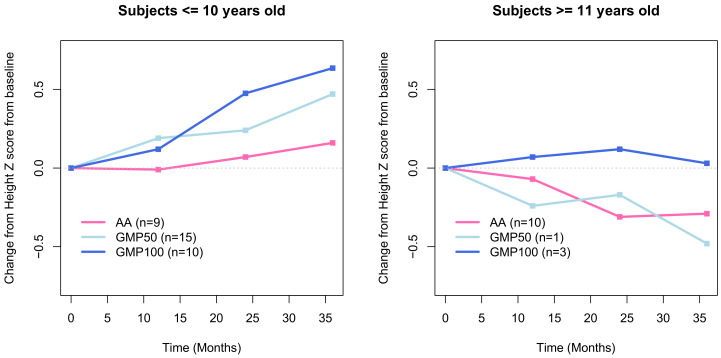
Protein quality and quantity are important factors in determining lean body (muscle) mass (LBM). In phenylketonuria (PKU), protein substitutes provide most of the nitrogen, either as amino acids (AA) or glycomacropeptide with supplementary amino acids (CGMP-AA). Body composition and growth are important indicators of long-term health. In a 3-year prospective study comparing the impact of AA and CGMP-AA on body composition and growth in PKU, 48 children were recruited. N = 19 (median age 11.1 years, range 5-15 years) took AA only, n = 16 (median age 7.3 years, range 5-15 years) took a combination of CGMP-AA and AA, (CGMP50) and 13 children (median age 9.2 years, range 5-16 years) took CGMP-AA only (CGMP100). A dual energy X-ray absorptiometry (DXA) scan at enrolment and 36 months measured LBM, % body fat (%BF) and fat mass (FM). Height was measured at enrolment, 12, 24 and 36 months. No correlation or statistically significant differences (after adjusting for age, gender, puberty and phenylalanine blood concentrations) were found between the three groups for LBM, %BF, FM and height. The change in height z scores, (AA 0, CGMP50 +0.4 and CGMP100 +0.7) showed a trend that children in the CGMP100 group were taller, had improved LBM with decreased FM and % BF but this was not statistically significant. There appeared to be no advantage of CGMP-AA compared to AA on body composition after 3-years of follow-up. Although statistically significant differences were not reached, a trend towards improved body composition was observed with CGMP-AA when it provided the entire protein substitute requirement.
Keywords: body composition; glycomacropeptide; phenylketonuria; protein substitute.
Conflict of interest statement
A.D., research funding from Vitaflo International, financial support from Nutricia, Mevalia & Vitaflo International to attend study days and conferences. S.E., research funding from Nutricia, financial support from Nutricia & Vitaflo International to attend study days and conferences. A.P. has received an educational grant from Cambrooke Therapeutics and grants from Vitaflo International, Nutricia, Merck Serono, Biomarin and Mevalia to attend scientific meetings. C.A. received honoraria from Nutricia and Vitaflo International to attend study days and conferences. J.C.R. is a member of the European Nutritionist Expert Panel (Biomarin), the Advisory Board for Applied Pharma Research and Nutricia, and received honoraria as a speaker from APR, Merck Serono, Biomarin, Nutricia, Vitaflo, Cambrooke, PIAM and Lifediet. A.M. received research funding and honoraria from Nutricia, Vitaflo International & Merck Serono, and is a member of the European Nutrition Expert Panel (Merck Serono International), the Sapropterin Advisory Board (Merck Serono international) and the Advisory Board Element (Danone-Nutricia). The funders had no role in the design of the study; in the collection, analyses, or interpretation of data; in the writing of the manuscript, or in the decision to publish the results.
Figures
References
-
- Kelly D.A. Nutritional factors affecting growth before and after liver transplantation. Pediatr. Transpl. 1997;1:80–84. - PubMed
Publication types
MeSH terms
Substances
Grants and funding
LinkOut - more resources
Full Text Sources
Other Literature Sources
Medical
Miscellaneous
