


Effectiveness of Clinical Pharmacist Service on Drug-Related Problems and Patient Outcomes for Hospitalized Patients with Chronic Kidney Disease: A Randomized Controlled Trial
- PMID: 33924036
- PMCID: PMC8072770
- DOI: 10.3390/jcm10081788
Effectiveness of Clinical Pharmacist Service on Drug-Related Problems and Patient Outcomes for Hospitalized Patients with Chronic Kidney Disease: A Randomized Controlled Trial
Abstract
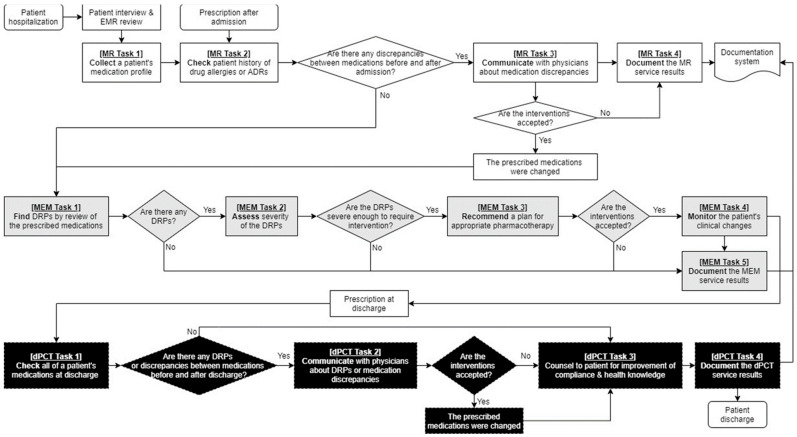
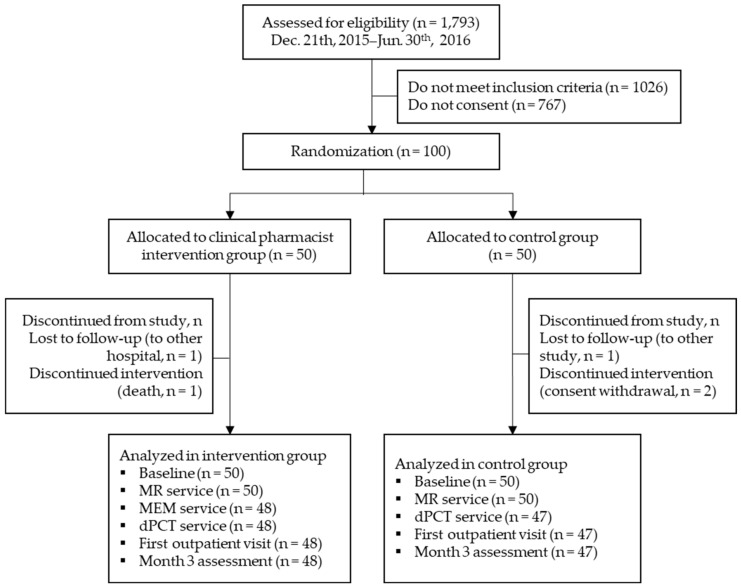
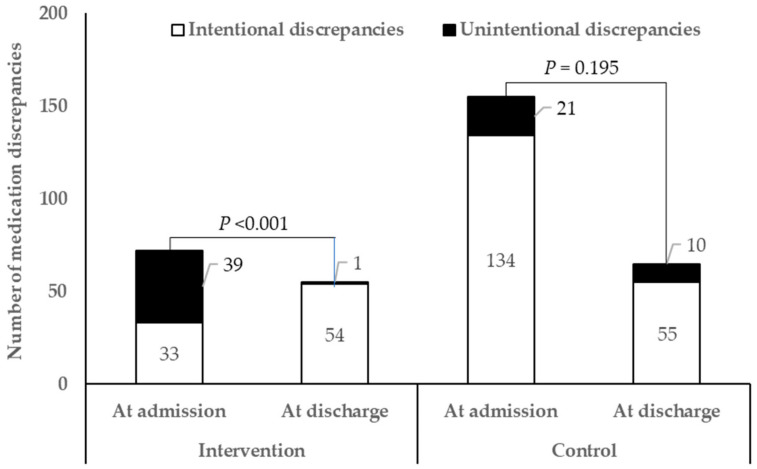
(1) Background: The study aimed to analyze the effectiveness of clinical pharmacist services on drug-related problems (DRPs) and patient outcomes in inpatients with chronic kidney disease (CKD). (2) Methods: In a randomized controlled trial, the participants in the intervention group received pharmacist services, including medication reconciliation, medication evaluation and management, and discharge pharmaceutical care transition services. Participants in the control group received usual care. The primary outcome was the number of DRPs per patient at discharge. (3) Results: The baseline characteristics of 100 participants included the following: mean age, 52.5 years; median eGFR, 9.2 mL/min/1.73 m2. The number of DRPs in the intervention group during hospitalization increased significantly with decreasing eGFR (PR, 0.970; 95% CI, 0.951-0.989) and an increasing number of unintentional medication discrepancies at admission (PR, 1.294; 95% CI, 1.034-1.620). At discharge, the number of DRPs per patient was 0.94 ± 1.03 and 1.96 ± 1.25 in the intervention and control groups, respectively (p < 0.001). The service had a significant effect on the reduction of the unintentional discrepancies at discharge (p < 0.001). (4) Conclusion: Hospital pharmacists play an important role in the prevention of DRPs at discharge and unintentional medication discrepancies in inpatients with CKD.
Keywords: chronic kidney disease; drug-related problems; hospitalized patients; pharmaceutical care service.
Conflict of interest statement
The authors declare no conflict of interest. The funders had no role in the design of the study; in the collection, analyses, or interpretation of data; in the writing of the manuscript, or in the decision to publish the results.
Figures
References
-
- Kidney Disease: Improving Global Outcomes (KDIGO) CKD Work Group KDIGO 2012 Clinical Practice Guideline for the Evaluation and Management of Chronic Kidney Disease. Kidney Int. Suppl. 2013;3:1–150.
-
- Xie Y., Bowe B., Mokdad A.H., Xian H., Yan Y., Li T., Maddukuri G., Tsai C.-Y., Floyd T., Al-Aly Z. Analysis of the Global Burden of Disease study highlights the global, regional, and national trends of chronic kidney disease epidemiology from 1990 to 2016. Kidney Int. 2018;94:567–581. doi: 10.1016/j.kint.2018.04.011. - DOI - PubMed
-
- Bikbov B., Purcell C.A., Levey A.S., Smith M., Abdoli A., Abebe M., Adebayo O.M., Afarideh M., Agarwal S.K., Agudelo-Botero M., et al. Global, regional, and national burden of chronic kidney disease, 1990–2017: A systematic analysis for the Global Burden of Disease Study 2017. Lancet. 2020;395:709–733. doi: 10.1016/S0140-6736(20)30045-3. - DOI - PMC - PubMed
-
- Chronic Kidney Disease (CKD) in Korea by Numbers KSN NEWS Factsheet. [(accessed on 28 December 2020)];2019 Available online: http://www.ksn.or.kr/rang_board/list.html?num=1570&code=factsheet.
-
- United States Renal Data System . 2020 USRDS Annual Data Report: Epidemiology of Kidney Disease in the United States. National Institutes of Health, National Institute of Diabetes and Digestive and Kidney Diseases; Bethesda, MD, USA: 2020. End Stage Renal Disease: Chapter 11. Iternational Comparisons.
Grants and funding
LinkOut - more resources
Full Text Sources
Other Literature Sources
Research Materials
Miscellaneous
