


Evidence-Based Aerobic Exercise Training in Metabolic-Associated Fatty Liver Disease: Systematic Review with Meta-Analysis
- PMID: 33924482
- PMCID: PMC8069623
- DOI: 10.3390/jcm10081659
Evidence-Based Aerobic Exercise Training in Metabolic-Associated Fatty Liver Disease: Systematic Review with Meta-Analysis
Abstract
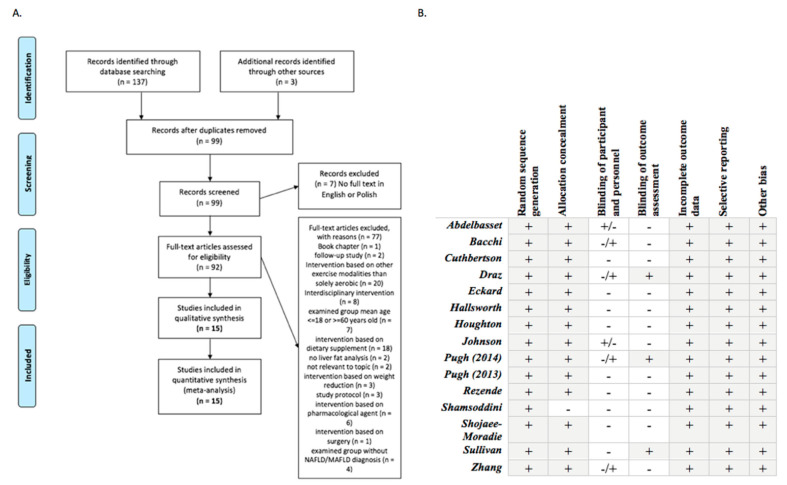
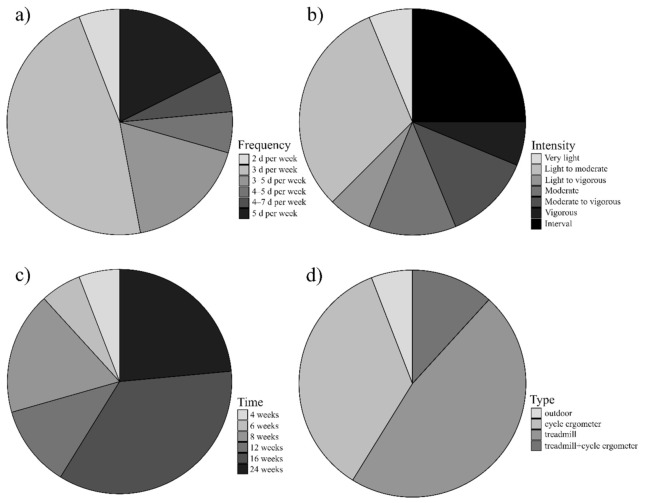
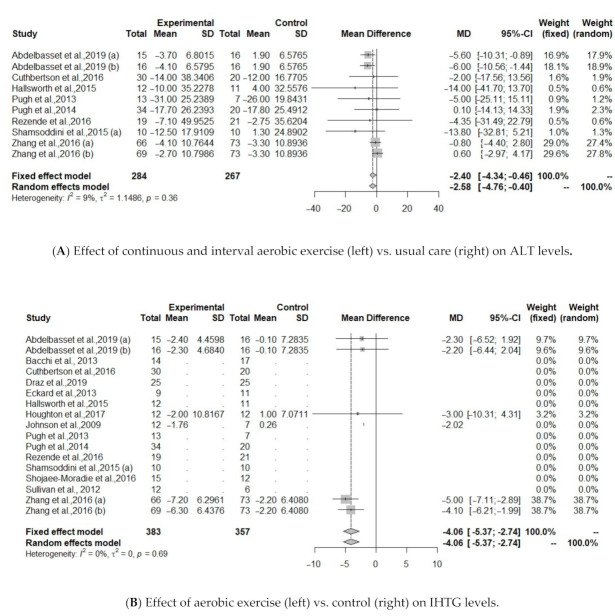
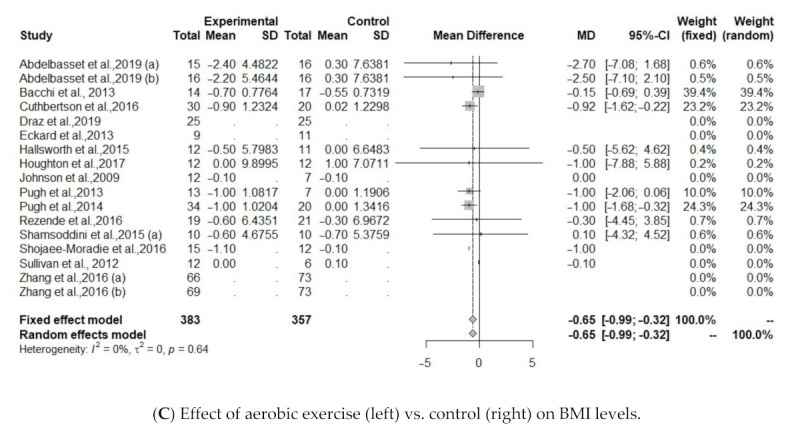
Background: This meta-analysis evaluates the overall effect of the non-pharmacological intervention, aerobic exercise, upon serum liver enzymes levels, glucose metabolism and anthropometric measures amongst patients with metabolic associated fatty liver disease (MAFLD). It also examines whether the effects on these outcomes are moderated by the aerobic training protocol when considered according to the American College of Sports Medicine (ACSM) recommended FITT (frequency, intensity, time, type) principles. Approach and Results: Fifteen randomized control trials were included in the meta-analysis. Compared with usual care, continuous and interval training showed significant efficacy in alanine aminotransferase (ALT) level improvement (MD = -2.4, 95% CI: -4.34 to -0.46 p = 0.015, I2 = 9.1%). Interventions based on all types of aerobic exercise protocols showed significant improvement of intrahepatic triglycerides (MD = -4.0557, 95% CI: -5.3711 to -2.7403, p < 0.0001, I2 = 0%) and BMI (MD = -0.9774, 95% CI: -1.4086 to -0.5462, p < 0.0001, I2 = 0). Meta-regression analysis demonstrated a significant correlation between total intervention time and ALT level (for all aerobic protocols: 6.0056, se = 2.6896, z = 2.2329, p = 0.02; as well as for continuous and interval aerobic protocols: 5.5069, se = 2.7315, z = 2.016, p = 0.04).
Conclusions: All types of aerobic exercise protocols are effective at improving intrahepatic triglycerides and lead to a reduction in body mass index. In addition, continuous and interval aerobic exercise may be more effective at improving ALT ≤12 weeks intervention time benefits the management of MAFLD.
Keywords: aerobic activity; exercise; fatty liver; metabolic fatty liver; treatment.
Conflict of interest statement
The authors declare no conflict of interest.
Figures
References
-
- Jarvis H., Craig D., Barker R., Spiers G., Stow D., Anstee Q.A., Hanratty B. Metabolic risk factors and incident advanced liver disease in non-alcoholic fatty liver disease (NAFLD): A systematic review and meta-analysis of population-based observational studies. PLoS Med. 2020;17:e1003100. doi: 10.1371/journal.pmed.1003100. - DOI - PMC - PubMed
-
- Eslam M., Newsome P.N., Sarin S.K., Anstee Q.M., Targher G., Romero-Gomez M., Shira Zelber-Sagi S., Wai-Sun Wong V., Dufour J.F., Schattenberg J.M., et al. A new definition for metabolic dysfunction-associated fatty liver disease: An international expert consensus statement. J. Hepatol. 2020;73:202–209. doi: 10.1016/j.jhep.2020.03.039. - DOI - PubMed
Publication types
LinkOut - more resources
Full Text Sources
Other Literature Sources
