


Differences in Salivary Proteins as a Function of PROP Taster Status and Gender in Normal Weight and Obese Subjects
- PMID: 33924512
- PMCID: PMC8069534
- DOI: 10.3390/molecules26082244
Differences in Salivary Proteins as a Function of PROP Taster Status and Gender in Normal Weight and Obese Subjects
Abstract
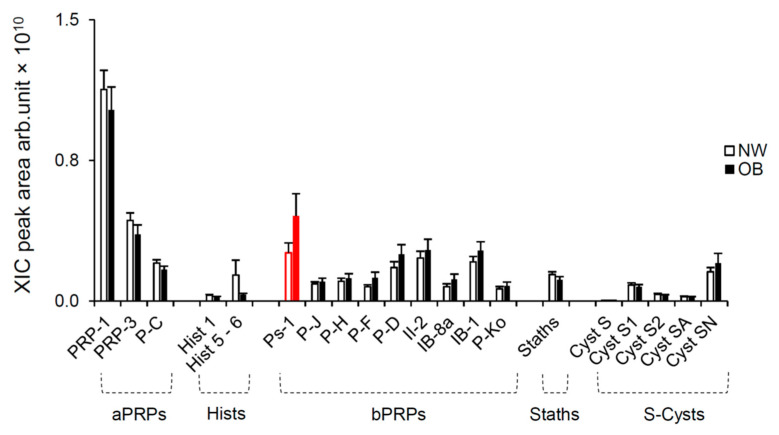
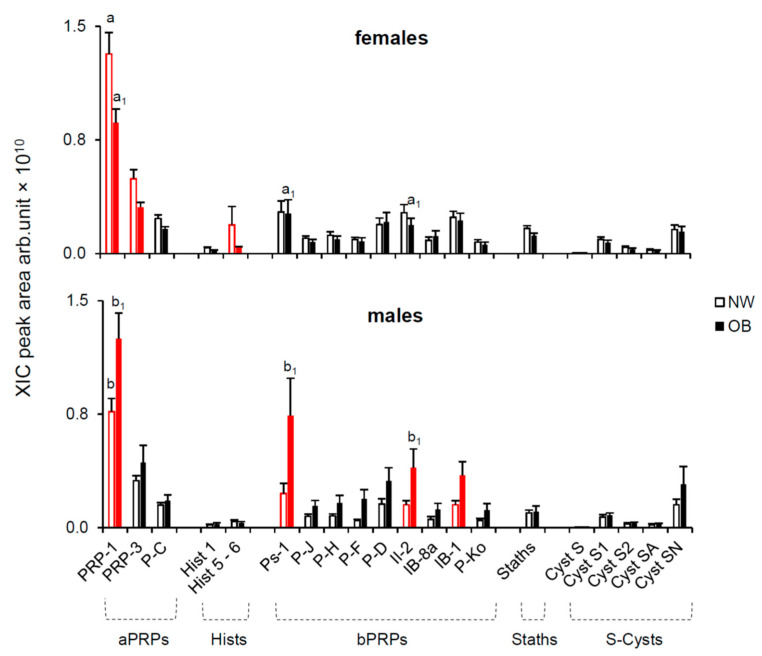
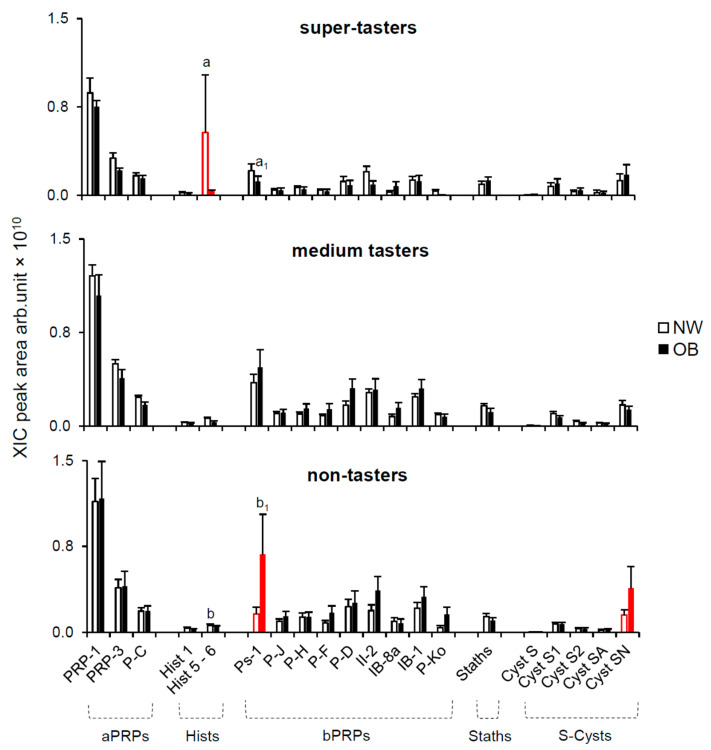
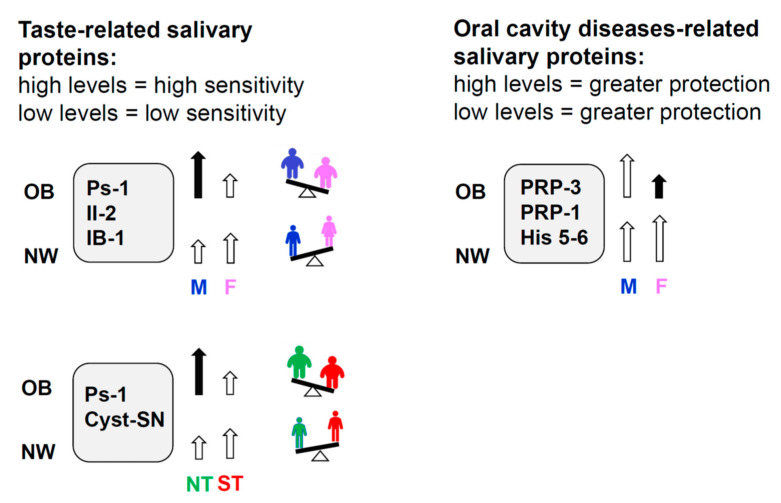
Taste plays an important role in processes such as food choices, nutrition status and health. Salivary proteins contribute to taste sensitivity. Taste reduction has been associated with obesity. Gender influences the obesity predisposition and the genetic ability to perceive the bitterness of 6-n-propylthiouracil (PROP), oral marker for food preferences and consumption. We investigated variations in the profile of salivary proteome, analyzed by HPLC-ESI-MS, between sixty-one normal weight subjects (NW) and fifty-seven subjects with obesity (OB), based on gender and PROP sensitivity. Results showed variations of taste-related salivary proteins between NW and OB, which were differently associated with gender and PROP sensitivity. High levels of Ps-1, II-2 and IB-1 proteins belonging to basic proline rich proteins (bPRPs) and PRP-1 protein belonging to acid proline rich proteins (aPRPs) were found in OB males, who showed a lower body mass index (BMI) than OB females. High levels of Ps-1 protein and Cystatin SN (Cyst SN) were found in OB non-tasters, who had lower BMI than OB super-tasters. These new insights on the role of salivary proteins as a factor driving the specific weight gain of OB females and super-tasters, suggest the use of specific proteins as a strategic tool modifying taste responses related to eating behavior.
Keywords: gender; obesity; salivary proteins; taste sensitivity.
Conflict of interest statement
The authors declare no conflict of interest.
Figures

Similar articles
-
Responsiveness to 6-n-propylthiouracil (PROP) is associated with salivary levels of two specific basic proline-rich proteins in humans.PLoS One. 2012;7(2):e30962. doi: 10.1371/journal.pone.0030962. Epub 2012 Feb 1. PLoS One. 2012. PMID: 22312435 Free PMC article. Clinical Trial.
-
Marked increase in PROP taste responsiveness following oral supplementation with selected salivary proteins or their related free amino acids.PLoS One. 2013;8(3):e59810. doi: 10.1371/journal.pone.0059810. Epub 2013 Mar 28. PLoS One. 2013. PMID: 23555788 Free PMC article.
-
Sensory perception of and salivary protein response to astringency as a function of the 6-n-propylthioural (PROP) bitter-taste phenotype.Physiol Behav. 2017 May 1;173:163-173. doi: 10.1016/j.physbeh.2017.01.031. Epub 2017 Jan 24. Physiol Behav. 2017. PMID: 28130087
-
Genetic sensitivity to the bitter taste of 6-n-propylthiouracil (PROP) and its association with physiological mechanisms controlling body mass index (BMI).Nutrients. 2014 Aug 27;6(9):3363-81. doi: 10.3390/nu6093363. Nutrients. 2014. PMID: 25166026 Free PMC article. Review.
-
Genetic variation in taste sensitivity to 6-n-propylthiouracil and its relationship to taste perception and food selection.Ann N Y Acad Sci. 2009 Jul;1170:126-39. doi: 10.1111/j.1749-6632.2009.03916.x. Ann N Y Acad Sci. 2009. PMID: 19686122 Review.
Cited by
-
The Multifaceted Roles of Proline in Cell Behavior.Front Cell Dev Biol. 2021 Aug 12;9:728576. doi: 10.3389/fcell.2021.728576. eCollection 2021. Front Cell Dev Biol. 2021. PMID: 34458276 Free PMC article. Review.
-
Automated identification of the genetic variants of TAS2R38 bitter taste receptor with supervised learning.Comput Struct Biotechnol J. 2023 Jan 22;21:1054-1065. doi: 10.1016/j.csbj.2023.01.029. eCollection 2023. Comput Struct Biotechnol J. 2023. PMID: 38213886 Free PMC article.
-
Is obesity associated with taste alterations? a systematic review.Front Endocrinol (Lausanne). 2023 Jun 2;14:1167119. doi: 10.3389/fendo.2023.1167119. eCollection 2023. Front Endocrinol (Lausanne). 2023. PMID: 37334283 Free PMC article.
-
Anti-inflammatory, cardioprotective effect of gypenoside against isoproterenol-induced cardiac remodeling in rats via alteration of inflammation and gut microbiota.Inflammopharmacology. 2023 Oct;31(5):2731-2750. doi: 10.1007/s10787-023-01307-9. Epub 2023 Aug 21. Inflammopharmacology. 2023. PMID: 37603159
References
-
- Carrai M., Steinke V., Vodicka P., Pardini B., Rahner N., Holinski-Feder E., Morak M., Schackert H.K., Gorgens H., Stemmler S., et al. Association between TAS2R38 gene polymorphisms and colorectal cancer risk: A case-control study in two independent populations of Caucasian origin. PLoS ONE. 2011;6:e20464. doi: 10.1371/journal.pone.0020464. - DOI - PMC - PubMed
Publication types
MeSH terms
Substances
Grants and funding
LinkOut - more resources
Full Text Sources
Other Literature Sources
Research Materials
Miscellaneous
