. 2021 Apr 28;12(5):660.
doi: 10.3390/genes12050660.

Sorghum Brown Midrib19 (Bmr19) Gene Links Lignin Biosynthesis to Folate Metabolism

Affiliations

Sorghum Brown Midrib19 (Bmr19) Gene Links Lignin Biosynthesis to Folate Metabolism

Adedayo O Adeyanju et al. Genes (Basel). .

Abstract

Genetic analysis of brown midrib sorghum (Sorghum bicolor) mutant lines assembled in our program has previously shown that the mutations fall into four allelic groups, bmr2, bmr6, bmr12 or bmr19. Causal genes for allelic groups bmr2, bmr6 and bmr12, have since been identified. In this report, we provide evidence for the nature of the bmr19 mutation. This was accomplished by introgressing each of the four bmr alleles into nine different genetic backgrounds. Polymorphisms from four resequenced bulks of sorghum introgression lines containing either mutation, relative to those of a resequenced bulk of the nine normal midrib recurrent parent lines, were used to locate their respective causal mutations. The analysis confirmed the previously reported causal mutations for bmr2 and bmr6 but failed in the case of bmr12-bulk due to a mixture of mutant alleles at the locus among members of that mutant bulk. In the bmr19-bulk, a common G → A mutation was found among all members in Sobic.001G535500. This gene encodes a putative folylpolyglutamate synthase with high homology to maize Bm4. The brown midrib phenotype co-segregated with this point mutation in two separate F2 populations. Furthermore, an additional variant allele at this locus obtained from a TILLING population also showed a brown midrib phenotype, confirming this locus as Bmr19.

Keywords: bmr19; brown midrib mutants; folylpolyglutamate synthase; lignin; lignocellulosic feedstock; sorghum.


Conflict of interest statement

The authors declare that they have no known competing financial interest or personal relationships that could have appeared to influence the work reported in this paper.

Figures
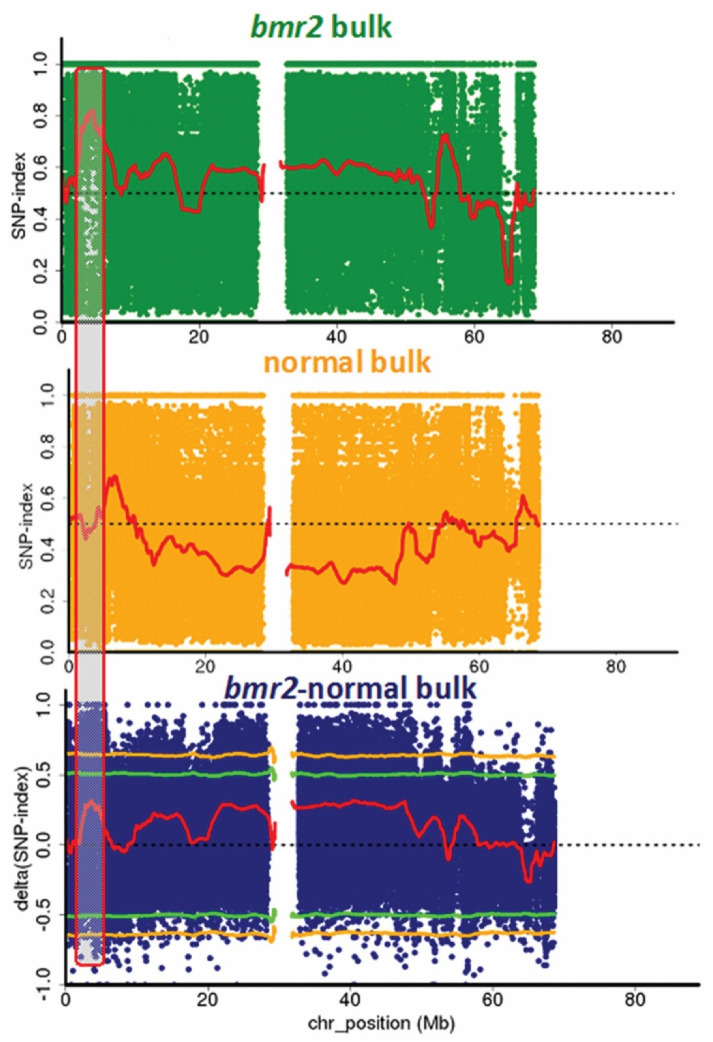
Figure 1
Figure 1
Single nucleotide polymorphism (SNP) analysis to identify bmr2 mutation. SNP index plots of bmr2 bulk (top), normal bulk (middle) and Δ(SNP-index) plot (bottom) of sorghum Chromosome 4 with statistical confidence intervals under the null hypothesis of no QTLs (green, p < 0.05; yellow, p < 0.01). Grey highlighted area shows the QTL near the beginning of Chromosome 4 where the significant difference between the bulks occurs.
Figure 2
Figure 2
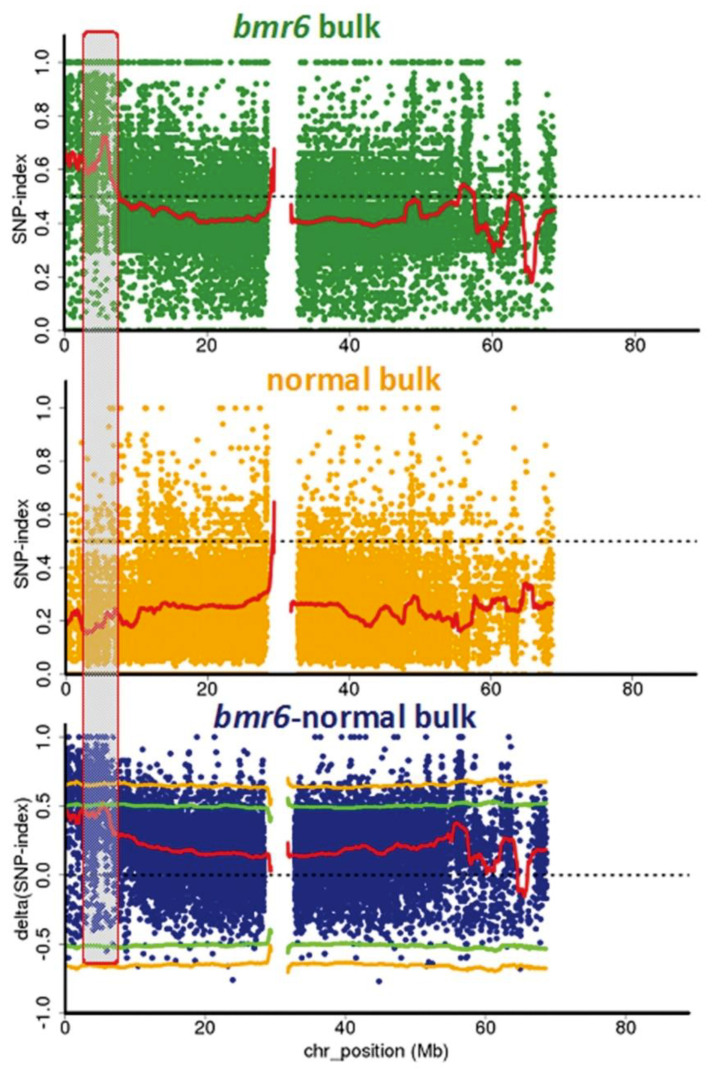
Single nucleotide polymorphism (SNP) analysis to identify bmr6 mutation. SNP index plots of bmr6 bulk (top), normal bulk (middle) and Δ(SNP-index) plot (bottom) of sorghum Chromosome 4 with statistical confidence intervals under the null hypothesis of no QTLs (green, p < 0.05; yellow, p < 0.01). Grey highlighted area shows the QTL near the beginning of Chromosome 4 where the significant difference between the bulks occurs.
Figure 3
Figure 3
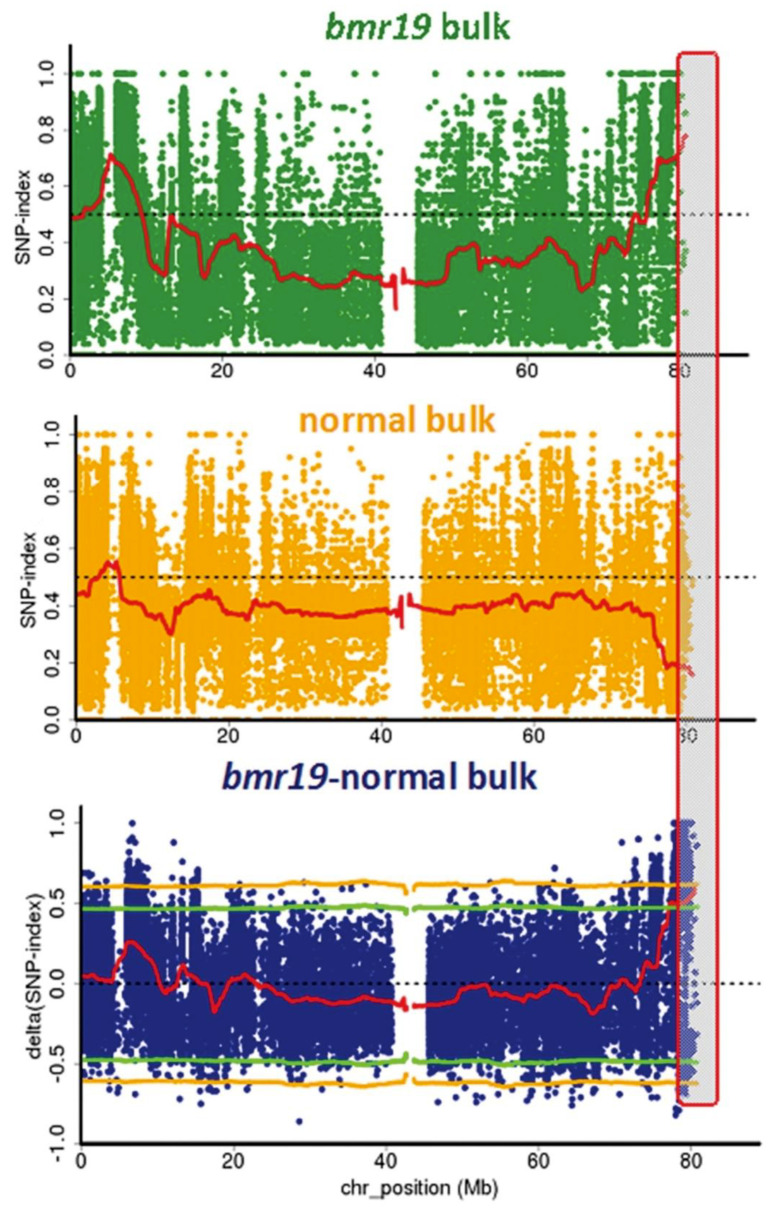
Single nucleotide polymorphism (SNP) analysis to identify bmr19 mutation. SNP index plots of bmr19 bulk (top), normal bulk (middle) and Δ(SNP-index) plot (bottom) of sorghum Chromosome 1 with statistical confidence intervals under the null hypothesis of no QTLs (green, p < 0.05; yellow, p < 0.01). Grey highlighted area shows the QTL at the end of Chromosome 1 where the significant difference between the bulks occurs.
Figure 4
Figure 4
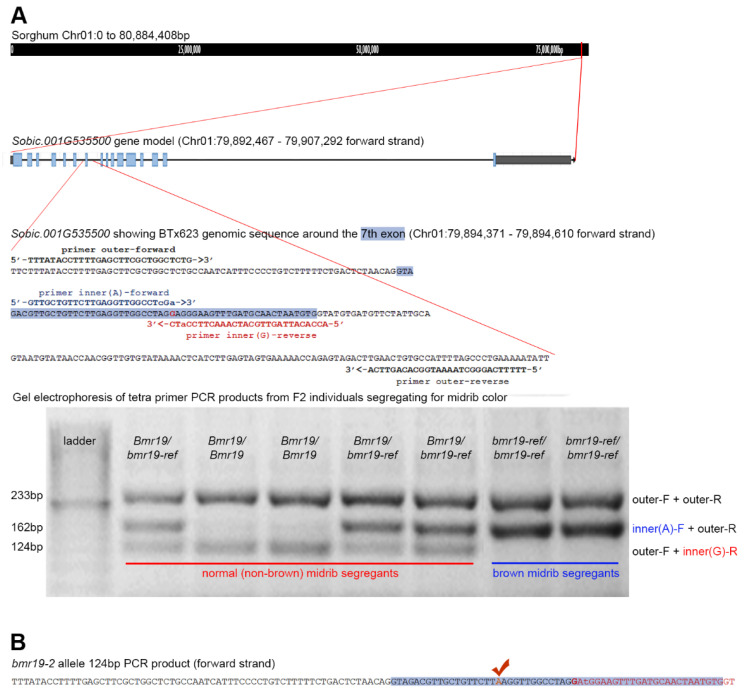
Detection of alleles at Bmr19 using DNA based markers. (A) Location and scheme for the primer set used to detect the SNP distinguishing the bmr19-ref (A) from wildtype Bmr19 (G) alleles. Based on the method described by Medrano and de Oliveira (2014) [37], four primers in the PCR amplify three possible products. The outer primers (outer-F + outer-R) result in a control amplicon of 233 bp in all samples. Mismatches are introduced near the 3′ ends of both inner primers (small case) which both end on the SNP. In the PCR with a wildtype template allele (Bmr19), only the inner(G)-R primer works to give a second amplicon of 124 bp with outer-F since the second mismatch at the 3′ end of inner(A)-F is not tolerated. Only when there is an “A” at this position, as occurs in bmr19-ref, will the inner(A)-F give an amplicon with outer-R of 162 bp. Because of the double mismatch at the 3′ end, inner(G)-R does not work with the mutant template. The PCR products are separated by size with gel electrophoresis. In F2 populations derived from bmr19 crossed with wildtype that segregate for midrib phenotypes, all brown midrib individuals give two bands (233 + 162 bp) corresponding to the bmr19-ref/bmr19-ref genotype. Normal plants give either two bands (233 + 124 bp) if they are homozygous (Bmr19/Bmr19) or three bands (233 + 162 + 124 bp) if they are heterozygous (Bmr19/bmr19-ref). (B) Due to the proximity of the SNP distinguishing the bmr19-2 allele, the same tetra primer set was useful for confirming F1s from the allelism test cross of emasculated bmr19 with 2354. PCR products from true F1s (bmr19-ref/bmr19-2) give three bands like the heterozygotes pictured above while any selfs due to incomplete emasculation (bmr19-ref/bmr19-ref) give only two bands. Sequencing of the smallest band (124 bp) from F1 plants showed the bmr19-2 mutation G → A at the position indicated in orange. The genotype bmr19-ref/bmr19-2 had a brown midrib phenotype, confirming that the mutations are allelic.
Figure 5
Figure 5
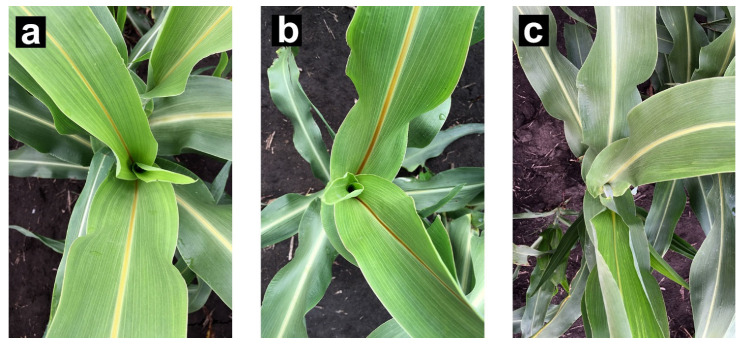
Visible midrib phenotypes of bmr19 mutants and wildtype in the BTx623 background. Photos taken from field grown plants at early boot stage: (a) brown midrib line (BTx623ms3 × bmr19)BC2F4, carrying the bmr19-ref allele; (b) brown midrib BTx623 EMS line 2354, carrying the bmr19-2 allele; (c) normal midrib BTx623, carrying the wildtype (Bmr19) allele.

References

    1. Cesarino I., Simões M.S., dos Santos Brito M., Fanelli A., da Franca Silva T., Romanel E. Building the wall: Recent advances in understanding lignin metabolism in grasses. Acta Physiol. Plant. 2016;38:269–282. doi: 10.1007/s11738-016-2293-5. - DOI
    1. Hatfield R.D., Marita J.M., Hatfield R.D., Marita J.M. Maize development: Cell wall changes in leaves and sheaths. Am. J Plant Sci. 2017;8:1248–1263. doi: 10.4236/ajps.2017.86083. - DOI
    1. Li H., Huang Y. Expression of brown-midrib in a spontaneous sorghum mutant is linked to a 5′-UTR deletion in lignin biosynthesis gene SbCAD2. Sci. Rep. 2017;7:11664. doi: 10.1038/s41598-017-10119-1. - DOI - PMC - PubMed
    1. Börjesson P., Tufvesson L.M. Agricultural crop-based biofuels—Resource efficiency and environmental performance including direct land use changes. J. Clean. Prod. 2011;19:108–120. doi: 10.1016/j.jclepro.2010.01.001. - DOI
    1. Li X., Zheng Y. Lignin-enzyme interaction: Mechanism, mitigation approach, modeling, and research prospects. Biotechnol. Adv. 2017;35:466–489. doi: 10.1016/j.biotechadv.2017.03.010. - DOI - PubMed

Publication types

LinkOut - more resources