Review
. 2021 Apr 28;13(9):2125.
doi: 10.3390/cancers13092125.

The Role of p53 Signaling in Colorectal Cancer

Affiliations
Review

The Role of p53 Signaling in Colorectal Cancer

Magdalena C Liebl et al. Cancers (Basel). .

Abstract

The transcription factor p53 functions as a critical tumor suppressor by orchestrating a plethora of cellular responses such as DNA repair, cell cycle arrest, cellular senescence, cell death, cell differentiation, and metabolism. In unstressed cells, p53 levels are kept low due to its polyubiquitination by the E3 ubiquitin ligase MDM2. In response to various stress signals, including DNA damage and aberrant growth signals, the interaction between p53 and MDM2 is blocked and p53 becomes stabilized, allowing p53 to regulate a diverse set of cellular responses mainly through the transactivation of its target genes. The outcome of p53 activation is controlled by its dynamics, its interactions with other proteins, and post-translational modifications. Due to its involvement in several tumor-suppressing pathways, p53 function is frequently impaired in human cancers. In colorectal cancer (CRC), the TP53 gene is mutated in 43% of tumors, and the remaining tumors often have compromised p53 functioning because of alterations in the genes encoding proteins involved in p53 regulation, such as ATM (13%) or DNA-PKcs (11%). TP53 mutations in CRC are usually missense mutations that impair wild-type p53 function (loss-of-function) and that even might provide neo-morphic (gain-of-function) activities such as promoting cancer cell stemness, cell proliferation, invasion, and metastasis, thereby promoting cancer progression. Although the first compounds targeting p53 are in clinical trials, a better understanding of wild-type and mutant p53 functions will likely pave the way for novel CRC therapies.

Keywords: cancer therapy; colorectal cancer; gain-of-function; mutant p53; p53 pathway; p53 signaling; wild type p53.


Conflict of interest statement

The authors declare no conflict of interest.

Figures
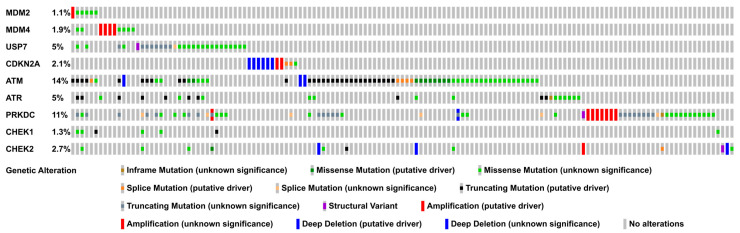
Figure 6
Figure 6
Prevalence of genetic alterations in upstream p53 regulators in COAD. The Oncoprint displays the genomic alterations (legend) in upstream p53 regulators (rows) across 526 COAD samples (columns; TCGA, PanCancer COAD dataset). For the sake of simplicity, only the 143 samples with genetic alterations are displayed. The full Oncoprint including all samples is shown in Supplementary Figure S1. The data were accessed via the cBioPortal webservice (https://www.cbioportal.org/ accessed on 1 April 2021) [131,132].
Figure 1
Figure 1
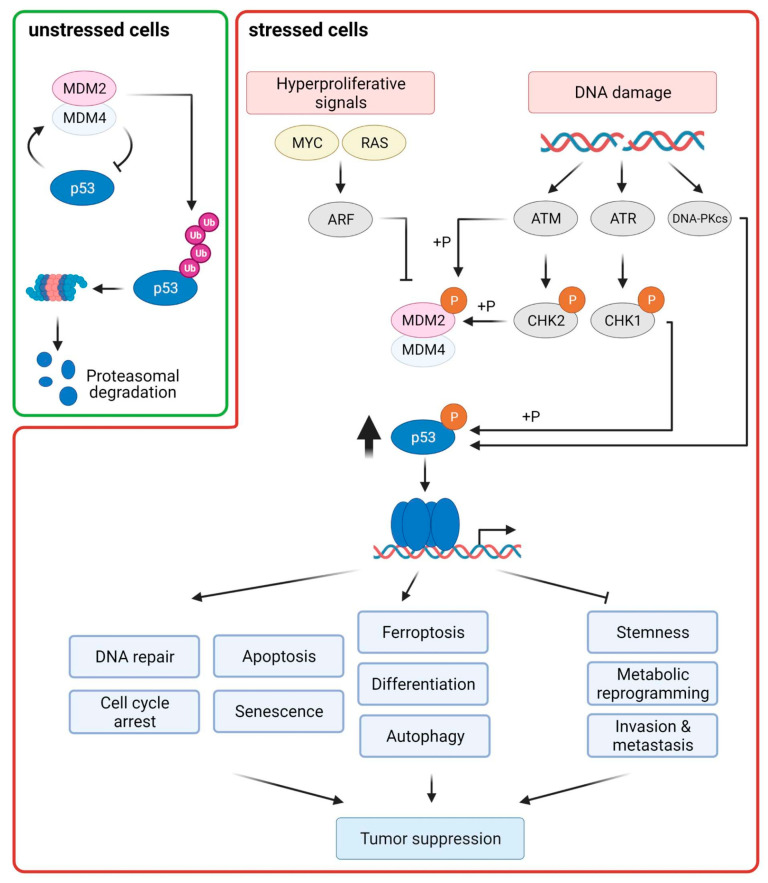
p53 is activated in response to DNA damage and oncogenic stress and coordinates diverse cellular responses that are important for tumor suppression. The transcription factor p53 transactivates MDM2, which is the main E3 ubiquitin ligase targeting p53 for proteasomal degradation, thereby creating a negative feedback loop. In unstressed cells, MDM2 and its partner protein MDM4 are the main regulators of p53 stability. Upon cellular stress, blocking the interaction of p53–MDM2/MDM4 is the major principle for p53 stabilization. DNA damage leads to the activation of the DNA damage response kinases ATM and ATR and their substrates CHK2 and CHK1. Phosphorylation of p53, MDM2, and MDM4 by these kinases stabilizes p53 by antagonizing the p53–MDM2 interaction. In response to oncogene activation, the ARF protein, which is activated by transcription factors of the E2F family, restricts MDM2 activity, thereby stabilizing p53. Activated p53 can modulate many downstream cellular responses mainly by transactivating target genes whose protein products are involved in these processes. Classical outcomes of p53 activation are cell-cycle inhibition, senescence, DNA repair, and apoptosis. Additionally, p53 can regulate other cellular processes, such as promoting autophagy, cellular differentiation, and ferroptosis; and inhibiting invasion and metastasis, metabolic reprogramming, and stem cell self-renewal. All these p53-regulated responses contribute to tumor suppression.
Figure 2
Figure 2
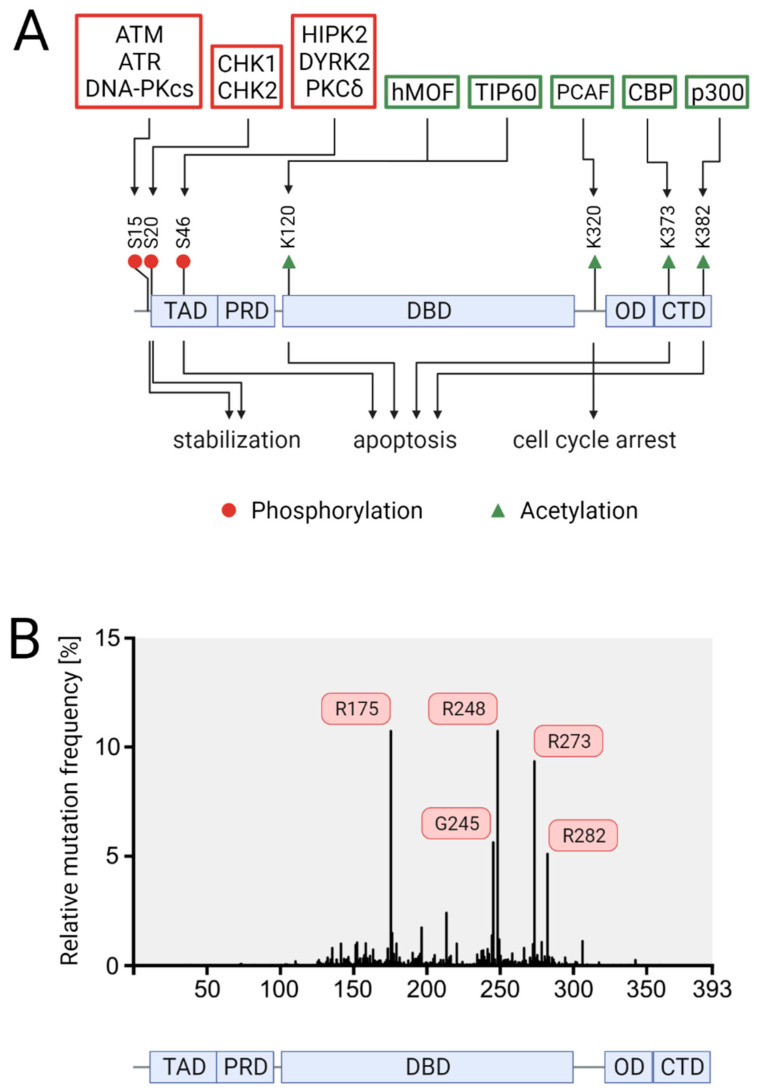
Schematic representation of the domain structure of p53, the impacts of selected post-translational modifications (PTMs), and the prevalence of p53 mutations. (A) Effects of selected p53 PTMs on p53 stability and cell fate. The enzymes catalyzing these PTMs are shown above the modified residues, whereas the impacts of these PTMs are depicted below. (B) Somatic p53 mutations in CRC according to the IARC TP53 mutation database. A schematic cartoon representing the domain structure of p53. The aligned histogram represents the relative mutation frequency at each position along the p53 protein-coding sequence, based on data of 3607 CRC samples with somatic mutations derived from the IARC TP53 database (R20, July 2019). The five most common mutations are labeled. Transactivation domain (TAD), DNA-binding domain (DBD), oligomerization domain (OD), and carboxyl-terminal domain (CTD).
Figure 3
Figure 3
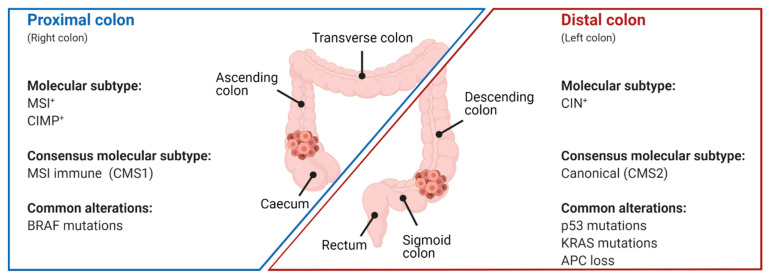
Associations of molecular features with the anatomical location of CRC. Simplified schematic representation of the proximal (caecum, ascending colon, and transverse colon) and distal colon (descending colon; sigmoid colon). Tumors in the proximal colon are associated with microsatellite instability (MSI), CpG island methylator phenotype (CIMP), the consensus molecular subtype (CMS; CMS1), and mutations in BRAF. CRCs of the distal colon are characterized by chromosomal instability (CIN) and CMS2, and often display mutations in p53, KRAS, and APC.
Figure 4
Figure 4
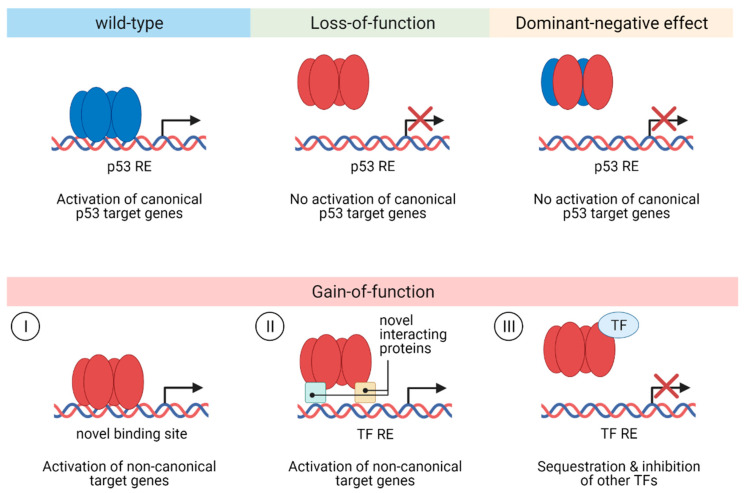
Functional consequences of p53 mutations. p53 mutations can lead to a loss-of-function of wild-type p53 activity abrogating the ability of mutant p53 to transactivate canonical p53 target genes. p53 mutants co-occurring with wild-type p53 can diminish canonical p53 target gene expression via exerting a dominant-negative effect over wild-type p53 by forming hetero-oligomers and preventing binding of wild-type p53 to its response elements. Mutant p53 proteins can also obtain gain-of-function activities by acquiring novel, non-canonical pro-tumorigenic functions through different molecular mechanisms. (I) The binding of mutant p53 to novel, non-canonical binding sites leads to the transactivation of non-canonical genes. (II) Protein–protein interactions (e.g., with other transcription factors or chromatin remodeling complexes) also induce the expression of non-canonical genes. (III) Sequestration of other transcription factors via protein–protein interactions with mutant p53 disrupts target gene expression of those transcription factors. RE, response element; TF, transcription factor.
Figure 5
Figure 5
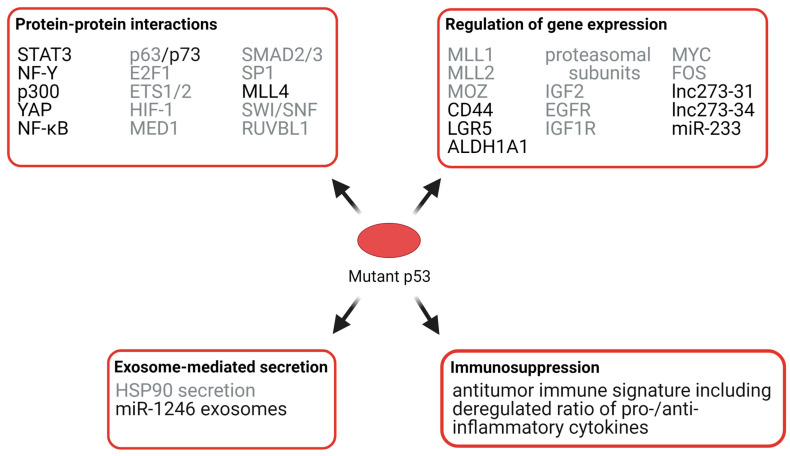
Selected mechanisms of p53 GOF in cancer. Mutant p53 can exert its GOF via protein–protein interactions, the regulation of gene expression, exosome-mediated secretion of biological-active molecules, and immunosuppression. Mechanisms that have been shown in CRC are labeled in black. Mechanisms that have been demonstrated in other types of cancer but might also be involved in CRC are labeled in grey.
Figure 7
Figure 7
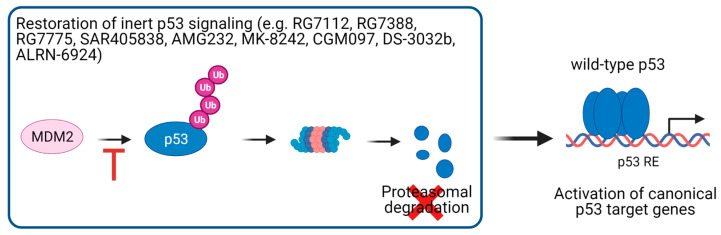
Therapeutic strategies of targeting wild-type p53. In tumors with inert p53 signaling, p53 signaling could be reactivated by using MDM2 inhibitors, thereby rescuing p53 from MDM2-mediated proteasomal degradation. RE, response element.
Figure 8
Figure 8
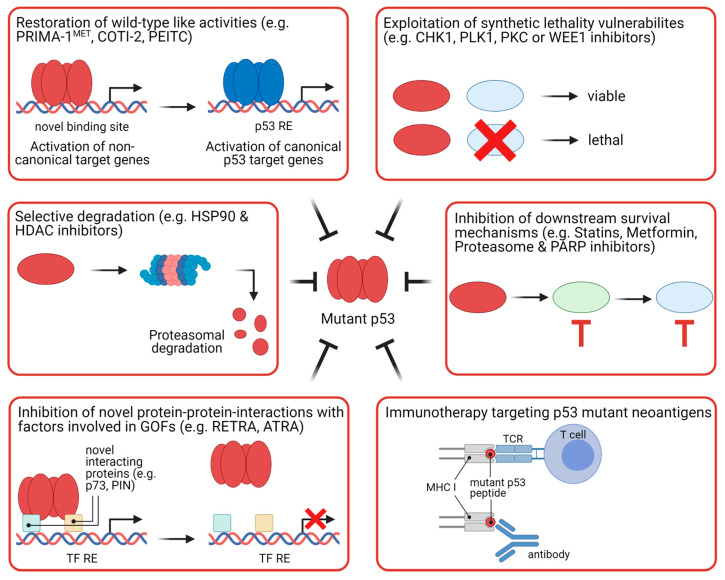
Therapeutic strategies of targeting mutant p53. Approaches targeting p53 mutant that are new or are already in clinical trials can be classified into six categories: restoration of wild-type like activities to mutant p53; selective degradation of mutant p53; inhibition of novel protein–protein interactions involved in mediating gain-of-functions of mutant p53; exploitation of synthetic lethality vulnerabilities of mutant p53; inhibition of downstream survival pathways augmented by mutant p53; and immunotherapy based on the recognition of mutant p53 neoantigens. GOF, gain-of-function; MHC I, major histocompatibility complex class I; RE, response element; TCR, T-cell receptor; TF, transcription factor.

References

    1. Ahmed M. Colon Cancer: A Clinician’s Perspective in 2019. Gastroenterol. Res. 2020;13:1–10. doi: 10.14740/gr1239. - DOI - PMC - PubMed
    1. Bray F., Ferlay J., Soerjomataram I., Siegel R.L., Torre L.A., Jemal A. Global cancer statistics 2018: GLOBOCAN estimates of incidence and mortality worldwide for 36 cancers in 185 countries. CA Cancer J. Clin. 2018;68:394–424. doi: 10.3322/caac.21492. - DOI - PubMed
    1. Mármol I., Sánchez-de-Diego C., Dieste A.P., Cerrada E., Yoldi M.J.R. Colorectal carcinoma: A general overview and future perspectives in colorectal cancer. Int. J. Mol. Sci. 2017;18:197. doi: 10.3390/ijms18010197. - DOI - PMC - PubMed
    1. Arnold M., Sierra M.S., Laversanne M., Soerjomataram I., Jemal A., Bray F. Global patterns and trends in colorectal cancer incidence and mortality. Gut. 2017;66:683–691. doi: 10.1136/gutjnl-2015-310912. - DOI - PubMed
    1. Siegel R.L., Torre L.A., Soerjomataram I., Hayes R.B., Bray F., Weber T.K., Jemal A. Global patterns and trends in colorectal cancer incidence in young adults. Gut. 2019;68:2179–2185. doi: 10.1136/gutjnl-2019-319511. - DOI - PubMed

LinkOut - more resources