


Recreational Screen Time Behaviors during the COVID-19 Pandemic in the U.S.: A Mixed-Methods Study among a Diverse Population-Based Sample of Emerging Adults
- PMID: 33925317
- PMCID: PMC8123581
- DOI: 10.3390/ijerph18094613
Recreational Screen Time Behaviors during the COVID-19 Pandemic in the U.S.: A Mixed-Methods Study among a Diverse Population-Based Sample of Emerging Adults
Abstract
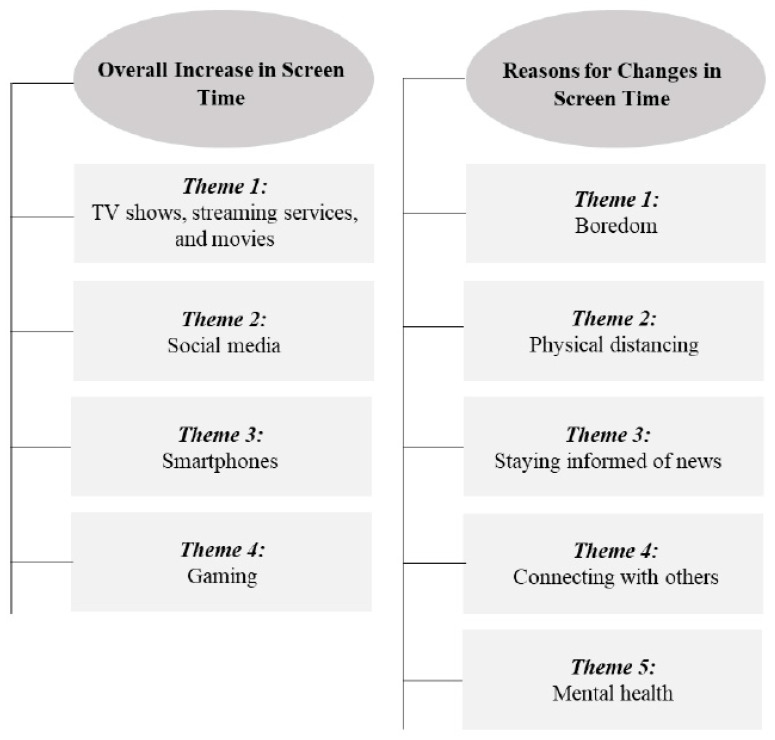
Understanding how screen time behaviors changed during the COVID-19 pandemic is important to inform the design of health promotion interventions. The purpose of this study was to quantify and describe changes in recreational screen time from 2018 to 2020 among a diverse sample of emerging adults. Participants (n = 716) reported their average weekly recreational screen time in 2018 and again during the pandemic in 2020. Additionally, participants qualitatively reported how events related to COVID-19 had influenced their screen time. Weekly recreational screen time increased from 25.9 ± 11.9 h in 2018 to 28.5 ± 11.6 h during COVID-19 (p < 0.001). The form of screen time most commonly reported to increase was TV shows and streaming services (n = 233). Commonly reported reasons for changes in screen time were boredom (n = 112) and a desire to connect with others (n = 52). Some participants reported trying to reduce screen time because of its negative impact on their mental health (n = 32). Findings suggest that screen time and mental health may be intertwined during the pandemic as it may lead to poorer mental health for some, while promoting connectedness for others. Health professionals and public health messaging could promote specific forms for screen time to encourage social connection during the COVID-19 pandemic and beyond.
Keywords: COVID-19; emerging adults; mental health; qualitative; screen time.
Conflict of interest statement
The authors declare no conflict of interest. The funders had no role in the design of the study; in the collection, analyses, or interpretation of data; in the writing of the manuscript, or in the decision to publish the results.
Figures
References
-
- Du Y., Liu B., Sun Y., Snetselaar L.G., Wallace R.B., Bao W. Trends in adherence to the Physical Activity Guidelines for Americans for aerobic activity and time spent on sedentary behavior among US adults, 2007 to 2016. JAMA Netw Open. 2019;2:e197597. doi: 10.1001/jamanetworkopen.2019.7597. - DOI - PMC - PubMed
-
- Physical Activity Guidelines for Americans. 2nd ed. U.S. Department of Health and Human Services; Washington, DC, USA: 2018.
Publication types
MeSH terms
Grants and funding
LinkOut - more resources
Full Text Sources
Medical
