


Tinnitus and Neuropsychological Dysfunction in the Elderly: A Systematic Review on Possible Links
- PMID: 33925344
- PMCID: PMC8123622
- DOI: 10.3390/jcm10091881
Tinnitus and Neuropsychological Dysfunction in the Elderly: A Systematic Review on Possible Links
Abstract
Introduction: Tinnitus is a common and disabling symptom often associated with hearing loss. While clinical practice frequently shows that a certain degree of psychological discomfort often characterizes tinnitus suffers, it has been recently suggested in adults as a determining factor for cognitive decline affecting attention and memory domains. The aim of our systematic review was to provide evidence for a link between tinnitus, psychological distress, and cognitive dysfunction in older patients and to focus on putative mechanisms of this relationship.
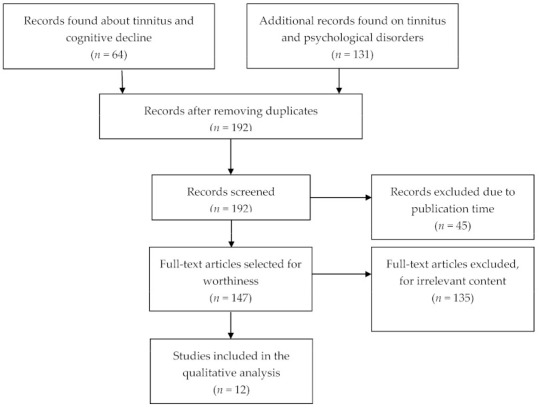
Methods: We performed a systematic review, finally including 192 articles that were screened. This resulted in 12 manuscripts of which the full texts were included in a qualitative analysis.
Results: The association between tinnitus and psychological distress, mainly depression, has been demonstrated in older patients, although only few studies addressed the aged population. Limited studies on cognitive dysfunction in aged patients affected by chronic tinnitus are hardly comparable, as they use different methods to validate cognitive impairment. Actual evidence does not allow us with certainty to establish if tinnitus matters as an independent risk factor for cognitive impairment or evolution to dementia.
Conclusion: Tinnitus, which is usually associated with age-related hearing loss, might negatively affect emotional wellbeing and cognitive capacities in older people, but further studies are required to improve the evidence.
Keywords: auditory pathways; cognition; elderly; psychological aspects; tinnitus.
Conflict of interest statement
The authors declare no conflict of interest.
Figures
References
-
- Sindhusake D., Mitchell P., Newall P., Golding M., Rochtchina E., Rubin G. Prevalence and characteristics of tinnitus in older adults: The Blue Mountains Hearing Study: Prevalencia y características del acúfeno en adultos mayores: El Estudio de Audición Blue Mountains. Int. J. Audiol. 2003;42:289–294. doi: 10.3109/14992020309078348. - DOI - PubMed
-
- Ralli M., Balla M.P., Greco A., Altissimi G., Ricci P., Turchetta R., De Virgilio A., De Vincentiis M., Ricci S., Cianfrone G. Work-Related Noise Exposure in a Cohort of Patients with Chronic Tinnitus: Analysis of Demographic and Audiological Characteristics. Int. J. Environ. Res. Public Health. 2017;14:1035. doi: 10.3390/ijerph14091035. - DOI - PMC - PubMed
-
- Paciello F., Podda M.V., Rolesi R., Cocco S., Petrosini L., Troiani D., Fetoni A.R., Paludetti G., Grassi C. Anodal transcranial direct current stimulation affects auditory cortex plasticity in normal-hearing and noise-exposed rats. Brain Stimul. 2018;11:1008–1023. doi: 10.1016/j.brs.2018.05.017. - DOI - PubMed
Publication types
LinkOut - more resources
Full Text Sources
