Review
. 2021 Apr 26;13(9):2090.
doi: 10.3390/cancers13092090.

Advances in Targeting Cutaneous Melanoma

Affiliations
Review

Advances in Targeting Cutaneous Melanoma

Dimitri Kasakovski et al. Cancers (Basel). .

Abstract

To date, the skin remains the most common cancer site among Caucasians in the western world. The complex, layered structure of human skin harbors a heterogenous population of specialized cells. Each cell type residing in the skin potentially gives rise to a variety of cancers, including non-melanoma skin cancer, sarcoma, and cutaneous melanoma. Cutaneous melanoma is known to exacerbate and metastasize if not detected at an early stage, with mutant melanomas tending to acquire treatment resistance over time. The intricacy of melanoma thus necessitates diverse and patient-centered targeted treatment options. In addition to classical treatment through surgical intervention and radio- or chemotherapy, several systemic and intratumoral immunomodulators, pharmacological agents (e.g., targeted therapies), and oncolytic viruses are trialed or have been recently approved. Moreover, utilizing combinations of immune checkpoint blockade with targeted, oncolytic, or anti-angiogenic approaches for patients with advanced disease progression are promising approaches currently under pre-clinical and clinical investigation. In this review, we summarize the current 'state-of-the-art' as well as discuss emerging agents and regimens in cutaneous melanoma treatment.

Keywords: cancer therapy; combination therapy; immunotherapy; intratumoral therapy; melanoma; skin cancer; targeted therapy.


Conflict of interest statement

L.S. has received speakers and/or advisory board honoraria from BMS, Sun-Pharma, MSD, and Novartis. T.G. has received speakers and/or advisory board honoraria from BMS, Sanofi-Genzyme, MSD, Novartis Pharma, Roche, Abbvie, Almirall, Janssen, Lilly, Pfizer, Pierre Fabre, Merck-Serono, outside the submitted work. D.K. and M.S. have no conflict of interest to declare.

Figures
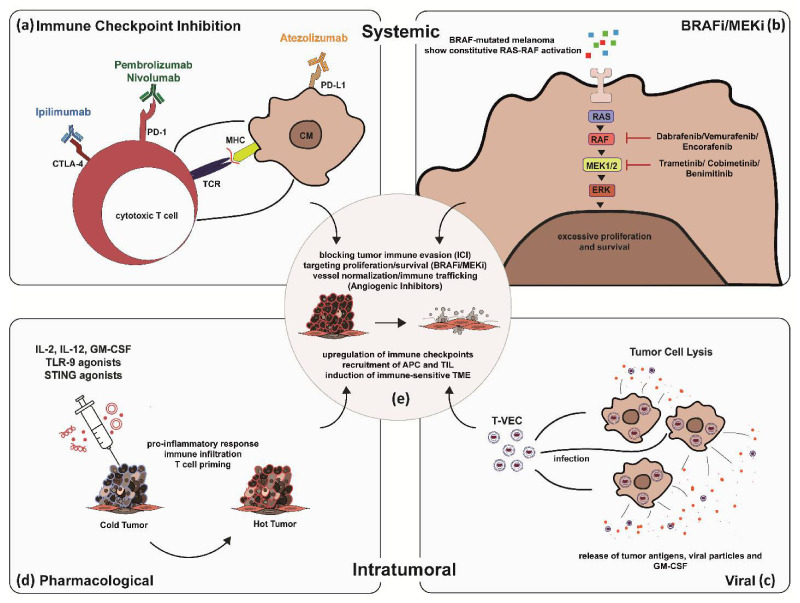
Figure 1
Figure 1
Synergistic effects of combined systemic and intratumoral therapy in skin cancer treatment exemplified by CM. Systemic immune checkpoint inhibition (ae): Blocking of immune checkpoints on cytotoxic T Lymphocytes (CTL) and CM cells disrupting tumor immune evasion (a). Systemic BRAFi/MEKi: Blocking overactivation of RAS-RAF signaling pathway in BRAF-mutated melanoma by BRAF and MEK inhibitors (b). Intratumoral application of genetically engineered oncolytic viral particles to express checkpoint inhibitors on CM cells, force production and release of tumor antigens and GM-CSF to prime T cell immune response and induce tumor cell lysis (c). Intratumoral pharmacological application of IL-2, IL12, GM-CSF, TLR-9 and STING agonists: Priming locally advanced CM to become immunogenic (d).
Figure 2
Figure 2
Showing a 59-year old male patient with metastatic melanoma and multiple benign melanocytic nevi on the back (a). After 4 cycles (3 months) of anti-PD-1 plus anti-CTLA-4 combination therapy, he developed marked nevi lightening (b, highlighted by arrowheads).
Figure 3
Figure 3
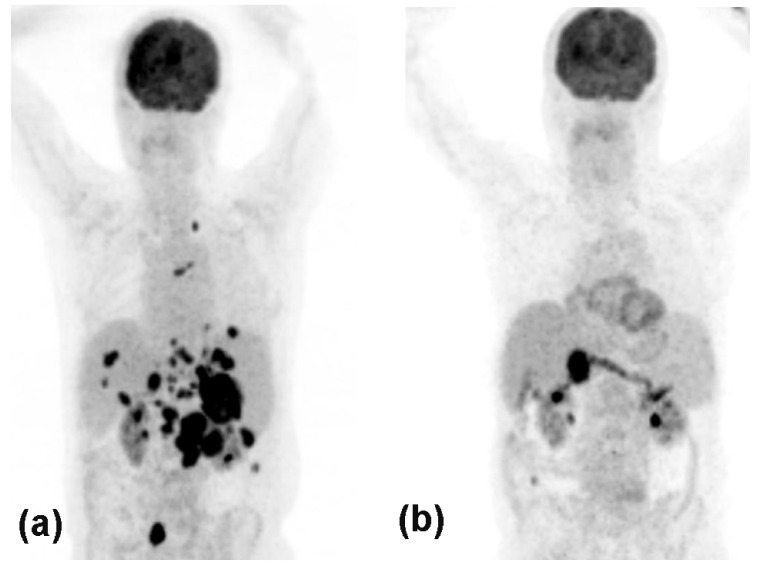
PET-CT of an 80-year old male showing massive melanoma metastases in the entire abdomen (a), which almost completely resolved after two cycles of anti-PD-1 plus an-ti-CTLA-4 combination therapy (b).
Figure 4
Figure 4
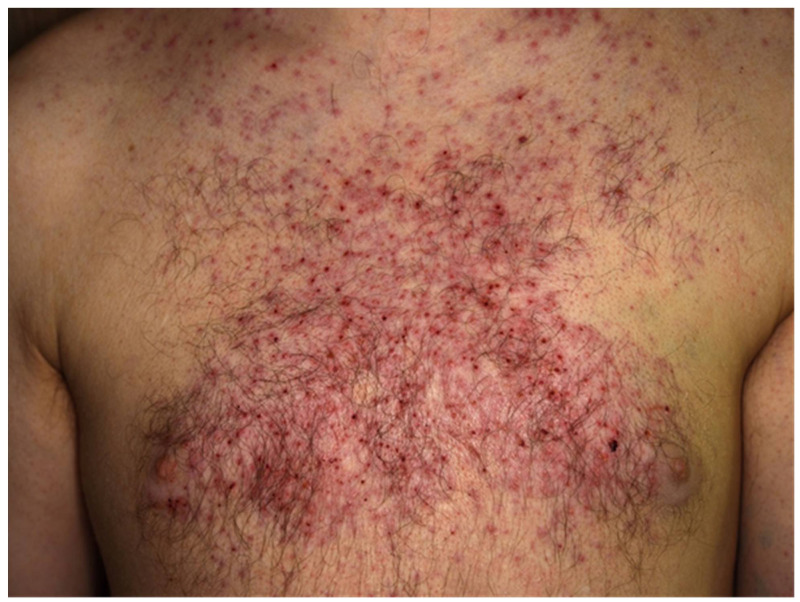
Widespread acneiform rash developing 2 months after the initiation of anti-BRAF plus anti-MEK combination therapy in a 33-year-old male with metastatic melanoma.
Figure 5
Figure 5
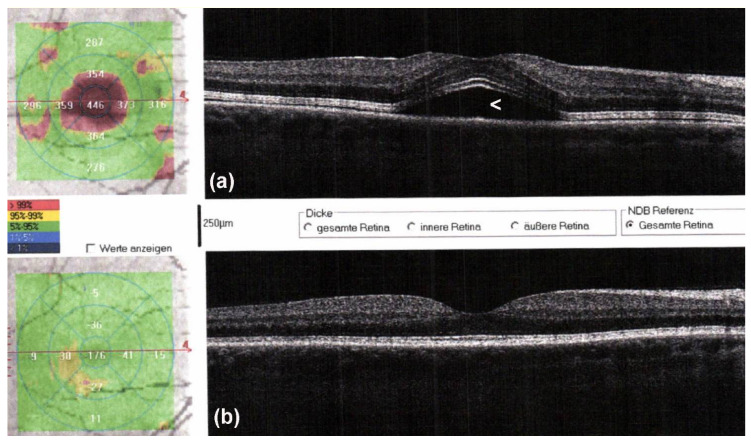
Optical coherence tomography (OCT) scans of a male patient with metastatic melanoma started targeted therapy with encorafenib and binimetinib. Two days after therapy initiation, he noticed blurry vision. On OCT, serous retinal detachment with subfoveolar fluid (a, arrowhead) is observed, which spontaneously resolved after withholding targeted therapy for 5 days (b).

References

    1. Paulson K.G., Gupta D., Kim T.S., Veatch J.R., Byrd D.R., Bhatia S., Wojcik K., Chapuis A.G., Thompson J.A., Madeleine M.M., et al. Age-Specific Incidence of Melanoma in the United States. JAMA Dermatol. 2020;156:57–64. doi: 10.1001/jamadermatol.2019.3353. - DOI - PMC - PubMed
    1. Apalla Z., Lallas A., Sotiriou E., Lazaridou E., Ioannides D. Epidemiological trends in skin cancer. Dermatol. Pract. Concept. 2017;7:1–6. doi: 10.5826/dpc.0702a01. - DOI - PMC - PubMed
    1. Guy G.P., Thomas C.C., Thompson T., Watson M., Massetti G.M., Richardson L.C. Vital signs: Melanoma incidence and mortality trends and projections—United States, 1982–2030. MMWR Morb. Mortal. Wkly. Rep. 2015;64:591. - PMC - PubMed
    1. Skin Cancer Foundation Skin Cancer Facts and Statistics. Skin Cancer Information. Last Updated: January 13, 2021. [(accessed on 25 April 2021)]; Available online: https://www.skincancer.org/skin-cancer-information/skin-cancer-facts/
    1. Seite S., Del Marmol V., Moyal D., Friedman A. Public primary and secondary skin cancer prevention, perceptions and knowledge: An international cross-sectional survey. J. Eur. Acad. Dermatol. Venereol. 2017;31:815–820. doi: 10.1111/jdv.14104. - DOI - PMC - PubMed

LinkOut - more resources