Review
. 2021 Apr 26;22(9):4518.
doi: 10.3390/ijms22094518.

Back to the Origins: Background and Perspectives of Grapevine Domestication

Affiliations
Review

Back to the Origins: Background and Perspectives of Grapevine Domestication

Fabrizio Grassi et al. Int J Mol Sci. .

Abstract

Domestication is a process of selection driven by humans, transforming wild progenitors into domesticated crops. The grapevine (Vitis vinifera L.), besides being one of the most extensively cultivated fruit trees in the world, is also a fascinating subject for evolutionary studies. The domestication process started in the Near East and the varieties obtained were successively spread and cultivated in different areas. Whether the domestication occurred only once, or whether successive domestication events occurred independently, is a highly debated mystery. Moreover, introgression events, breeding and intense trade in the Mediterranean basin have followed, in the last thousands of years, obfuscating the genetic relationships. Although a succession of studies has been carried out to explore grapevine origin and different evolution models are proposed, an overview of the topic remains pending. We review here the findings obtained in the main phylogenetic and genomic studies proposed in the last two decades, to clarify the fundamental questions regarding where, when and how many times grapevine domestication took place. Finally, we argue that the realization of the pan-genome of grapes could be a useful resource to discover and track the changes which have occurred in the genomes and to improve our understanding about the domestication.

Keywords: Vitis; crop wild relatives; demography; grapes; introgression; palaeogenomic; pan-genome; selection; sylvestris; wild.


Conflict of interest statement

The authors declare no conflict of interest.

Figures
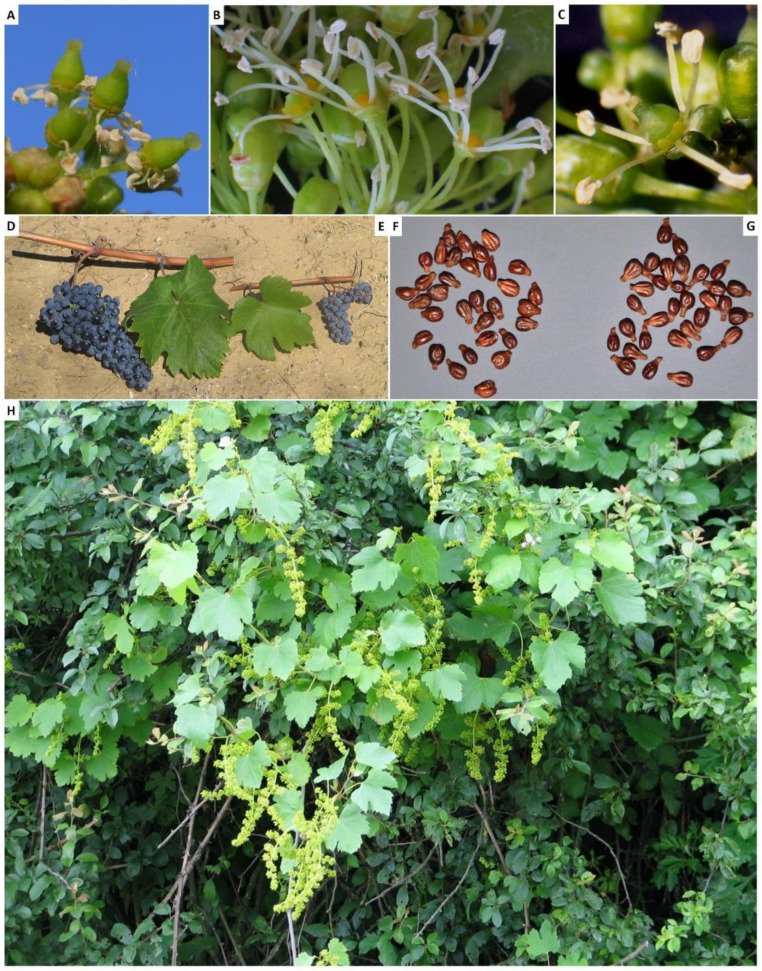
Figure 1
Figure 1
Phenotypical traits of sylvestris and vinifera. Female (A) and male (B) flowers of sylvestris individuals. Hermaphrodite flower (C) of vinifera individuals. Leaf and bunch of vinifera (D) and sylvestris (E) individuals. Seed of sylvestris (F) and vinifera (G) individuals. (H) Plant of sylvestris individual. Seeds of sylvestris are small, with a rounded outline and short stalks, while the vinifera ones are large, elongated, pyriform with elongated stalk. Leaves of sylvestris are smaller than the cultivated ones. Vinifera shows berries and bunches bigger than those of sylvestris, with a higher sugar content.
Figure 2
Figure 2
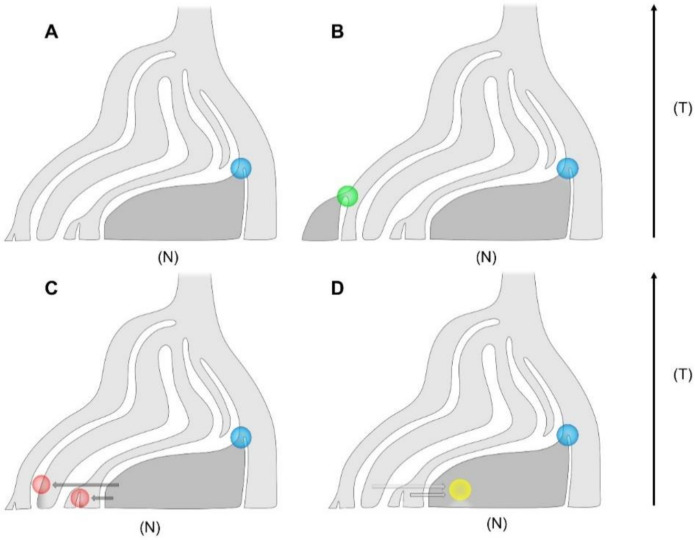
Main models of domestication proposed in the literature to explain the evolution of ancestral wild (light grey) and domesticated grapevine (dark grey). (A) Single-origin model; blue circle indicates a demographic bottleneck which occurred during the evolution of grapevine. (B) Multi-origin model; green circle indicates a secondary domestication event. (C) Multiple events of introgression from domesticated to wild grapevine (red circles) caused by gene flow (dark grey arrows). (D) Multiple events of introgression from wild to domesticated grapevine (yellow circle) caused by gene flow (light grey arrows). T = time (arrowhead indicates the past) and N = size of population.
Figure 3
Figure 3
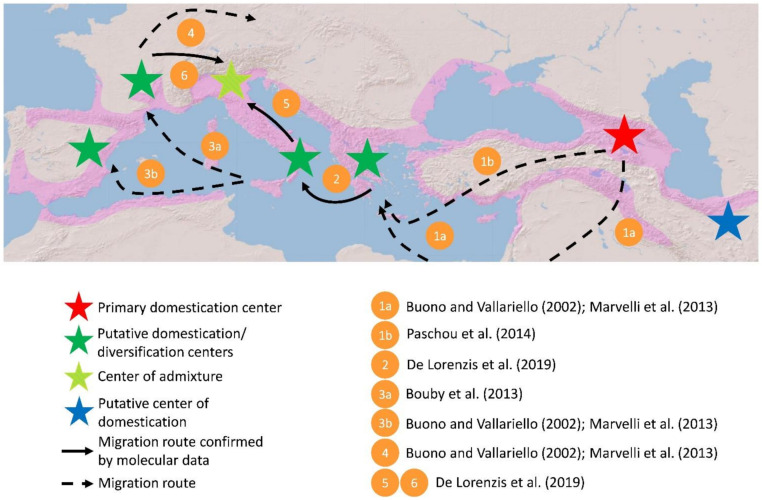
Map depicting probable grapevine domestication and diversification centres (stars) and the main grapevine migration routes (arrows). Pink area shows the distribution range of wild grapevine. According to many researchers, the domestication of grapevine took place around Mount Ararat in the Caucasus (red star). Its diffusion around the Mediterranean basin could have followed three main pathways. The first pathway goes from Mount Ararat to Mesopotamia, Egypt and Greece, considered a secondary domestication centre (green star), in the Bronze Age (arrow 1a). Others agree that grapevine arrived in Greece through Anatolia (arrow 1b). The second route starts from Greece and goes to Magna Graecia (Sicily, Southern Italy) (green star), France (Marseille) (green star) and Spain (green star) under the influence of the Greeks, Etruscans and Phoenicians (arrows 2, 3a and 3b). The third route goes from France to the north of Europe, mainly through the Rhone, the Rhine and the Danube, under the influence of the Roman Empire (arrow 4). Recently, Northern Italy (striped star) has been highlighted as an admixed centre of the Southern Italian (arrow 5) and Central European (arrow 6) population.
Figure 4
Figure 4
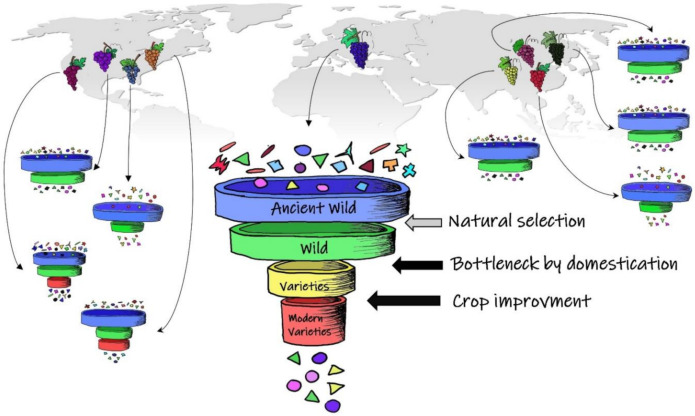
Grapevine is originated from an ancient wild progenitor. Although it has suffered from a weak bottleneck and the breeding have maintained a high level of heterozygosity, several resistance or tolerance genes could be lost during the evolution. The funnel shows the reduction of genetic diversity in time (different shapes indicate different classes of genes and different colours indicate different alleles). Natural selection (horizontal grey arrow) caused by climate changes in the past and artificial selection (horizontal black arrows) caused by human activity more recently can have driven the loss of genes and alleles. On the other hand, the wild American and Asian grapes are adapted to a wide range of climatic conditions and have suffered minor effects from human activity, thus they can harbour several resistance or tolerance genes. The assembly of a pangenome offers the possibility to recover and collect the original gene diversity conserved in wild and domesticated grapes.

References

    1. International Organisation of Vine and Wine. [(accessed on 1 April 2021)]; Available online: https://www.oiv.int/en/
    1. This P., Lacombe T., Thomas M.R. Historical origins and genetic diversity of wine grapes. Trends Genet. 2006;22:511–519. doi: 10.1016/j.tig.2006.07.008. - DOI - PubMed
    1. Caporali E., Spada A., Marziani G., Failla O., Scienza A. The arrest of development of abortive reproductive organs in the unisexual flower of Vitis vinifera ssp. silvestris. Sex. Plant Reprod. 2003;15:291–300. doi: 10.1007/s00497-003-0169-5. - DOI
    1. Massonnet M., Cochetel N., Minio A., Vondras A.M., Lin J., Muyle A., Garcia J.F., Zhou Y., Delledonne M., Riaz S., et al. The genetic basis of sex determination in grapes. Nat. Commun. 2020;11:2902. doi: 10.1038/s41467-020-16700-z. - DOI - PMC - PubMed
    1. Ekhvaia J., Akhalkatsi M. Morphological variation and relationships of Georgian populations of Vitis vinifera L. subsp. sylvestris (C.C. Gmel.) Hegi. Flora Morphol. Distrib. Funct. Ecol. Plants. 2010;205:608–617.