


High Diversity of Cryptosporidium Species and Subtypes Identified in Cryptosporidiosis Acquired in Sweden and Abroad
- PMID: 33926039
- PMCID: PMC8147002
- DOI: 10.3390/pathogens10050523
High Diversity of Cryptosporidium Species and Subtypes Identified in Cryptosporidiosis Acquired in Sweden and Abroad
Abstract
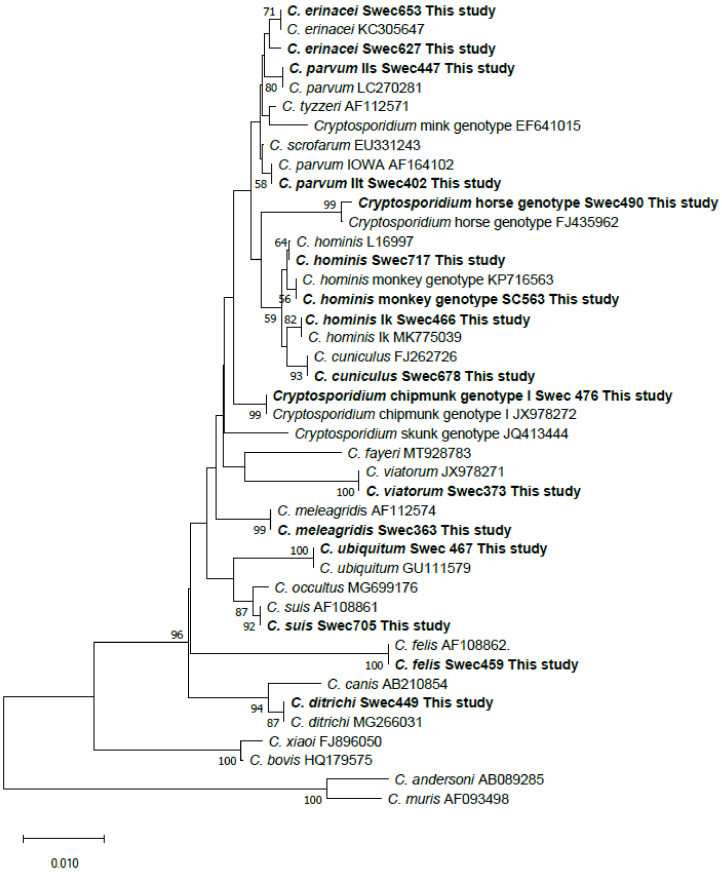
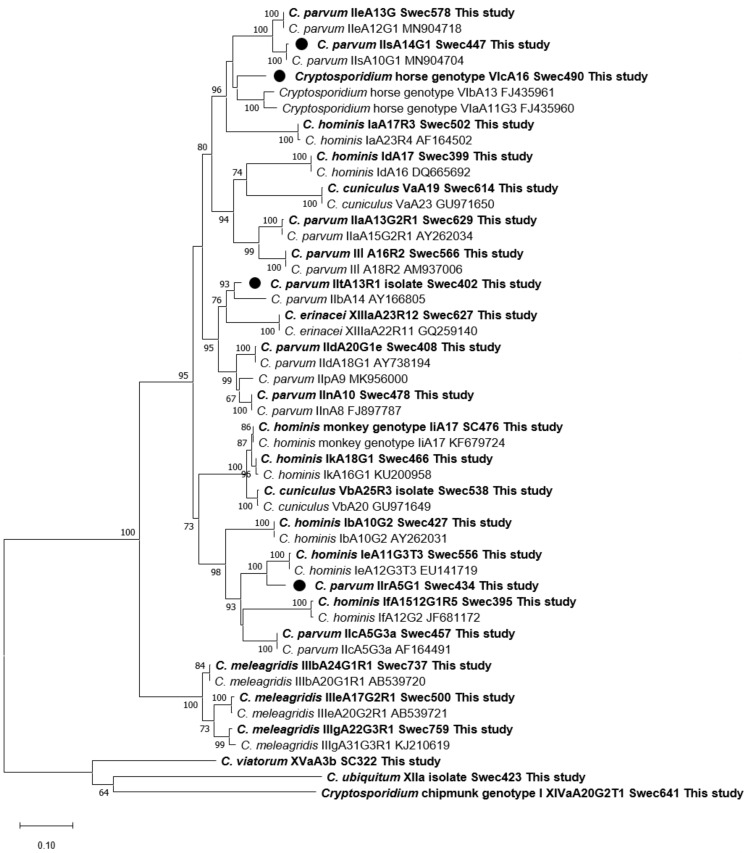
The intestinal protozoan parasite Cryptosporidium is an important cause of diarrheal disease worldwide. The aim of this study was to expand the knowledge on the molecular epidemiology of human cryptosporidiosis in Sweden to better understand transmission patterns and potential zoonotic sources. Cryptosporidium-positive fecal samples were collected between January 2013 and December 2014 from 12 regional clinical microbiology laboratories in Sweden. Species and subtype determination was achieved using small subunit ribosomal RNA and 60 kDa glycoprotein gene analysis. Samples were available for 398 patients, of whom 250 (63%) and 138 (35%) had acquired the infection in Sweden and abroad, respectively. Species identification was successful for 95% (379/398) of the samples, revealing 12 species/genotypes: Cryptosporidium parvum (n = 299), C. hominis (n = 49), C. meleagridis (n = 8), C. cuniculus (n = 5), Cryptosporidium chipmunk genotype I (n = 5), C. felis (n = 4), C. erinacei (n = 2), C. ubiquitum (n = 2), and one each of C. suis, C. viatorum, C. ditrichi, and Cryptosporidium horse genotype. One patient was co-infected with C. parvum and C. hominis. Subtyping was successful for all species/genotypes, except for C. ditrichi, and revealed large diversity, with 29 subtype families (including 4 novel ones: C. parvum IIr, IIs, IIt, and Cryptosporidium horse genotype Vic) and 81 different subtypes. The most common subtype families were IIa (n = 164) and IId (n = 118) for C. parvum and Ib (n = 26) and Ia (n = 12) for C. hominis. Infections caused by the zoonotic C. parvum subtype families IIa and IId dominated both in patients infected in Sweden and abroad, while most C. hominis cases were travel-related. Infections caused by non-hominis and non-parvum species were quite common (8%) and equally represented in cases infected in Sweden and abroad.
Keywords: Europe; Scandinavia; epidemiology; genetic diversity; host specificity; molecular epidemiology; parasite; parasitology; protist; sporozoa; zoonosis; zoonotic transmission.
Conflict of interest statement
The authors declare no conflict of interest.
Figures

References
-
- Kotloff K.L., Nataro J.P., Blackwelder W.C., Nasrin D., Farag T.H., Panchalingam S., Wu Y., Sow S.O., Sur D., Breiman R.F., et al. Burden and aetiology of diarrhoeal disease in infants and young children in developing countries (the Global Enteric Multicenter Study, GEMS): A prospective, case-control study. Lancet. 2013;382:209–222. doi: 10.1016/S0140-6736(13)60844-2. - DOI - PubMed
-
- Public Health Agency of Sweden Surveillance of Communicable Diseases Sweden. [(accessed on 24 April 2021)]; Available online: https://www.folkhalsomyndigheten.se/folkhalsorapportering-statistik/stat...
Grants and funding
LinkOut - more resources
Full Text Sources
Other Literature Sources
