


Utilizing ultrasound findings of a single indicator joint to assess non-systemic juvenile idiopathic arthritis
- PMID: 33926518
- PMCID: PMC8082904
- DOI: 10.1186/s12969-021-00550-0
Utilizing ultrasound findings of a single indicator joint to assess non-systemic juvenile idiopathic arthritis
Abstract
Background: Musculoskeletal ultrasound (MSUS) has been used worldwide in adult patients with rheumatoid arthritis (RA) but is beginning to play an increasing role in patients with juvenile idiopathic arthritis (JIA). The aim of this study was to investigate the application of MSUS findings of a single indicator joint in JIA to assess the disease activity and classify disease subtype.
Methods: Thirty-five non-systemic JIA patients with a total of 62 visits were retrospectively recruited in this study. Among the involved joints, the joint with highest value of grey-scale (GS) plus power Doppler (PD) (=GSPD) was selected as the indicator joint at each visit. The correlations between each MSUS parameter (GS, PD, GSPD) of indicator joints and the Physician Global Assessment (PGA) score, the Childhood Health Assessment Questionnaire-disability index (CHAQ-DI), and laboratory data were analyzed. The ultrasound features in different subtypes of JIA were also compared.
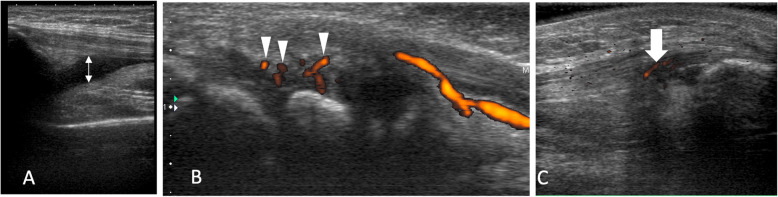
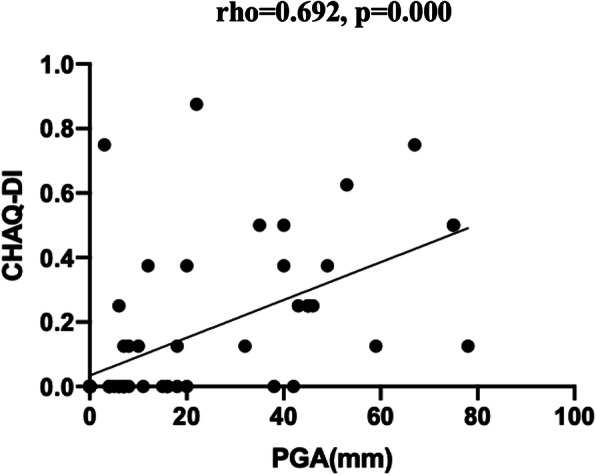
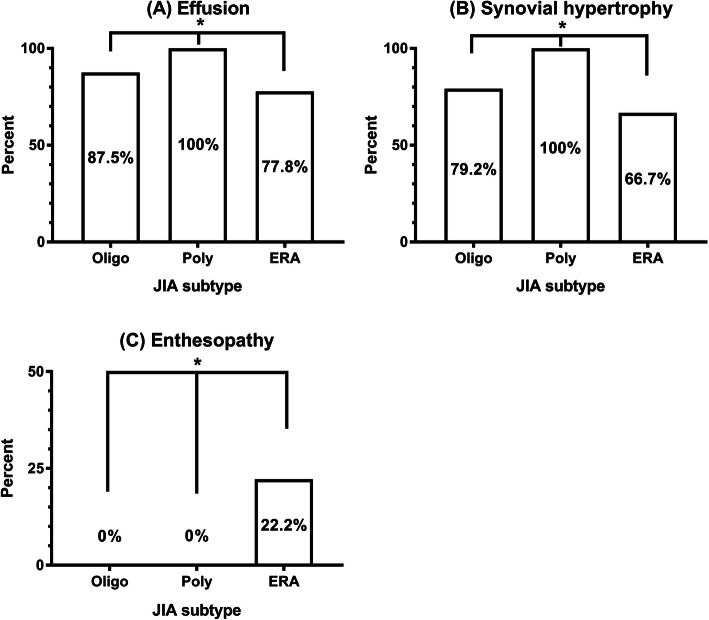
Results: PD was weakly correlated with the PGA score (rho = 0.323, p = 0.010), while both GS and GSPD were moderately correlated with the PGA score (rho = 0.405, p = 0.001; rho = 0.434, p = 0.000). On the other hand, GS, PD, and GSPD were weakly correlated with CHAQ-DI. Although erythrocyte sedimentation rate (ESR) and C-reactive protein (CRP) had a weak correlation with PGA, they were not statistically correlated with GS, PD, or GSPD. The proportions of effusion, synovial hypertrophy, and enthesopathy in three different subtypes, showed significant differences (Fisher's exact test, p = 0.037; p = 0.004; p = 0.019). Enthesopathy was only seen in joints of enthesitis-related arthritis (ERA), but not in joints of polyarthritis and oligoarthritis.
Conclusions: MSUS is an acceptable non-invasive tool for the patients with JIA, particularly for those with non-systemic JIA, that might assist disease classification, and whose parameters of the indicator joints may potentially contribute to the evaluation of disease activity.
Keywords: Disease activity; Indicator joint; Juvenile idiopathic arthritis; Musculoskeletal ultrasound.
Conflict of interest statement
None to declare.
Figures
Similar articles
-
The correlation between the Childhood Health Assessment Questionnaire and disease activity in juvenile idiopathic arthritis.Musculoskeletal Care. 2018 Sep;16(3):339-344. doi: 10.1002/msc.1239. Epub 2018 Mar 24. Musculoskeletal Care. 2018. PMID: 29573557
-
Musculoskeletal Ultrasound and the Assessment of Disease Activity in Juvenile Idiopathic Arthritis.Arthritis Care Res (Hoboken). 2023 Aug;75(8):1815-1820. doi: 10.1002/acr.25073. Epub 2023 Feb 21. Arthritis Care Res (Hoboken). 2023. PMID: 36530040 Free PMC article.
-
Can ultrasound help to overcome uncertainty in clinical joint assessment in juvenile idiopathic arthritis?Clin Exp Rheumatol. 2023 Jan;41(1):177-185. doi: 10.55563/clinexprheumatol/5lk4x2. Epub 2022 Aug 5. Clin Exp Rheumatol. 2023. PMID: 35930492
-
Ultrasound in juvenile idiopathic arthritis.Pediatr Rheumatol Online J. 2016 May 27;14(1):33. doi: 10.1186/s12969-016-0096-2. Pediatr Rheumatol Online J. 2016. PMID: 27234966 Free PMC article. Review.
-
Ultrasonography in Pediatric Rheumatology.Rheum Dis Clin North Am. 2022 Feb;48(1):217-231. doi: 10.1016/j.rdc.2021.09.009. Rheum Dis Clin North Am. 2022. PMID: 34798948 Review.
References
-
- Boros C, Whitehead B. Juvenile idiopathic arthritis. Aust Fam Physician. 2010;39(9):630–636. - PubMed
-
- Sztajnbok F, Coronel-Martinez DL, Diaz-Maldonado A, Novarini C, Pistorio A, Viola S, Ruperto N, Buoncompagni A, Martini A, Ravelli A. Discordance between physician's and parent's global assessments in juvenile idiopathic arthritis. Rheumatology (Oxford) 2007;46(1):141–145. doi: 10.1093/rheumatology/kel201. - DOI - PubMed
MeSH terms
LinkOut - more resources
Full Text Sources
Other Literature Sources
Medical
Research Materials
Miscellaneous
