


Bortezomib Inhibits Hypoxia-Induced Proliferation by Suppressing Caveolin-1/SOCE/[Ca2+]i Signaling Axis in Human PASMCs
- PMID: 33928148
- PMCID: PMC8049800
- DOI: 10.1155/2021/5551504
Bortezomib Inhibits Hypoxia-Induced Proliferation by Suppressing Caveolin-1/SOCE/[Ca2+]i Signaling Axis in Human PASMCs
Abstract
Background: Previous studies have demonstrated the ubiquitin-proteasome inhibitor bortezomib (BTZ) can effectively alleviate hypoxia-induced pulmonary hypertension (HPH) by suppressing the intracellular calcium homeostasis in pulmonary arterial smooth muscle cells (PASMCs). Further evaluation showed that the antiproliferation roles of BTZ are mainly mediated by inhibition of the intracellular calcium homeostasis. Caveolin-1 belongs to one of the key regulators of the intracellular calcium homeostasis in PASMCs, which can regulate the store-operated calcium entry (SOCE). However, the effects of BTZ on Caveolin-1 remain unclear.
Methods: Primarily cultured human PASMCs were used as the cell model. CCK-8 assay was performed to assess the PASMCs proliferation. Western blotting and real-time qPCR were used to detect the mRNA and protein expressions. Fura-2-based fluorescence imaging experiments were used to determine the intracellular calcium concentration ([Ca2+]i). The protein synthesis inhibitor cycloheximide (CHX) was utilized to determine the protein degradation process.
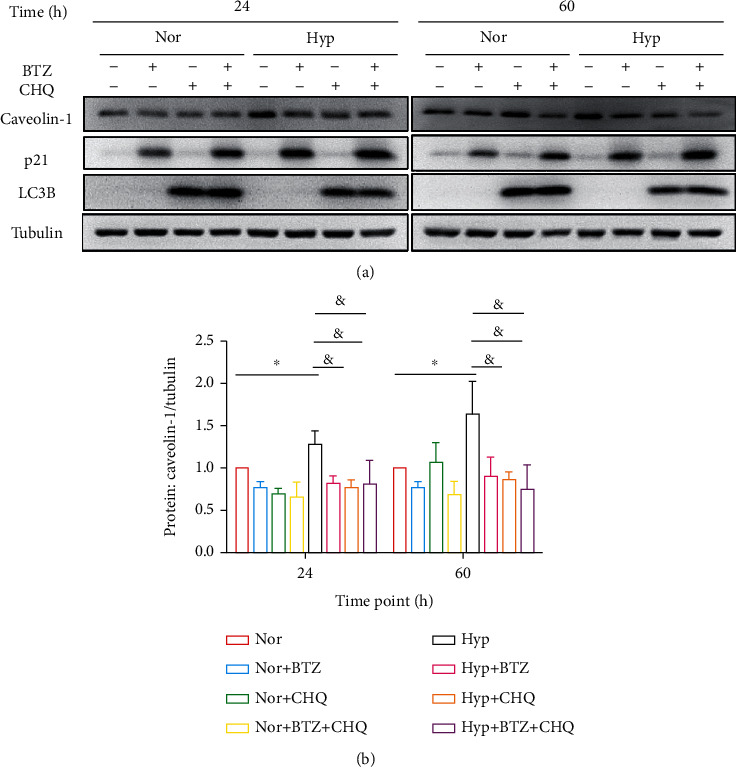
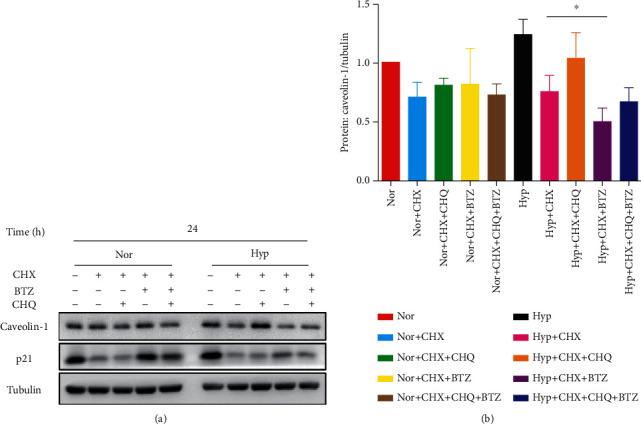
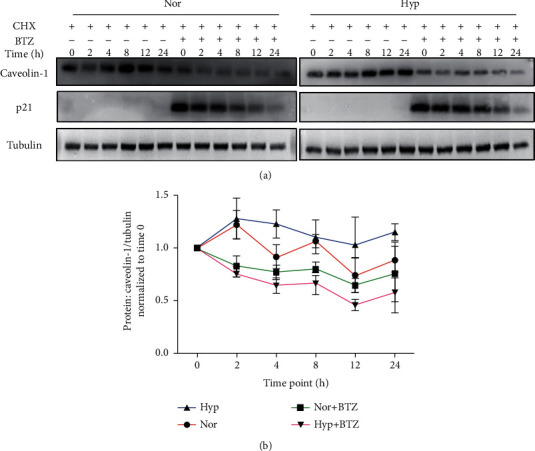
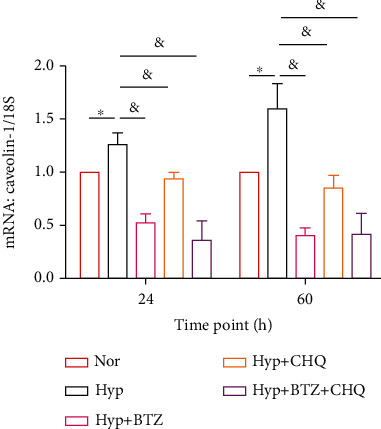
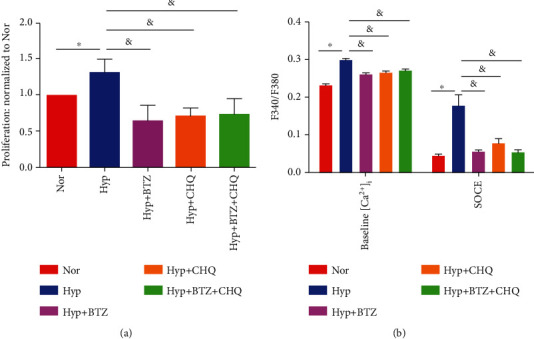
Results: Firstly, in cultured human PASMCs, treatment of BTZ for 24 or 60 hours significantly downregulates Caveolin-1 at both mRNA and protein levels. Secondly, in the presence CHX, BTZ treatment also leads to downregulated protein expression and fastened protein degradation of Caveolin-1, indicating that BTZ can promote the Caveolin-1 protein degradation, other than the BTZ on Caveolin-1 mRNA transcription. Then, BTZ significantly attenuates the hypoxia-elevated baseline [Ca2+]i, SOCE, and cell proliferation.
Conclusion: We firstly observed that the ubiquitin-proteasome inhibitor BTZ can inhibit the Caveolin-1 expression at both mRNA transcription and protein degradation processes, providing new mechanistic basis of BTZ on PASMC proliferation.
Copyright © 2021 Chao Wang et al.
Conflict of interest statement
The authors declare that they have no conflicts of interest.
Figures
References
-
- Shimoda L. A., Wang J., Sylvester J. T. Ca2+ channels and chronic hypoxia. Microcirculation. 2006;13(8):657–670. - PubMed
-
- Wang J., Weigand L., Lu W., Sylvester J. T., Semenza G. L., Shimoda L. A. Hypoxia inducible factor 1 mediates hypoxia-induced TRPC expression and elevated intracellular Ca2+ in pulmonary arterial smooth muscle cells. Circulation Research. 2006;98(12):1528–1537. doi: 10.1161/01.RES.0000227551.68124.98. - DOI - PubMed
-
- Wang J., Shimoda L. A., Weigand L., Wang W., Sun D., Sylvester J. T. Acute hypoxia increases intracellular [Ca2+] in pulmonary arterial smooth muscle by enhancing capacitative Ca2+ entry. American journal of physiology Lung cellular and molecular physiology. 2005;288(6):L1059–L1069. doi: 10.1152/ajplung.00448.2004. - DOI - PubMed
MeSH terms
Substances
LinkOut - more resources
Full Text Sources
Other Literature Sources
Miscellaneous
