. 2021 Jun;38(6):3089-3112.
doi: 10.1007/s12325-021-01703-z. Epub 2021 Apr 30.

Efficacy and Safety of Budesonide/Glycopyrronium/Formoterol Fumarate versus Other Triple Combinations in COPD: A Systematic Literature Review and Network Meta-analysis

Affiliations

Efficacy and Safety of Budesonide/Glycopyrronium/Formoterol Fumarate versus Other Triple Combinations in COPD: A Systematic Literature Review and Network Meta-analysis

Arnaud Bourdin et al. Adv Ther. 2021 Jun.

Abstract

In patients with chronic obstructive pulmonary disease (COPD) who experience further exacerbations or symptoms, despite being prescribed dual long-acting muscarinic antagonist (LAMA)/long-acting β2-agonist (LABA) or inhaled corticosteroid (ICS)/LABA therapies, triple ICS/LAMA/LABA therapy is recommended. A previous network meta-analysis showed comparable efficacy of the ICS/LAMA/LABA, budesonide/glycopyrronium bromide/formoterol fumarate (BUD/GLY/FOR) 320/18/9.6 µg, to other fixed-dose and open combination triple therapies at 24 weeks in COPD. Subsequently, the ETHOS study was published, including data for 8509 patients, assessing the efficacy and safety of BUD/GLY/FOR over 52 weeks. This network meta-analysis (NMA) was conducted to compare the relative efficacy, safety, and tolerability of BUD/GLY/FOR 320/18/9.6 µg with other fixed-dose and open combination triple therapies in COPD over 52 weeks, including data from ETHOS. A systematic literature review was conducted to identify ≥ 10-week randomized controlled trials, including ≥ 1 fixed-dose or open combination triple-therapy arm, in patients with moderate-to-very severe COPD. The methodologic quality and risk of bias of included studies were assessed. Study results were combined using a three-level hierarchical Bayesian NMA model to assess efficacy and safety outcomes at or over 24 and 52 weeks. Meta-regression and sensitivity analyses were used to assess heterogeneity across studies. Nineteen studies (n = 37,741 patients) met the inclusion criteria of the review; 15 contributed to the base case network. LAMA/LABA dual combinations were combined as a single treatment group to create a connected network. Across all outcomes for exacerbations, lung function, symptoms, health-related quality of life, safety, and tolerability, the efficacy and safety of BUD/GLY/FOR were comparable to those of other triple ICS/LAMA/LABA fixed-dose (fluticasone furoate/umeclidinium/vilanterol and beclomethasone dipropionate/glycopyrronium bromide/formoterol fumarate) and open combinations at or over 24 and 52 weeks. Sensitivity analyses and meta-regression results for exacerbation outcomes were broadly in line with the base case NMA. In this NMA, BUD/GLY/FOR 320/18/9.6 μg showed comparable efficacy versus other ICS/LAMA/LABA fixed-dose or open combination therapies in terms of reducing exacerbation rates and improving lung function, symptoms and health-related quality of life in patients with moderate-to-very-severe COPD, in line with previously published meta-analysis results of triple combinations in COPD. The safety and tolerability profile of BUD/GLY/FOR was also found to be comparable to other triple combination therapies.

Keywords: Chronic obstructive pulmonary disease; Exacerbations; Inhaled corticosteroid; Long-acting muscarinic antagonist; Long-acting β2-agonist; Lung function; Network meta-analysis; Patient-reported outcomes; Safety; Triple therapy.


Figures
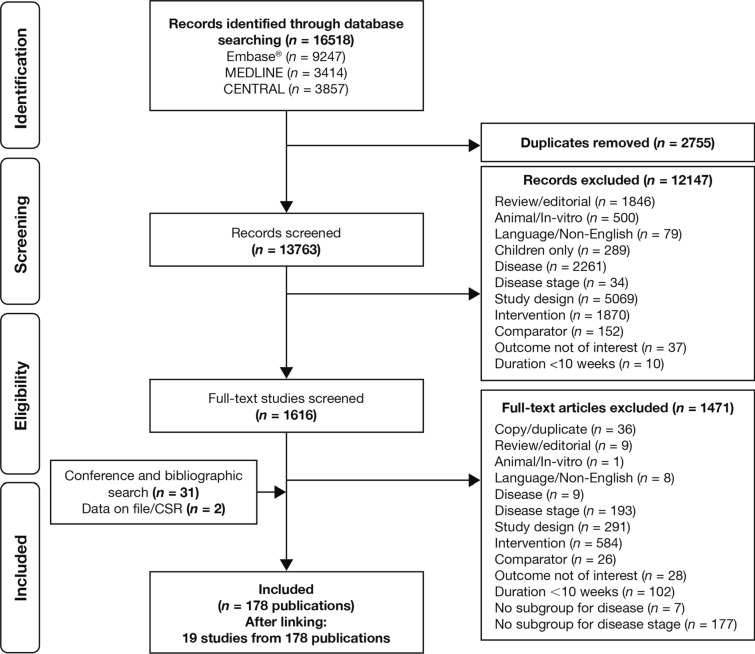
Fig. 1
Fig. 1
PRISMA flowchart of study screening process. CSR clinical study report
Fig. 2
Fig. 2
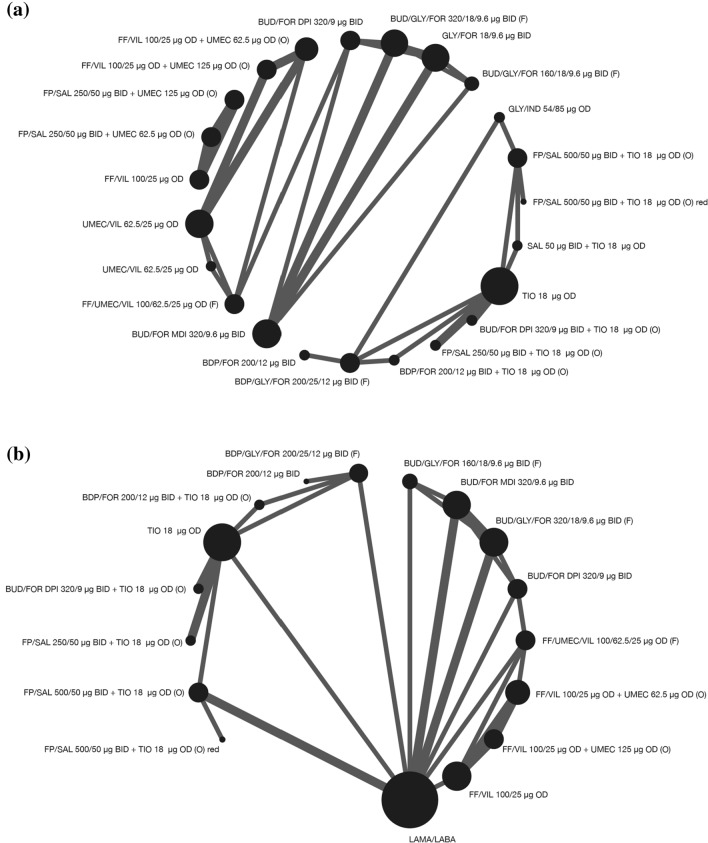
Networks using treatments as reported (a) and using all LAMA/LABA treatments as a single treatment group (b). BDP beclomethasone dipropionate, BID twice daily, BUD budesonide, DPI dry powder inhaler, F fixed-dose combination triple therapy, FF fluticasone furoate, FOR formoterol, FP fluticasone propionate, GLY glycopyrronium bromide, IND indacaterol, LABA long-acting β2-agonist, LAMA long-acting muscarinic antagonist, MDI metered dose inhaler, O open triple therapy, OD once daily, red reducing dose of fluticasone, SAL salmeterol, TIO tiotropium, UMEC umeclidinium, VIL vilanterol trifenatate
Fig. 3
Fig. 3
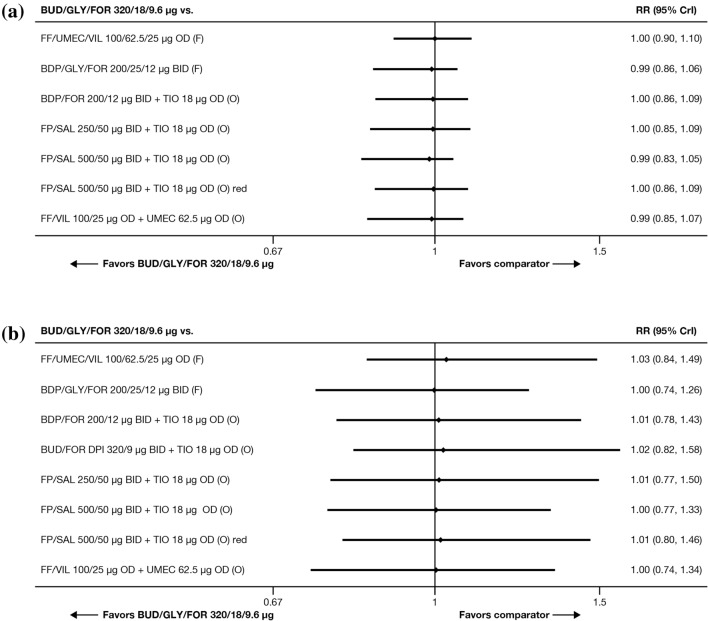
Rate ratio of moderate-to-severe (a) and severe (b) exacerbations. Data from REM. BDP beclomethasone dipropionate, BID twice daily, BUD budesonide, CrI credible interval, DPI dry powder inhaler, F fixed-dose combination triple therapy, FF fluticasone furoate, FOR formoterol, FP fluticasone propionate, GLY glycopyrronium bromide, O open triple therapy, OD once daily, red reducing dose of fluticasone, REM random effects model, RR rate ratio, SAL salmeterol, TIO tiotropium, UMEC umeclidinium, VIL vilanterol trifenatate
Fig. 4
Fig. 4
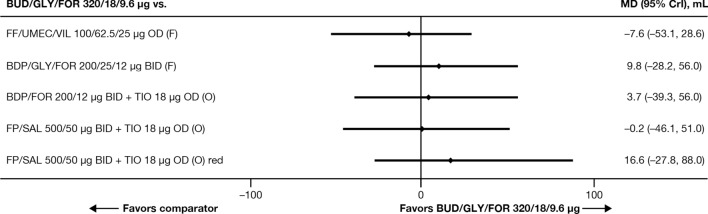
Change from baseline in trough FEV1 at 52 weeks. BDP beclomethasone dipropionate, BID twice daily, BUD budesonide, CrI credible interval, F fixed-dose combination triple therapy, FEV1 forced expiratory volume in 1 s, FF fluticasone furoate, FOR formoterol, FP fluticasone propionate, GLY glycopyrronium bromide, MD mean difference, O open triple therapy, OD once daily, red reducing dose of fluticasone, SAL salmeterol, TIO tiotropium, UMEC umeclidinium, VIL vilanterol trifenatate
Fig. 5
Fig. 5
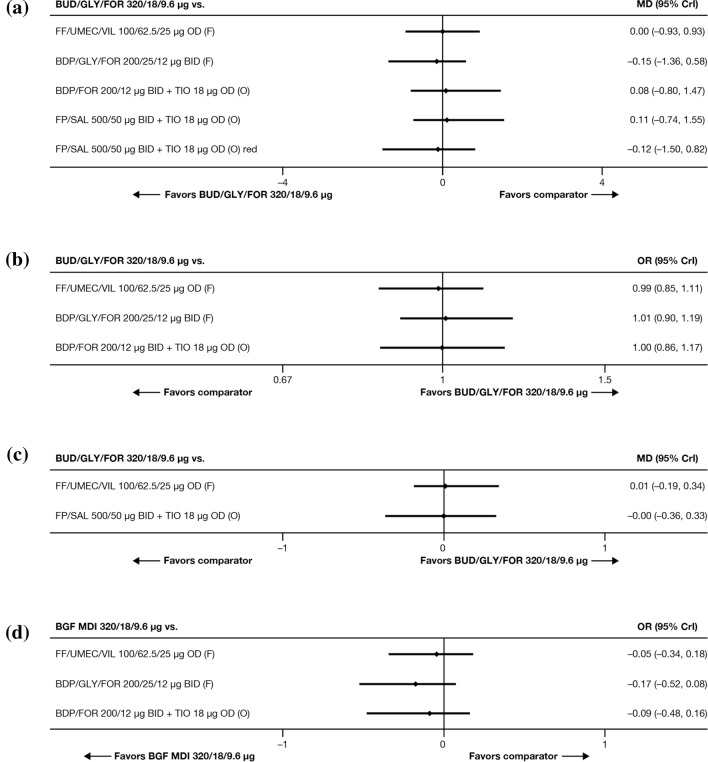
HRQoL and symptom endpoints. Change from baseline in SGRQ total score (a), SGRQ responders (b) and TDI focal score (c) at 52 weeks; change from baseline in daily rescue medication use over 52 weeks (d). BDP beclomethasone dipropionate, BID twice daily, BUD budesonide, CrI credible interval, F fixed-dose combination triple therapy, FF fluticasone furoate, FOR formoterol, FP fluticasone propionate, GLY glycopyrronium bromide, HRQoL health-related quality of life, MD mean difference, O open triple therapy, OD once daily, OR odds ratio, red reducing dose of fluticasone, SAL salmeterol, SGRQ St George’s Respiratory Questionnaire, TIO tiotropium, UMEC umeclidinium, VIL vilanterol trifenatate
Fig. 6
Fig. 6
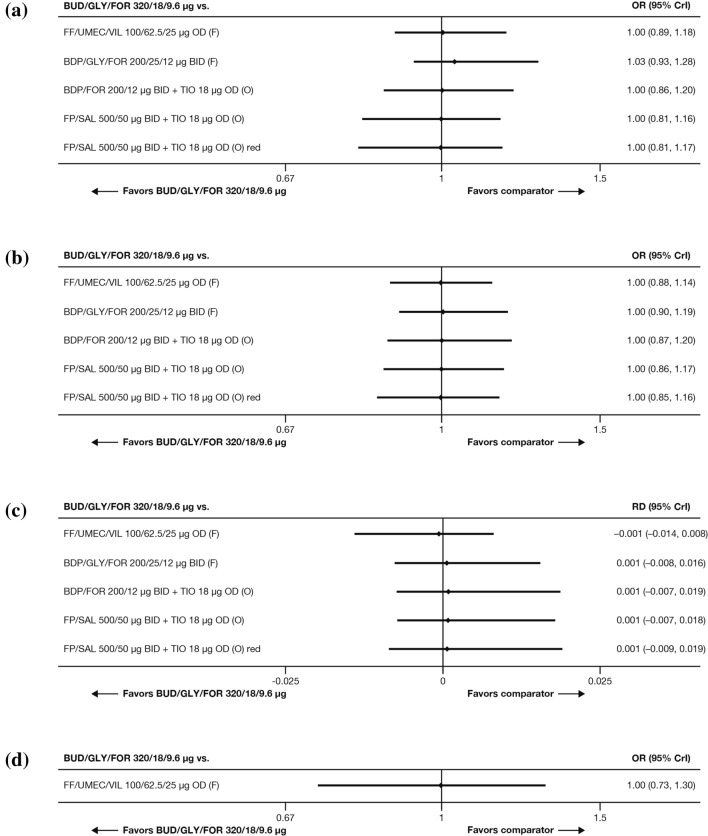
Safety endpoints. AEs (a), SAEs (b), pneumonia (any grade) (c) and URTI (any grade) (d) at 52 weeks. AEs adverse events, BDP beclomethasone dipropionate, BID twice daily, BUD budesonide, CrI credible interval, F fixed-dose combination triple therapy, FF fluticasone furoate, FOR formoterol, FP fluticasone propionate, GLY glycopyrronium bromide, O open triple therapy, OD once daily, OR odds ratio, RD risk difference, red reducing dose of fluticasone, SAEs serious adverse events SAL salmeterol, TIO tiotropium, UMEC umeclidinium, URTI upper respiratory tract infection, VIL vilanterol trifenatate
Fig. 7
Fig. 7
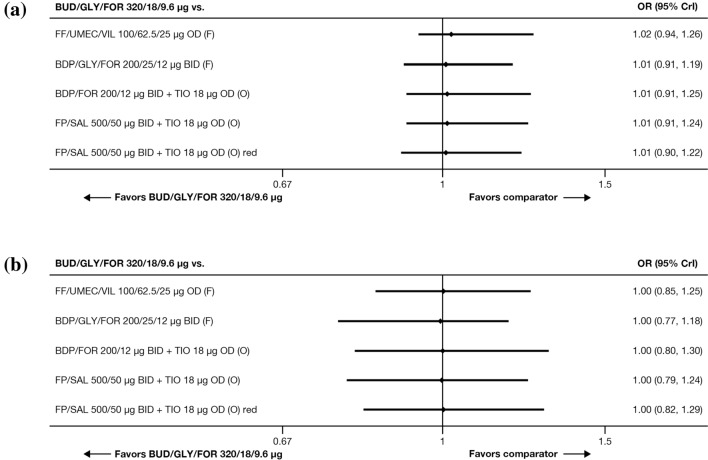
Tolerability endpoints. All withdrawals (a) and withdrawals due to an AE (b) at 52 weeks. AE adverse event, BDP beclomethasone dipropionate, BID twice daily, BUD budesonide, F fixed-dose combination triple therapy, FF fluticasone furoate, FP fluticasone propionate, FOR formoterol, GLY glycopyrronium bromide, O open triple therapy, OD once daily, OR odds ratio, red reducing dose of fluticasone, SAL salmeterol, TIO tiotropium, UMEC umeclidinium, VIL vilanterol trifenatate

References

    1. Global Initiative for Chronic Obstructive Lung Disease. Global strategy for the diagnosis, management, and prevention of chronic obstructive pulmonary disease. 2021 report. 2021. https://goldcopd.org/wp-content/uploads/2020/11/GOLD-REPORT-2021-v1.0-16.... Accessed 18 Nov 2020.
    1. Jung KS, Park HY, Park SY, et al. Comparison of tiotropium plus fluticasone propionate/salmeterol with tiotropium in COPD: a randomized controlled study. Respir Med. 2012;106:382–389. doi: 10.1016/j.rmed.2011.09.004. - DOI - PubMed
    1. Siler TM, Kerwin E, Sousa AR, Donald A, Ali R, Church A. Efficacy and safety of umeclidinium added to fluticasone furoate/vilanterol in chronic obstructive pulmonary disease: results of two randomized studies. Respir Med. 2015;109:1155–1163. doi: 10.1016/j.rmed.2015.06.006. - DOI - PubMed
    1. Lee SD, Xie CM, Yunus F, et al. Efficacy and tolerability of budesonide/formoterol added to tiotropium compared with tiotropium alone in patients with severe or very severe COPD: a randomized, multicentre study in East Asia. Respirology. 2016;21:119–127. doi: 10.1111/resp.12646. - DOI - PubMed
    1. Singh D, Papi A, Corradi M, et al. Single inhaler triple therapy versus inhaled corticosteroid plus long-acting β2-agonist therapy for chronic obstructive pulmonary disease (TRILOGY): a double-blind, parallel group, randomised controlled trial. Lancet. 2016;388:963–973. doi: 10.1016/S0140-6736(16)31354-X. - DOI - PubMed

Publication types

MeSH terms