


Patient preferences for growth hormone treatment in Japanese children
- PMID: 33930225
- PMCID: PMC8596999
- DOI: 10.1111/ped.14760
Patient preferences for growth hormone treatment in Japanese children
Abstract
Background: There are not clear evidence to date evaluating patients' and caregivers' preferences for the recombinant-human growth hormone (r-hGH) injection in children in Japan. This study aimed to quantitatively evaluated the factors driving preferences for daily r-hGH injections among Japanese children with growth hormone deficiency (GHD) or their caregivers and to determine the relative importance of treatment delivery factors.
Methods: This study was performed among Japanese children with GHD or their caregivers who visited a specialized clinic in Japan as part of their routine care. The participants were asked to complete a web-based discrete choice experiment (DCE) questionnaire.
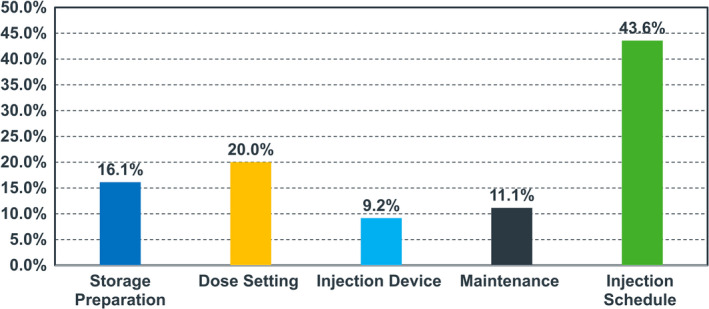
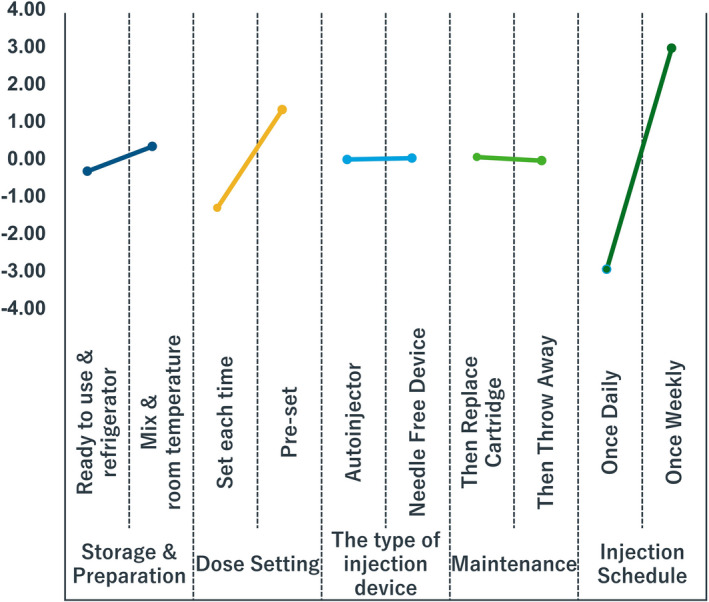
Results: Choice-based conjoint analysis was used to evaluate the relative importance of the attributes of the choice predictors and determine utility scores for each attribute. Of the 47 respondents who participated in this study, 41 were caregivers who responded on behalf of the patients, the remaining six were patients who completed the DCE themselves. The injection schedule was found to be the most important factor for both patients and caregivers; a once-weekly injection schedule was preferred over a daily injection schedule. Storage and preparation was deemed more important to patients than it was to caregivers, with patients preferring storage at room temperature even if it required additional mixing (reconstitution). Both patients and caregivers showed a clear preference for devices that offered a dose-setting memory.
Conclusions: A less frequent injection schedule may enhance adherence to r-hGH treatment and expected improve quality of life for GHD patients over the long term.
Keywords: children; conjoint analysis; discrete choice experiment; growth hormone deficiency; patient reported outcome.
© 2021 The Authors. Pediatrics International published by John Wiley & Sons Australia, Ltd on behalf of Japan Pediatric Society.
Conflict of interest statement
Pfizer Japan Inc. fully funded the study and was involved in study design. Fees were paid to IQVIA Solutions Japan K.K. for study conduct, analysis, and reporting. The authors declare the following potential conflicts of interest with respect to the research, authorship, and/or publication of this article: TT has received an advisory fee and honoraria from Pfizer Japan Inc. However, he did not receive any payment regarding the development of this manuscript. TS and AY are full‐time employees of Pfizer Japan Inc. TA and AT are full‐time employees of IQVIA Solutions Japan K.K.
Figures
References
-
- Ranke MB, Wit JM. Growth hormone ‐ past, present and future. Nat. Rev. Endocrinol. 2018; 14: 285–300. - PubMed
-
- Hibi I, Tanaka T. Final height of patients with idiopathic growth hormone deficiency after long‐term growth hormone treatment. Committee for Treatment of Growth Hormone Deficient Children. Growth Science Foundation, Japan. Acta Endocrinol. (Copenh). 1989; 120(4): 409–15. - PubMed
-
- Tanaka T. Growth hormone treatment in Japan: past, present, and future. Pediatr. Endocrinol. Rev. 2012; 10(Suppl 1): 89–97. - PubMed
-
- Yokoya S, Tanaka T. The History of Growth Hormone Treatment for GHD in Japan. Pediatr Endocrinol Rev. 2017; 14 (Suppl 1): 201–8. - PubMed
-
- Kuromaru R, Kohno H, Ueyama N, Hassan HM, Honda S, Hara T. Long‐term prospective study of body composition and lipid profiles during and after growth hormone (GH) treatment in children with GH deficiency: gender‐specific metabolic effects. J. Clin. Endocrinol. Metab. 1998; 83: 3890–6. - PubMed
MeSH terms
Substances
Grants and funding
LinkOut - more resources
Full Text Sources
Other Literature Sources
