


Federal, state, and institutional barriers to the expansion of medication and telemedicine abortion services in Ohio, Kentucky, and West Virginia during the COVID-19 pandemic
- PMID: 33930382
- PMCID: PMC9748601
- DOI: 10.1016/j.contraception.2021.04.020
Federal, state, and institutional barriers to the expansion of medication and telemedicine abortion services in Ohio, Kentucky, and West Virginia during the COVID-19 pandemic
Abstract
Objectives: We aimed to characterize the combined impact of federal, state, and institutional policies on barriers to expanding medication and telemedicine abortion care delivery during the COVID-19 pandemic in the abortion-restrictive states of Ohio, Kentucky, and West Virginia.
Study design: We analyzed 4 state policies, 2 COVID-related state executive orders, and clinic-level survey data on medication abortion provision from fourteen abortion facilities in Ohio, Kentucky, and West Virginia from December 2019 to December 2020. We calculated the percent of medication abortions provided at these facilities during the study period by state, to assess changes in medication abortion use during the pandemic.
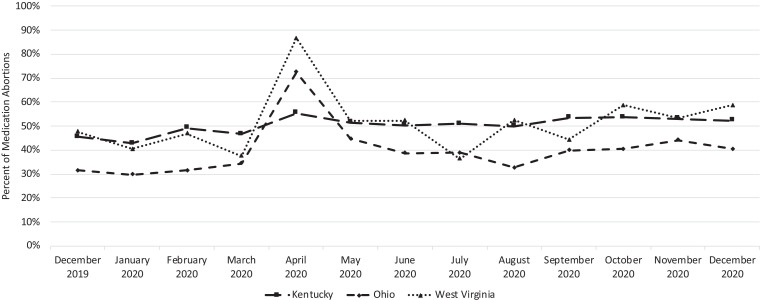
Results: We ascertained that COVID-19-executive orders in Ohio and West Virginia that limited procedural abortion in Spring 2020 coincided with an increase in the overall number and proportion of medication abortions in this region, peaking at 1613 medication abortions (70%) in April 2020. Ohio and West Virginia, which had executive orders limiting procedural abortion, saw relatively greater increases in April compared to Kentucky. Despite temporary lifting of the mifepristone REMS, prepandemic regulations banning telemedicine abortion in Kentucky and West Virginia and requiring in-person clinic visits for medication abortion distribution in Ohio limited clinics' ability to adapt to offer medication abortion by mail.
Conclusions: Our findings illustrate how restrictive medication and telemedicine abortion policies in Ohio, Kentucky, and West Virginia created additional obstacles for patients seeking medication abortion during the pandemic. Permanently lifting federal regulations on in-clinic distribution of mifepristone would only advantage abortion seekers in states without restrictive telehealth and medication abortion policies. State policies that limit access to comprehensive abortion services should be central in larger efforts toward dismantling barriers that impinge upon reproductive autonomy.
Implication statement: We find that abolishing the REMS on mifepristone would not be enough to expand access to patients in abortion-restrictive states with telemedicine and medication abortion laws. While the REMS is a barrier, it represents one of several hindrances to the expansion of telemedicine abortion distribution across the United States.
Keywords: Abortion; COVID-19; Mifepristone; REMS; State policy; Telemedicine.
Copyright © 2021. Published by Elsevier Inc.
Figures
References
-
- Guttmacher Institute. Induced Abortion in the United States, https://www.guttmacher.org/fact-sheet/induced-abortion-united-states; 2019 [accessed December 18, 2020].
-
- Grossman D. Telemedicine for medical abortion – time to move towards broad implementation. BJOG. 2019;126(9):1103. - PubMed
-
- US Food & Drug Administration. Approved Risk Evaluation and Mitigation Strategies (REMS), https://www.accessdata.fda.gov/scripts/cder/rems/index.cfm; 2021 [accessed December 20, 2020].
MeSH terms
Substances
LinkOut - more resources
Full Text Sources
Other Literature Sources
Medical
Miscellaneous
