. 2021 Apr 30;16(1):195.
doi: 10.1186/s13023-021-01784-7.

Implementation of second-tier tests in newborn screening for the detection of vitamin B12 related acquired and genetic disorders: results on 258,637 newborns

Affiliations

Implementation of second-tier tests in newborn screening for the detection of vitamin B12 related acquired and genetic disorders: results on 258,637 newborns

Sonia Pajares et al. Orphanet J Rare Dis. .

Erratum in

Abstract

Background: Alteration of vitamin B12 metabolism can be genetic or acquired, and can result in anemia, failure to thrive, developmental regression and even irreversible neurologic damage. Therefore, early diagnosis and intervention is critical. Most of the neonatal cases with acquired vitamin B12 deficiency have been detected by clinical symptoms and only few of them trough NBS programs. We aim to assess the usefulness of the second-tier test: methylmalonic acid (MMA), methylcitric acid (MCA) and homocysteine (Hcys) in our newborn screening program and explore the implications on the detection of cobalamin (vitamin B12) related disorders, both genetic and acquired conditions.

Methods: A screening strategy using the usual primary markers followed by the analysis of MMA, MCA and Hcys as second tier-test in the first dried blood spot (DBS) was developed and evaluated.

Results: During the period 2015-2018 a total of 258,637 newborns were screened resulting in 130 newborns with acquired vitamin B12 deficiency (incidence 1:1989), 19 with genetic disorders (incidence 1:13,613) and 13 were false positive. No false negatives were notified. Concerning the second-tier test, the percentage of cases with MMA above the cut-off levels, both for genetic and acquired conditions was very similar (58% and 60%, respectively). Interestingly, the percentage of cases with increased levels of Hcys was higher in acquired conditions than in genetic disorders (87% and 47%, respectively). In contrast, MCA was high only in 5% of the acquired conditions versus in 53% of the genetic disorders, and it was always very high in all patients with propionic acidemia.

Conclusions: When screening for methylmalonic acidemia and homocystinuria, differential diagnosis with acquired vitamin B12 deficiency should be done. The results of our strategy support the inclusion of this acquired condition in the NBS programs, as it is easily detectable and allows the adoption of corrective measures to avoid the consequences of its deficiency.

Keywords: Homocysteine; Homocystinuria; Methylcitric acid; Methylmalonic acid; Methylmalonic acidemia; Newborn screening; Propionic acidemia; Second-tier test; Vitamin B12 deficiency.


Conflict of interest statement

The authors declare that they have no competing interests.

Figures
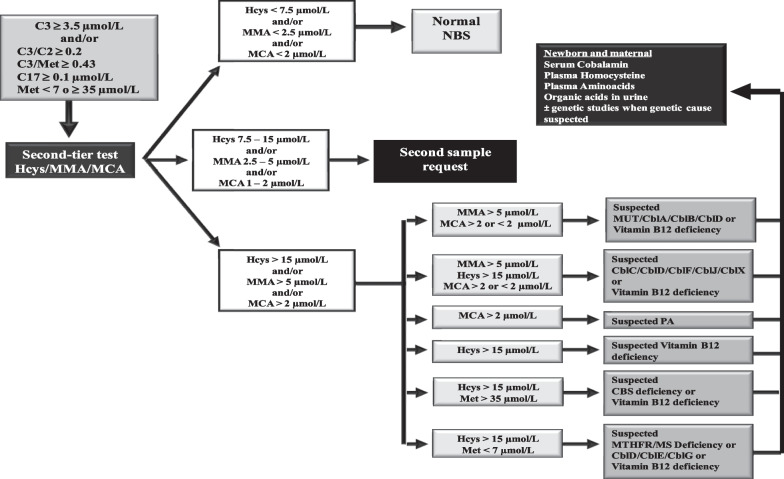
Fig. 1
Fig. 1
Algorithm for the detection of genetic disorders and acquired vitamin B12, from 2015 to nowadays. Cut-off values in μmol/L: C3: initial strategy: < 4.5 (99th ptl); current strategy: 3.5 (96th ptl); Met: 7–35 (1th ptl and 99.7th ptl, respectively); C17: < 0.1 (99.9th ptl); C3/C2 ratio: < 0.2 (99.8th ptl); C3/Met ratio: < 0.43 (99.8th ptl). Ptl percentile. CblA methylmalonic acidemia CblA type, CblB methylmalonic acidemia CblB type, CblC methylmalonic acidemia with homocystinuria CblC type, CblD methylmalonic acidemia with homocystinuria CblD type, CblE methylmalonic acidemia with homocystinuria CblE type, CblF methylmalonic acidemia with homocystinuria CblF type, CblG homocystinuria CblG type, CblJ methylmalonic acidemia with homocystinuria CblJ type, CblX methylmalonic acidemia with homocystinuria CblX type, CBS cystathionine β-synthase deficiency, C17 heptadecanoilcarnitine, C2 acetylcarnitine, C3 propionylcarnitine, Hcys homocysteine, MCA methylcitric acid, Met methionine, MMA methylmalonic acid, MS methionine synthase, MTHFR methylenetetrahydrofolate reductase, MUT methylmalonyl-CoA mutase deficiency, NBS newborn screening, PA propionic acidemia
Fig. 2
Fig. 2
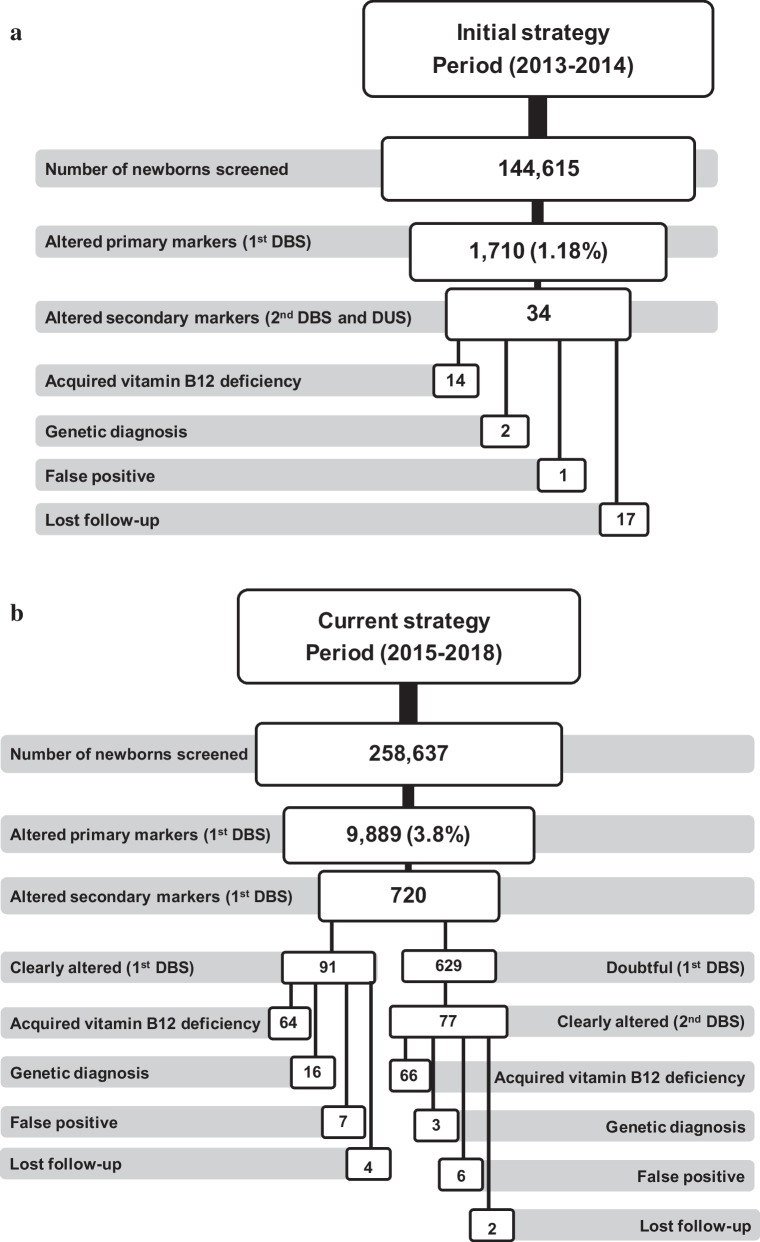
Results of newborn screening strategies. DBS dried blood spot, DUS dried urine spot
Fig. 3
Fig. 3
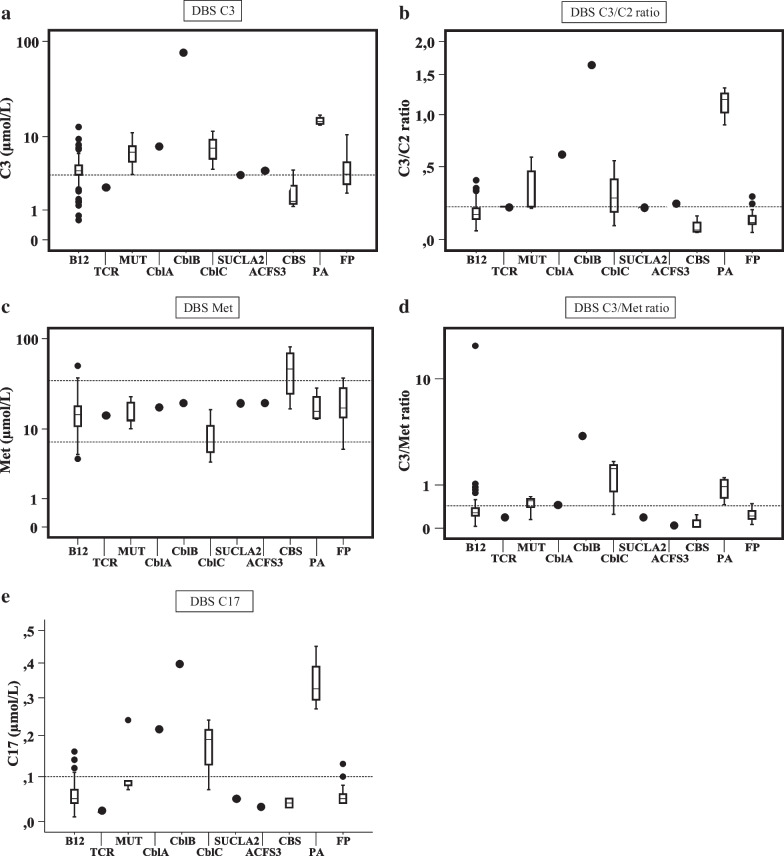
Altered values of primary markers on dried blood spots on selected newborns. Y-axis is represented in logarithmic scale. Values are depicted as box-and-whisker plots with minimum and maximum. Dashed lines represents the cut-off values in μmol/L: C3: initial strategy: > 4.5 (99th ptl); current strategy: > 3.5 (96th ptl); Met: 7–35 (1th ptl and 99.7th ptl, respectively); C17: > 0.1 (99.9th ptl); C3/C2 ratio: > 0.2 (99.8th ptl); C3/Met ratio: > 0.43 (99.8th ptl). Ptl: percentile. ACSF3 combined malonic and methylmalonic acidemia due to acyl-CoA synthetase family, member 3 deficiency, B12 vitamin B12 deficient newborns, CblA methylmalonic acidemia CblA type, CblB methylmalonic acidemia CblB type, CblC methylmalonic acidemia with homocystinuria CblC type, CBS cystathionine β-synthase deficiency, C17 heptadecanoilcarnitine, C2 acetylcarnitine, C3 propionylcarnitine, FP false positive, Met methionine, MUT methylmalonyl-CoA mutase deficiency, PA propionic acidemia, SUCLA2 beta-subunit of the ADP-forming succinyl-CoA synthetase deficiency, TCR transcobalamin receptor defect
Fig. 4
Fig. 4
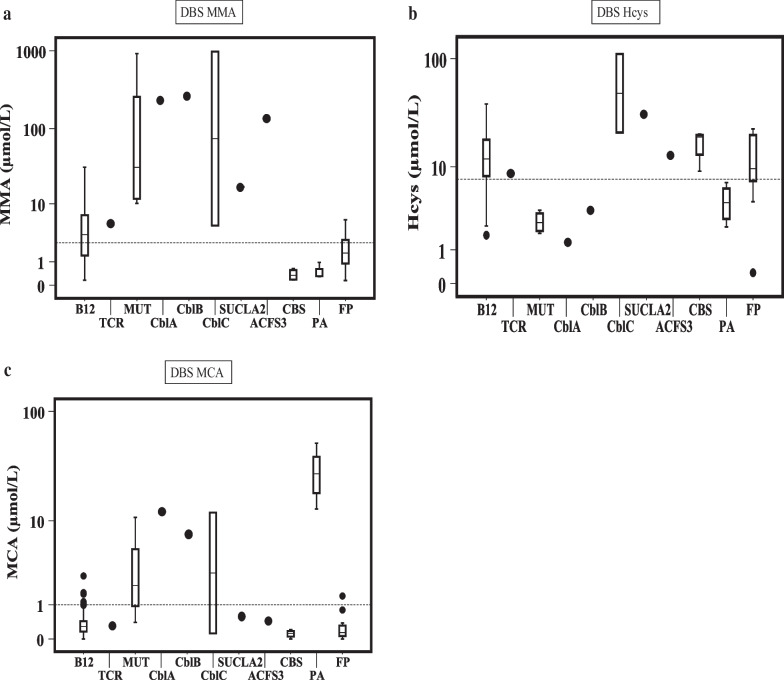
Second-tier test values on dried blood spots in newborns with altered primary markers. Hcys homocysteine, MCA methylcitric acid, MMA methylmalonic acid. Y-axis is represented as logarithmic scale. Values are depicted as box-and-whisker plots with minimum and maximum. Dashes lines represents the cut-off values (μmol/L) in the doubtful limit that implies the request of a second DBS: MMA > 2.5; Hcys > 7.5 and MCA > 1. ACSF3 combined malonic and methylmalonic acidemia due to acyl-CoA synthetase family, member 3 deficiency, B12 vitamin B12 deficiency, CblA methylmalonic acidemia CblA type, CblB methylmalonic acidemia CblB type, CblC methylmalonic acidemia with homocystinuria CblC type, CBS cystathionine β-synthase deficiency, FP false positive, MUT methylmalonyl-CoA mutase deficiency, PA propionic acidemia, SUCLA2 beta-subunit of the ADP-forming succinyl-CoA synthetase deficiency, TCR transcobalamin receptor defect

References

    1. Therrell BL, Padilla CD, Loeber JG, Kneisser I, Saadallah A, Borrajo GJ, et al. Current status of newborn screening worldwide: 2015. Semin Perinatol. 2015;39:171–187. doi: 10.1053/j.semperi.2015.03.002. - DOI - PubMed
    1. Garcia-Villoria J, Pajares S, López RM, Marin JL, Ribes A. Neonatal Screening for Inherited Metabolic Diseases in 2016. Semin Pediatr Neurol. 2016;23:257–272. doi: 10.1016/j.spen.2016.11.001. - DOI - PubMed
    1. Fowler B, Leonard JV, Baumgartner MR. Causes of and diagnostic approach to Methylmalonic acidurias. J Inherit Metab Dis. 2008;31:350–360. doi: 10.1007/s10545-008-0839-4. - DOI - PubMed
    1. Huemer M, Kožich V, Rinaldo P, Baumgartner MR, Merinero B, Pasquini E, et al. Newborn screening for homocystinurias and Methylation disorders: systematic review and proposed guidelines. J Inherit Metab Dis. 2015;38:1007–1019. doi: 10.1007/s10545-015-9830-z. - DOI - PMC - PubMed
    1. Baumgartner MR, Hörster F, Dionisi-Vici C, Haliloglu G, Karall D, Chapman KA, et al. Proposed guidelines for the diagnosis and management of methylmalonic and propionic acidemia. Orphanet J Rare Dis. 2014;9:13. doi: 10.1186/s13023-014-0130-8. - DOI - PMC - PubMed

Publication types