. 2021 Apr 30;372(6549):1418-1423.
doi: 10.1126/science.abh1282. Online ahead of print.

Prior SARS-CoV-2 infection rescues B and T cell responses to variants after first vaccine dose

Collaborators, Affiliations

Prior SARS-CoV-2 infection rescues B and T cell responses to variants after first vaccine dose

Catherine J Reynolds et al. Science. .

Abstract

SARS-CoV-2 vaccine rollout has coincided with the spread of variants of concern. We investigated if single dose vaccination, with or without prior infection, confers cross protective immunity to variants. We analyzed T and B cell responses after first dose vaccination with the Pfizer/BioNTech mRNA vaccine BNT162b2 in healthcare workers (HCW) followed longitudinally, with or without prior Wuhan-Hu-1 SARS-CoV-2 infection. After one dose, individuals with prior infection showed enhanced T cell immunity, antibody secreting memory B cell response to spike and neutralizing antibodies effective against B.1.1.7 and B.1.351. By comparison, HCW receiving one vaccine dose without prior infection showed reduced immunity against variants. B.1.1.7 and B.1.351 spike mutations resulted in increased, abrogated or unchanged T cell responses depending on human leukocyte antigen (HLA) polymorphisms. Single dose vaccination with BNT162b2 in the context of prior infection with a heterologous variant substantially enhances neutralizing antibody responses against variants.


Figures

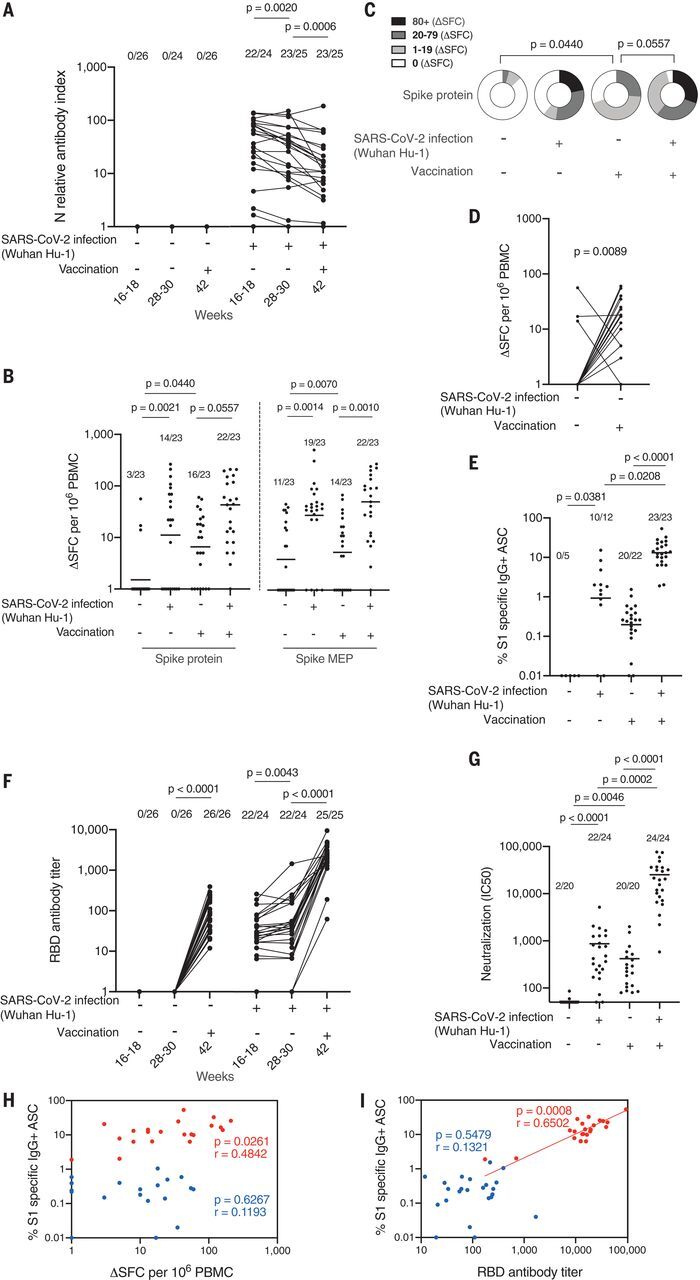
Fig. 1
Fig. 1. Impact of prior natural infection with SARS-CoV-2 during the first wave on T and B cell responses to a single dose of the mRNA SARS-CoV-2 vaccine BNT162b2.
(A) Nucleocapsid Abs measured by electrochemiluminescence immunoassay analyzer (ECLIA) in serum samples from HCW with (n = 25 individuals) and without (n = 26 individuals) laboratory-confirmed SARS-CoV-2 infection (Wuhan-Hu-1, during the first wave) 3 weeks after a single dose of the mRNA SARS-CoV-2 vaccine BNT162b2. (B) Magnitude of T cell response to spike protein and spike mapped epitope peptides (MEPs) in HCW with and without laboratory-confirmed SARS-CoV-2 infection (n = 23 per group). Data are shown prevaccination (16 to 18 weeks after infection) and 3 weeks after the first-dose vaccination (week 42) with line at geometric mean. (C) Proportion of HCW with (n = 23) and without (n = 23) laboratory-confirmed SARS-CoV-2 infection (during the first wave) with a T cell response to spike protein within the range of 0, 1 to 19, 20 to 79, and >80 ΔSFC/106 PBMC before and 3 weeks after first-dose vaccination. (D) Magnitude of T cell response to spike protein in HCW without a history of SARS-CoV-2 infection, plotted pairwise at 16 to 18 weeks and 42 weeks (3 weeks after first-dose vaccination). (E) Percentage of S1-specific IgG+ antibody-secreting cells (ASCs) in vaccinated HCW with (n = 23) and without (n = 22) prior SARS-CoV-2 infection and in unvaccinated HCW with (n = 12) and without (n = 5) prior infection. Line at geometric mean. (F) RBD Ab titers measured by ECLIA in serum samples from HCW with (n = 25) and without (n = 26) laboratory-confirmed SARS-CoV-2 infection following first-dose vaccination. (G) Neutralizing antibody titer (IC50) against Wuhan-Hu-1 authentic virus in HCW with (n = 24) and without (n = 20) laboratory-confirmed SARS-CoV-2 infection. Line at arithmetic mean. (H) Correlation between percentage of S1-specific ASC and magnitude of T cell response to spike protein in vaccinated HCW with (n = 21, red) and without (n = 19, blue) a history of SARS-CoV-2 infection during the first wave. (I) Correlation between percentage of S1-specific ASC and RBD Ab titer in HCW with (n = 23, red) and without (n = 23, blue) a history of SARS-CoV-2 infection. [(A), (B), (E), and (F)] Numbers of HCW in each group with detectable responses are shown. [(F) and (G)] Data are shown prevaccination (16 to 18 weeks after infection) and 3 weeks after the first-dose vaccination (week 42). [(A), (D), and (F)] Wilcoxon matched-pairs signed rank test. [(B), (C), (E), and (G)] Kruskal Wallis multiple comparison analysis of variance (ANOVA) with Dunn’s correction. [(H) and (I)] Spearman’s rank correlation. Ab, antibody; HCW, health care workers; RBD, receptor binding domain; S1, spike subunit 1; SFC, spot forming cells.
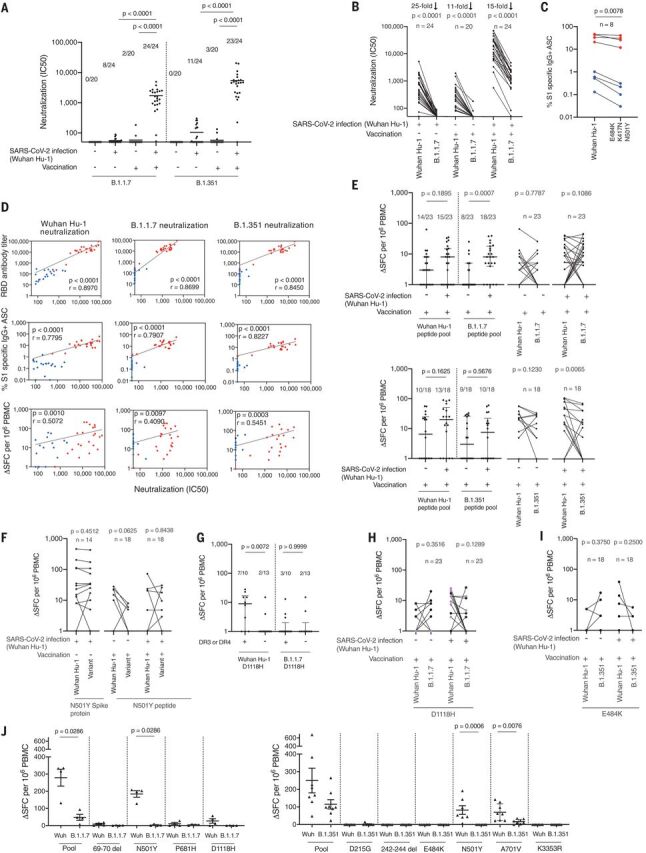
Fig. 2
Fig. 2. Impact of vaccination and prior natural infection with SARS-CoV-2 during the first wave on T and B cell responses to the UK B.1.1.7 and South African B.1.351 variants.
(A) Neutralizing antibody (nAb) titer (IC50) against B.1.1.7 and B.1.351 authentic virus in HCW with (n = 24) and without (n = 20) laboratory-confirmed SARS-CoV-2 infection (Wuhan-Hu-1). Lines at arithmetic mean. Data are shown prevaccination (16 to 18 weeks after infection) and 3 weeks after the first-dose vaccination (week 42). (B) nAb (IC50) titers against Wuhan-Hu-1 and B.1.1.7 authentic viruses plotted pairwise by individual. (C) Percentage of Wuhan-Hu-1 S1 and S1 containing variant mutations (E484K, K417N, and N501Y) specific IgG+ antibody-secreting cells (ASCs) in vaccinated HCW with (n = 4) and without (n = 4) prior SARS-CoV-2 infection. Single-letter abbreviations for the amino acid residues are as follows: A, Ala; C, Cys; D, Asp; E, Glu; F, Phe; G, Gly; H, His; I, Ile; K, Lys; L, Leu; M, Met; N, Asn; P, Pro; Q, Gln; R, Arg; S, Ser; T, Thr; V, Val; W, Trp; and Y, Tyr. (D) Correlations between nAb (IC50) titers of Wuhan-Hu-1, B.1.1.7, or B.1.351 authentic virus and RBD Ab titer, percentage of S1-specific ASC, and magnitude of T cell response to S1 protein in vaccinated HCW with (n = 22 to 24, red) and without (n = 18 to 20, blue) a history of SARS-CoV-2 infection. (E) Magnitude of T cell response to Wuhan-Hu-1, B.1.1.7, or B.1.351 peptide pools in vaccinated HCW with (n = 23 or 18) and without (n = 23 or 18) SARS-CoV-2 infection (Wuhan-Hu-1), plotted as grouped data (median plus interquartile range) and pairwise for each individual. (F) Magnitude of T cell response to Wuhan-Hu-1 S1 protein and N501Y variant spike RBD protein in unvaccinated HCW with laboratory-confirmed SARS-CoV-2 infection (n = 14) or to Wuhan-Hu-1 and N501Y mutated peptide in vaccinated HCW with (n = 18) and without (n = 18) a history of SARS-CoV-2 infection, plotted pairwise by individual. (G) Magnitude of T cell response to Wuhan-Hu-1 or B.1.1.7 D1118H peptide in vaccinated HCW with a history of SARS-CoV-2 infection (n = 23), plotted by DRB1*0301 or DRB1*0401 status. Lines at median plus interquartile range. (H) Magnitude of T cell response to Wuhan-Hu-1 or B.1.1.7 D1118H peptide in vaccinated HCW with (n = 23) and without (n = 23) a history of SARS-CoV-2 infection, plotted pairwise by individual and with individuals carrying DRB1*0301 or DRB1*0401 alleles marked in purple. (I) Magnitude of T cell response to Wuhan-Hu-1 or B.1.351 E484K mutated peptide in vaccinated HCW with (n = 18) and without (n = 18) a history of SARS-CoV-2 infection, plotted pairwise by individual. (J) Magnitude of T cell response to Wuhan-Hu-1 (Wuh), B.1.1.7, or B.1.351 peptide pools and individual peptides in Wuhan-Hu-1 peptide immunized HLA-DRB1*04:01 transgenic mice (left-hand panel, n = 4; right-hand panel, n = 8; lines at arithmetic mean + SEM). (A) Kruskal Wallis multiple comparison ANOVA with Dunn’s correction. [(B), (C), (E) (right-hand panels), (F), (H), and (I)] Wilcoxon matched-pairs signed rank test. (D) Spearman’s rank correlation. [(E) (left-hand panels), (G), and (J)] Mann-Whitney U test. ASC, antibody-secreting cells; HCW, health care workers; RBD, receptor binding domain; S1, spike subunit 1; SFC, spot forming cells.

Comment in

  • Corona-Splitter.
    Patzer KH. Patzer KH. MMW Fortschr Med. 2021 May;163(9):21. doi: 10.1007/s15006-021-9937-0. MMW Fortschr Med. 2021. PMID: 33961240 Free PMC article. German. No abstract available.

References

    1. Polack F. P., Thomas S. J., Kitchin N., Absalon J., Gurtman A., Lockhart S., Perez J. L., Pérez Marc G., Moreira E. D., Zerbini C., Bailey R., Swanson K. A., Roychoudhury S., Koury K., Li P., Kalina W. V., Cooper D., Frenck R. W. Jr.., Hammitt L. L., Türeci Ö., Nell H., Schaefer A., Ünal S., Tresnan D. B., Mather S., Dormitzer P. R., Şahin U., Jansen K. U., Gruber W. C.; C4591001 Clinical Trial Group , Safety and efficacy of the BNT162b2 mRNA Covid-19 vaccine. N. Engl. J. Med. 383, 2603–2615 (2020). 10.1056/NEJMoa2034577 - DOI - PMC - PubMed
    1. Mascola J. R., Graham B. S., Fauci A. S., SARS-CoV-2 viral variants—tackling a moving target. JAMA 325, 1261–1262 (2021). 10.1001/jama.2021.2088 - DOI - PubMed
    1. Altmann D. M., Boyton R. J., Beale R., Immunity to SARS-CoV-2 variants of concern. Science 371, 1103–1104 (2021). 10.1126/science.abg7404 - DOI - PubMed
    1. A. Rambaut, N. Loman, O. Pybus, W. Barclay, J. Barrett, A. Carabelli, T. Connor, T. Peacock, D. L. Robertson, E. Volz, on behalf of COVID-19 Genomics Consortium UK (CoG-UK), Preliminary genomic characterisation of an emergent SARS-CoV-2 lineage in the UK defined by a novel set of spike mutations, virological.org (2020); https://virological.org/t/preliminary-genomic-characterisation-of-an-eme....
    1. Wang Z., Schmidt F., Weisblum Y., Muecksch F., Barnes C. O., Finkin S., Schaefer-Babajew D., Cipolla M., Gaebler C., Lieberman J. A., Oliveira T. Y., Yang Z., Abernathy M. E., Huey-Tubman K. E., Hurley A., Turroja M., West K. A., Gordon K., Millard K. G., Ramos V., Da Silva J., Xu J., Colbert R. A., Patel R., Dizon J., Unson-O’Brien C., Shimeliovich I., Gazumyan A., Caskey M., Bjorkman P. J., Casellas R., Hatziioannou T., Bieniasz P. D., Nussenzweig M. C., mRNA vaccine-elicited antibodies to SARS-CoV-2 and circulating variants. Nature 592, 616–622 (2021). 10.1038/s41586-021-03324-6 - DOI - PMC - PubMed