. 2021 Jun 3;108(6):965-982.
doi: 10.1016/j.ajhg.2021.04.009. Epub 2021 Apr 30.

Sub-genic intolerance, ClinVar, and the epilepsies: A whole-exome sequencing study of 29,165 individuals

Collaborators

Sub-genic intolerance, ClinVar, and the epilepsies: A whole-exome sequencing study of 29,165 individuals

Epi25 Collaborative. Electronic address: jm4279@cumc.columbia.edu et al. Am J Hum Genet. .

Erratum in

Abstract

Both mild and severe epilepsies are influenced by variants in the same genes, yet an explanation for the resulting phenotypic variation is unknown. As part of the ongoing Epi25 Collaboration, we performed a whole-exome sequencing analysis of 13,487 epilepsy-affected individuals and 15,678 control individuals. While prior Epi25 studies focused on gene-based collapsing analyses, we asked how the pattern of variation within genes differs by epilepsy type. Specifically, we compared the genetic architectures of severe developmental and epileptic encephalopathies (DEEs) and two generally less severe epilepsies, genetic generalized epilepsy and non-acquired focal epilepsy (NAFE). Our gene-based rare variant collapsing analysis used geographic ancestry-based clustering that included broader ancestries than previously possible and revealed novel associations. Using the missense intolerance ratio (MTR), we found that variants in DEE-affected individuals are in significantly more intolerant genic sub-regions than those in NAFE-affected individuals. Only previously reported pathogenic variants absent in available genomic datasets showed a significant burden in epilepsy-affected individuals compared with control individuals, and the ultra-rare pathogenic variants associated with DEE were located in more intolerant genic sub-regions than variants associated with non-DEE epilepsies. MTR filtering improved the yield of ultra-rare pathogenic variants in affected individuals compared with control individuals. Finally, analysis of variants in genes without a disease association revealed a significant burden of loss-of-function variants in the genes most intolerant to such variation, indicating additional epilepsy-risk genes yet to be discovered. Taken together, our study suggests that genic and sub-genic intolerance are critical characteristics for interpreting the effects of variation in genes that influence epilepsy.

Keywords: ClinVar; Epi25; Louvain; epilepsy; epileptic encephalopathy; focal epilepsy; generalized epilepsy; intolerance; seizures; whole-exome sequencing.


Conflict of interest statement

B.M.N. is a member of the scientific advisory board at Deep Genomics and RBNC Therapeutics, a member of the scientific advisory committee at Milken, and a consultant for Camp4 Therapeutics, Takeda Pharmaceutical, and Biogen. R.S.D. is a consultant for AstraZeneca. D.B.G. is a founder and shareholder in Praxis Precision Medicines, a shareholder in and member of the scientific advisor board for Apostle Inc., a shareholder in Q State – Biosciences, and a consultant for Gilead Sciences, AstraZeneca, and GoldFinch Bio.

Figures
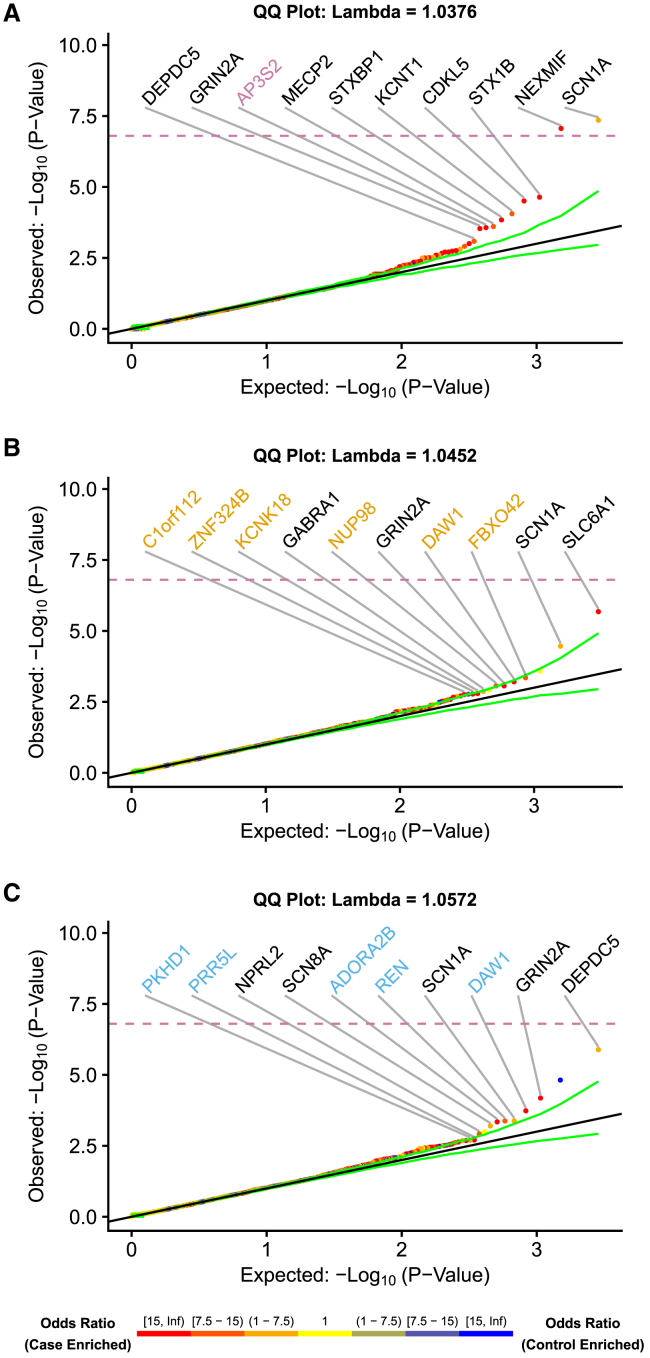
Figure 1
Figure 1
Quantile-quantile (QQ) plots for the protein-coding genes with at least one individual with epilepsy or control carrier Qualifying variants were high-quality, ultra-rare variants with a predicted functional effect but restricting missense variants to REVEL ≥ 0.5 (when defined). We generated p values from the exact two-sided Cochran-Mantel-Haenszel (CMH) test by gene by cluster to indicate a different carrier status of affected individuals in comparison to control individuals. SCN1A (p = 4.4 × 10−8) and NEXMIF (previously known as KIAA2022, p = 8.6 × 10−8) achieved study-wide significance p < 1.6 × 10−7 after Bonferroni correction indicated by dashed line (see gene-based collapsing). (A) Developmental and epileptic encephalopathy (DEE)-affected individuals, (B) genetic generalized epilepsy (GEE)-affected individuals, and (C) non-acquired focal epilepsy (NAFE)-affected individuals. Top ten genes enriched among individuals with epilepsy are labeled. Point coloring determined by CMH odds ratio. Genes labeled in black are known epilepsy genes. Genes labeled in color are candidate epilepsy genes. The green lines represent the 95% confidence interval.
Figure 2
Figure 2
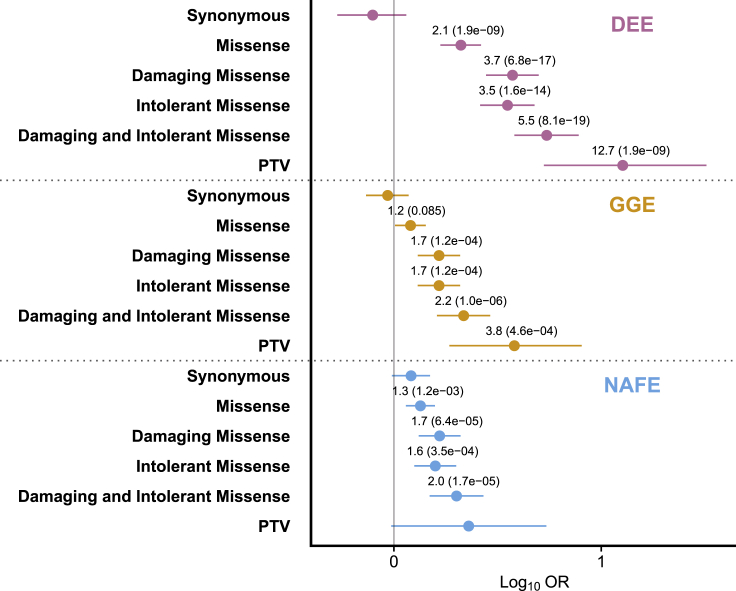
Gene set enrichment analysis shows indviduals with mild epilepsies enriched for rare variants in genes associated with severe epilepsies Gene set burden testing with 24 genes drawn from the 43 OMIM epileptic encephalopathy phenotype series with dominant transmission by limiting to genes harboring damaging (REVEL ≥ 0.5) missense variants in all three epilepsies (see gene set enrichment testing, Table S5). All variants are ultra-rare (see subjects and methods). Pooled odds ratio, 95% confidence intervals, and FDR-corrected p value were generated from the exact two-sided Cochran-Mantel-Haenszel (CMH) test. Odds ratio and FDR-adjusted p values displayed for comparisons with unadjusted p value < 0.05. x axis displays the log10 of the odds ratio and confidence intervals. PTV, protein-truncating variants; “damaging,” REVEL ≥ 0.5 (when defined); “intolerant,” MTR ≤ 0.78 (when defined); DEE, developmental and epileptic encephalopathy; GGE, genetic generalized epilepsy; NAFE, non-acquired focal epilepsy.
Figure 3
Figure 3
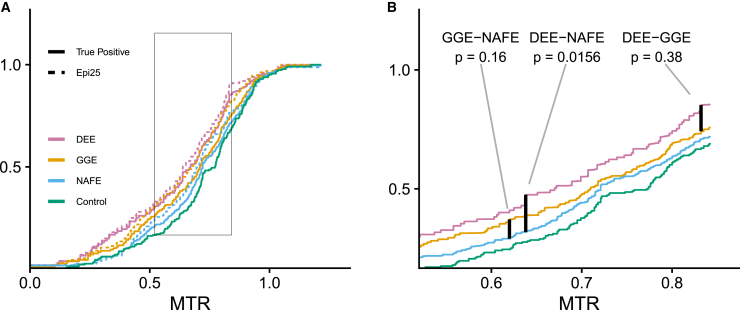
Sub-genic intolerance analysis reveals variants associated with DEE are located in more intolerant genic sub-regions Comparison of cumulative distribution functions weighted by background control variant rate. Genes limited to 24 from OMIM epileptic encephalopathy phenotype series also containing damaging (REVEL ≥ 0.5) missense variants in all three epilepsies (see gene set enrichment testing, Table S5). DEE, developmental and epileptic encephalopathy; GGE, genetic generalized epilepsy; NAFE, non-acquired focal epilepsy. (A) CDF drawn directly from Epi25 data (dashed line) and weighted by control CDF (solid lines) to estimate “true positive” distribution. (B) Enlarged box from (A) showing just “true positive” CDFs with control CDF. “True positive” median MTR DEE = 0.670, GGE = 0.710, and NAFE = 0.721. p values generated by 10,000 permutations of Kolmogorov–Smirnov test. Plots calculated from 614 missense variants (DEE = 100, GGE = 133, and NAFE = 153; control = 228).
Figure 4
Figure 4
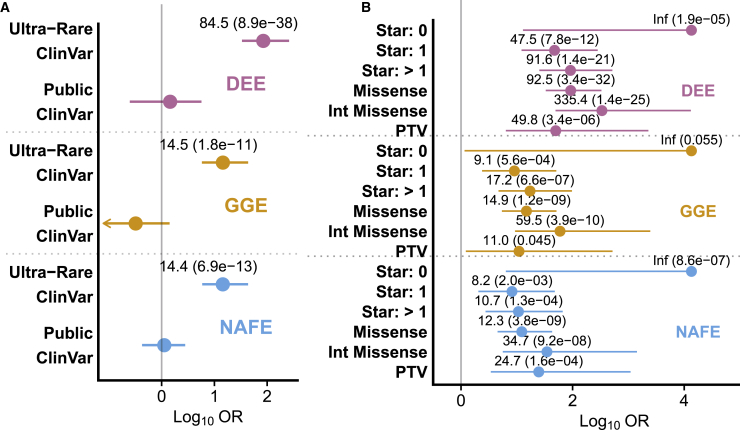
Burden of pathogenic/likely pathogenic (P/LP) variants in ClinVar found in Epi25 participants Ultra-rare and intolerant P/LP variants are enriched in Epi25 participants with epilepsy compared to control individuals. (A) Variants divided into ultra-rare (absent from non-neuro gnomAD populations) and public (present in non-neuro gnomAD populations) variants showing enrichment only among ultra-rare variants. (B) Ultra-rare variants sub-divided to show drivers of enrichment. “Star” indicates the variant review status in ClinVar, which summarizes the level of review supporting the clinical significance of the variant with increasing number of “gold stars” from 0 to 4 (see qualifying variant). Pooled odds ratio, 95% confidence intervals, and FDR-corrected p value were generated from the exact two-sided Cochran-Mantel-Haenszel (CMH) test. Odds ratio and FDR-adjusted p values displayed for comparisons with unadjusted p value < 0.05. x axis displays the log10 of the odds ratio and confidence intervals. PTV, protein-truncating variants; “Int,” “intolerant,” MTR ≤ 0.78 (when defined); DEE, developmental and epileptic encephalopathy; GGE, genetic generalized epilepsy; NAFE, non-acquired focal epilepsy.
Figure 5
Figure 5
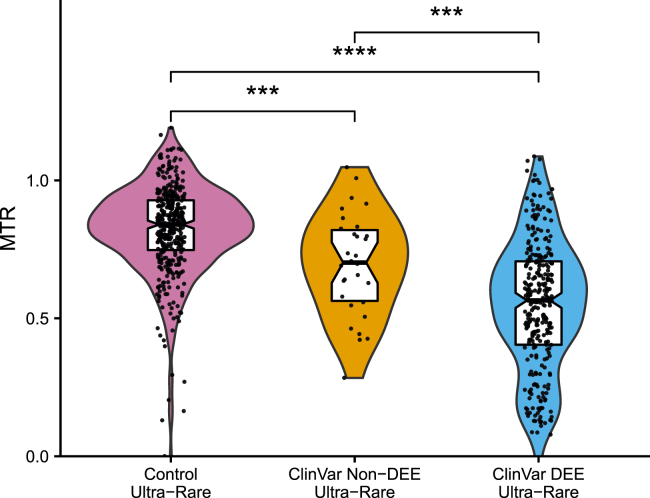
Comparison of median MTR scores of published ultra-rare P/LP ClinVar variants Violin plots with boxplots showing distribution of MTR scores of published missense ClinVar P/LP variants divided into those associated with DEE (n = 302) and non-DEE (n = 29) epilepsies. We considered only those genes harboring missense variants in both groups (14 genes, see gene set enrichment testing, Table S2). Ultra-rare control variants (n = 335) drawn from Epi25 analysis (see sub-genic intolerance comparison). Comparisons by Wilcoxon signed-rank test. p values unadjusted. The middle horizontal line represents the median value and the lower and upper hinges represent the 1st and 3rd quartiles. The notches in the boxplot approximate the 95% confidence interval (see data analysis and display). MTR median ± standard deviation: DEE 0.57 ± 0.24, non-DEE 0.70 ± 0.18, control 0.83 ± 0.16. ∗∗p ≤ 0.01, ∗∗∗p ≤ 0.001, ∗∗∗∗p ≤ 0.0001.
Figure 6
Figure 6
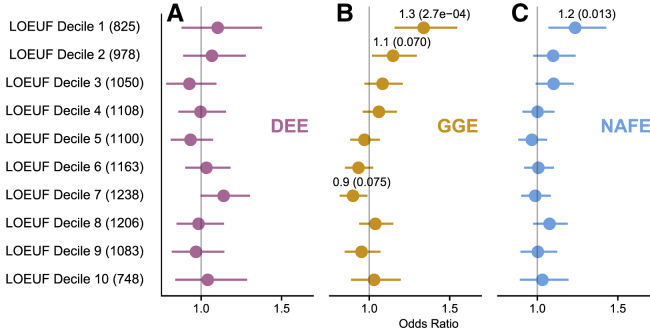
Burden of protein-truncating variants in intolerant non-OMIM genes The burden of protein-truncating variants (PTVs) in genes not associated with a disease in OMIM in epilepsy-affected individuals in comparison to control individuals was assessed. We divided non-OMIM genes into 10 gene sets by their intersection with loss-of-function intolerance deciles defined by LOEUF (see gene set enrichment testing, Table S5). The number of genes in each gene set with at least one PTV in the case-control set is specified in the parenthesis. Pooled odds ratio, 95% confidence intervals, and FDR-corrected p value were generated from the exact two-sided Cochran-Mantel-Haenszel (CMH) test for (A) developmental and epileptic encephalopathies (DEE), (B) genetic generalized epilepsy (GGE), and (C) non-acquired focal epilepsy (NAFE). Odds ratio and FDR-adjusted p values are displayed in parentheses for comparisons with unadjusted p value < 0.05. x axis displays the odds ratio and confidence intervals.

References

    1. Aaberg K.M., Gunnes N., Bakken I.J., Lund Søraas C., Berntsen A., Magnus P., Lossius M.I., Stoltenberg C., Chin R., Surén P. Incidence and Prevalence of Childhood Epilepsy: A Nationwide Cohort Study. Pediatrics. 2017;139:e20163908. - PubMed
    1. Fisher R.S., Acevedo C., Arzimanoglou A., Bogacz A., Cross J.H., Elger C.E., Engel J., Jr., Forsgren L., French J.A., Glynn M. ILAE official report: a practical clinical definition of epilepsy. Epilepsia. 2014;55:475–482. - PubMed
    1. Hesdorffer D.C., Logroscino G., Benn E.K., Katri N., Cascino G., Hauser W.A. Estimating risk for developing epilepsy: a population-based study in Rochester, Minnesota. Neurology. 2011;76:23–27. - PMC - PubMed
    1. EpiPM Consortium A roadmap for precision medicine in the epilepsies. Lancet Neurol. 2015;14:1219–1228. - PMC - PubMed
    1. Ellis C.A., Petrovski S., Berkovic S.F. Epilepsy genetics: clinical impacts and biological insights. Lancet Neurol. 2020;19:93–100. - PubMed

Publication types

Substances