


Associated factors with umbilical arterial pH after cesarean delivery under spinal anesthesia: a retrospective cohort study
- PMID: 33932390
- PMCID: PMC9373073
- DOI: 10.1016/j.bjane.2021.04.022
Associated factors with umbilical arterial pH after cesarean delivery under spinal anesthesia: a retrospective cohort study
Abstract
Background: Maximum decrease of blood pressure and number of minutes of hypotension were independently associated with umbilical arterial pH. However, the impact of hypotension considering the duration of it on umbilical arterial pH is unknown.
Methods: Pregnant women aged ≥ 20 years who delivered a baby at full-term via a cesarean delivery under a single-shot spinal anesthesia between January 2017 and March 2019 were included. The main outcome was to predict umbilical arterial pH, based on the value of the time integral of hypotension. Patient demographics, patient comorbidities, and intraoperative data, including the total dose of ephedrine and phenylephrine by fetal delivery and cumulative duration of maternal hypotension, were evaluated. Maternal hypotension was reflected as a decrease in systolic arterial pressure and mean arterial pressure to < 80% of baseline values. The systolic arterial pressure and mean arterial pressure were independently included in a multiple regression analysis along with all other explanatory factors to predict the umbilical arterial pH.
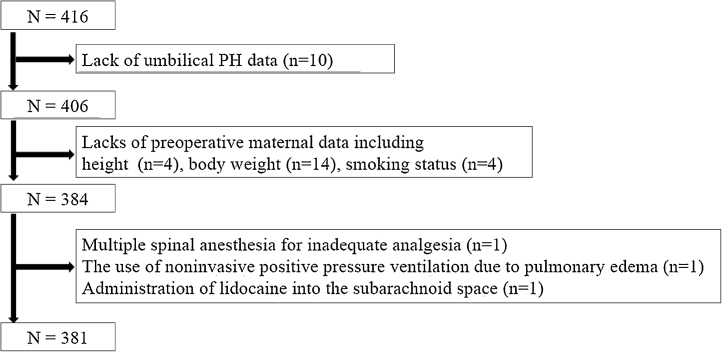
Results: Of the 416 eligible patients, 381 were enrolled. When including the systolic arterial pressure or mean arterial pressure in the model, emergency cases, the total dose of ephedrine, hypertensive disorders of pregnancy, and systolic arterial pressure or mean arterial pressure values were found to be significant predictive factors of umbilical arterial pH.
Conclusion: Our results suggest that an elevated time integral of maternal hypotension may have a negative impact on umbilical arterial pH. Therefore, to minimize the risk of fetal acidosis, maternal hypotension should be prevented with the consideration of vasopressors selection.
Keywords: Anesthesia, spinal; Arterial pressure, mean; Cesarean section; Ephedrine; Fetal blood; Hydrogen-ion concentration.
Copyright © 2021 Sociedade Brasileira de Anestesiologia. Published by Elsevier Editora Ltda. All rights reserved.
Figures

References
-
- Cyna A.M., Andrew M., Emmett R.S., et al. Techniques for preventing hypotension during spinal anaesthesia for caesarean section. Cochrane Database Syst Rev. 2006;4 - PubMed
-
- Ngan Kee W.D., Lee A. Multivariate analysis of factors associated with umbilical arterial pH and standard base excess after Caesarean section under spinal anaesthesia. Anaesthesia. 2003;58:125–130. - PubMed
-
- Corke B.C., Datta S., Ostheimer G.W., et al. Spinal anaesthesia for Caesarean section. The influence of hypotension on neonatal outcome. Anaesthesia. 1982;37 - PubMed
-
- Okudaira S., Suzuki S. Influence of spinal hypotension on fetal oxidative status during elective cesarean section in uncomplicated pregnancies. Arch Gynecol Obstet. 2005;271:292e5. - PubMed
-
- Kinsella S.M., Carvalho B., Dyer R.A., et al. International consensus statement on the management of hypotension with vasopressors during caesarean section under spinal anaesthesia. Anaesthesia. 2018;73:71–92. - PubMed
MeSH terms
Substances
LinkOut - more resources
Full Text Sources
Other Literature Sources
Medical
