. 2021 May 1;22(1):314.
doi: 10.1186/s12864-021-07622-1.

Genome-wide identification and analysis of class III peroxidases in Betula pendula

Affiliations

Genome-wide identification and analysis of class III peroxidases in Betula pendula

Kewei Cai et al. BMC Genomics. .

Abstract

Background: Class III peroxidases (POD) proteins are widely present in the plant kingdom that are involved in a broad range of physiological processes including stress responses and lignin polymerization throughout the plant life cycle. At present, POD genes have been studied in Arabidopsis, rice, poplar, maize and Chinese pear, but there are no reports on the identification and function of POD gene family in Betula pendula.

Results: We identified 90 nonredundant POD genes in Betula pendula. (designated BpPODs). According to phylogenetic relationships, these POD genes were classified into 12 groups. The BpPODs are distributed in different numbers on the 14 chromosomes, and some BpPODs were located sequentially in tandem on chromosomes. In addition, we analyzed the conserved domains of BpPOD proteins and found that they contain highly conserved motifs. We also investigated their expression patterns in different tissues, the results showed that some BpPODs might play an important role in xylem, leaf, root and flower. Furthermore, under low temperature conditions, some BpPODs showed different expression patterns at different times.

Conclusions: The research on the structure and function of the POD genes in Betula pendula plays a very important role in understanding the growth and development process and the molecular mechanism of stress resistance. These results lay the theoretical foundation for the genetic improvement of Betula pendula.

Keywords: Betula pendula; Chromosomal location; Class III peroxidases; Expression pattern; Phylogenetic analysis.


Conflict of interest statement

The authors declare that they have no competing interests.

Figures

Fig. 1
Fig. 1
Phylogenetic analysis of POD family genes from B. pendula. According to phylogenetic relationships, 90 BpPOD genes were classified into 12 subgroups (subgroups I to XII). The phylogenetic tree was constructed using MEGA 7.0 with the maximum likelihood (ML) method
Fig. 2
Fig. 2
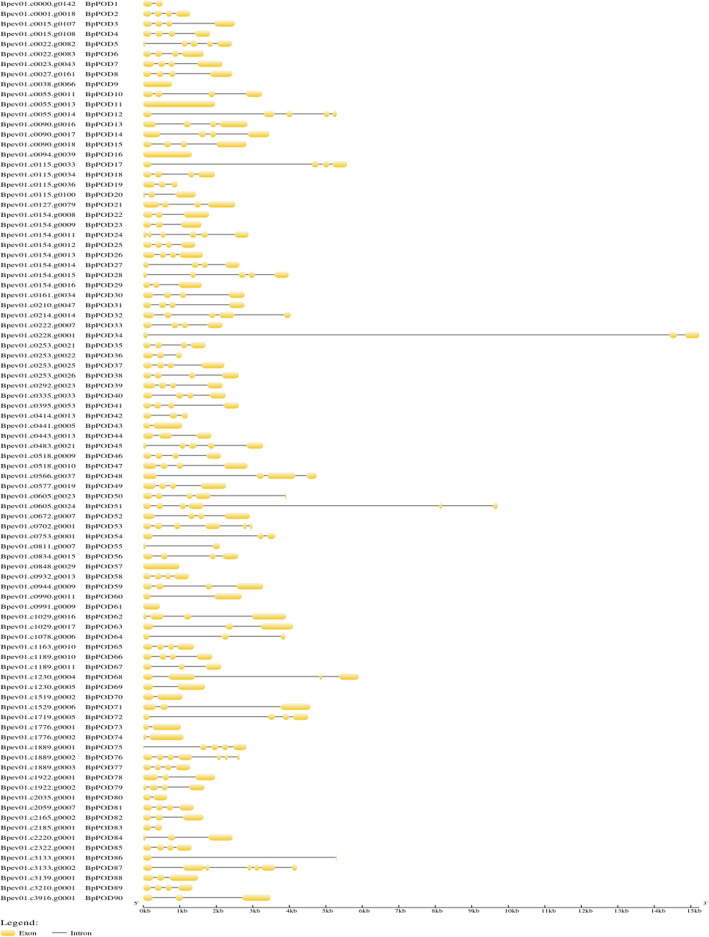
Gene structure analyses of BpPOD genes. The exons and introns are indicated by yellow cylinder bars and black lines, respectively. The scale at the bottom of the figure is in kilobases. Gene structure was visualized by Gene Structure Display Server (GSDS)
Fig. 3
Fig. 3
The conserved motifs of 90 BpPOD proteins. Conserved motifs are represented by different colored boxes while nonconserved sequences are shown by gray lines. The conserved motif figure of BpPOD proteins was visualized by TBtools software
Fig. 4
Fig. 4
Chromosomal locations of 90 POD genes on 14 B. pendula chromosomes. The number of chromosomes (chr01-chr14) is marked in yellow, and each POD gene is marked in red. The gene names on the right side of each chromosome correspond to the approximate locations of each POD gene. The chromosome location figure of BpPODs was constructed by TBtools software
Fig. 5
Fig. 5
BpPODs genomic distribution and collinear relationships. A total of 90 BpPODs were disproportionately mapped on the Betula pendula linkage groups using TBtools software. Red lines represent all homologous blocks in Betula pendula genome
Fig. 6
Fig. 6
Synteny map of POD family genes between B. pendula and three representative species. Gray lines indicate all syntenic blocks among birch linkage groups or between birch and the other species. In three species, collinear pairs of BpPODs are connected by green, blue and orange lines. Syntenic maps of birch associated with three representative species were visualized by MCScanX
Fig. 7
Fig. 7
Expression profiles of BpPOD genes across different tissues. Different tissues are exhibited below each column. The BpPOD genes were listed at the right of the expression array, and the colour box from blue (0) to orange (2.5) indicate an increased expression level is shown at the right of the figure. Color scale represent the normalized value of the expression. For the sake of unified comparison, the normalized value of the expression was log10 transformed
Fig. 8
Fig. 8
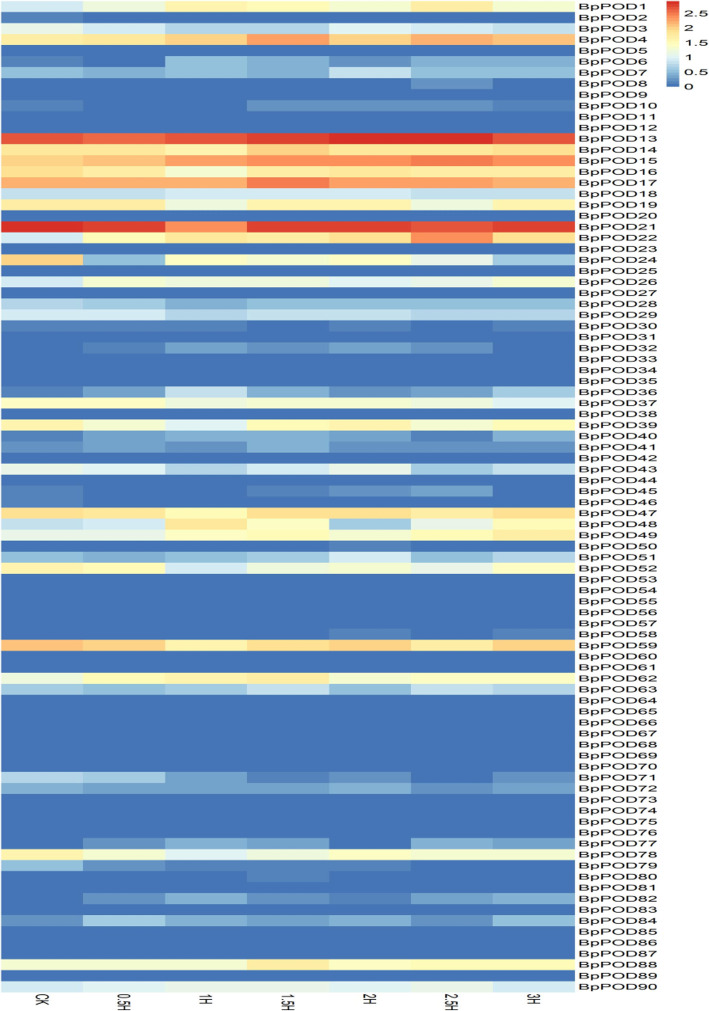
Responses of BpPOD genes expression to cold treatment. Different time are exhibited below each column. The BpPOD genes were listed at the right of the expression array, and the colour box from blue (0) to orange (2.5) indicate an increased expression level is shown at the right of the figure. Color scale represent the normalized value of the expression. For the sake of unified comparison, the normalized value of the expression was log10 transformed
Fig. 9
Fig. 9
qRT-PCR analysis of POD genes in B. pendula under cold stress. The X-axis represents the time course of stress treatment and the Y-axis represents the relative expression level. Seedlings were sampled at 0, 1.5 and 3 after cold treatment. Data represent means ± SD in three replicates

References

    1. Dunford HB, Stillman JS. On the function and mechanism of action of peroxidases. Coord Chem Rev. 1976;19(3):187–251. doi: 10.1016/S0010-8545(00)80316-1. - DOI
    1. Passardi F, Theiler G, Zamocky M, Cosio C, Rouhier N, Teixera F, Margis-Pinheiro M, Ioannidis V, Penel C, Falquet L, Dunand C. PeroxiBase: the peroxidase database. Phytochemistry. 2007;68(12):1605–1611. doi: 10.1016/j.phytochem.2007.04.005. - DOI - PubMed
    1. Mei W, Qin Y, Song W, Li J, Zhu Y. Cotton GhPOX1 encoding plant class III peroxidase may be responsible for the high level of reactive oxygen species production that is related to cotton fiber elongation. J Genet Genomics. 2009;36(3):141–150. doi: 10.1016/S1673-8527(08)60101-0. - DOI - PubMed
    1. Martínez-Rubio R, Acebes JL, Encina A, Krknen A. Class III peroxidases in cellulose deficient cultured maize cells during cell wall remodeling. Physiol Plant. 2018;164(1):45–55. doi: 10.1111/ppl.12710. - DOI - PubMed
    1. Zhang Z, Xin W, Wang S, Zhang X, Wang Q. Xylem sap in cotton contains proteins that contribute to environmental stress response and cell wall development. Funct Integr Genomics. 2014;15(1):17–26. doi: 10.1007/s10142-014-0395-y. - DOI - PubMed

LinkOut - more resources