


Ancestry specific associations of a genetic risk score, dietary patterns and metabolic syndrome: a longitudinal ARIC study
- PMID: 33933074
- PMCID: PMC8088631
- DOI: 10.1186/s12920-021-00961-8
Ancestry specific associations of a genetic risk score, dietary patterns and metabolic syndrome: a longitudinal ARIC study
Abstract
Background: Associations have been observed among genetic variants, dietary patterns, and metabolic syndrome (MetS). A gap in knowledge is whether a genetic risk score (GRS) and dietary patterns interact to increase MetS risk among African Americans. We investigated whether MetS risk was influenced by interaction between a GRS and dietary patterns among Whites and African Americans. A secondary aim examined if molecular genetic clusterings differed by racial ancestry.
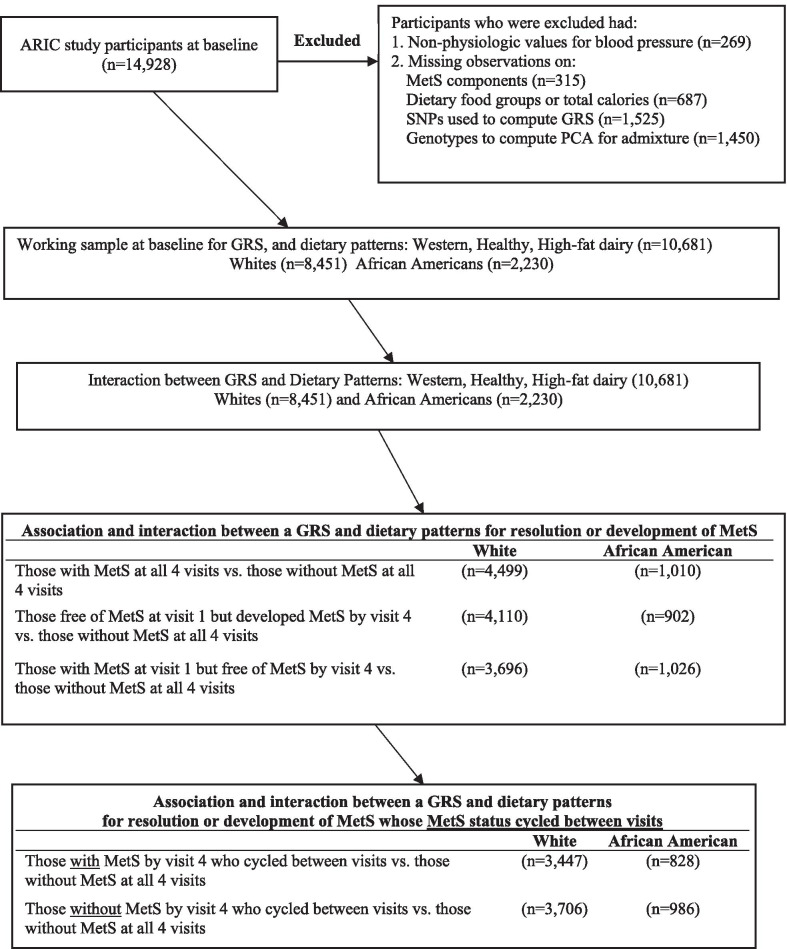
Methods: We used longitudinal data over 4-visits (1987-1998) that included 10,681 participants aged 45-64y at baseline from the Atherosclerosis Risk in Communities study (8451 Whites and 2230 African Americans). We constructed a simple-count GRS as the linear weighted sum of high-risk alleles (0, 1, 2) from cardiovascular disease polymorphisms from the genome-wide association studies catalog associated with MetS risk. Three dietary patterns were determined by factor analysis of food frequency questionnaire data: Western, healthy, and high-fat dairy. MetS was defined according to the 2016 National Cholesterol Education Program Adult Treatment Panel III criteria but used 2017 American Heart Association/American College of Cardiology criteria for elevated blood pressure. Analyses included generalized linear model risk ratios (RR), 95% confidence intervals (CI), and Bonferroni correction for multiple testing.
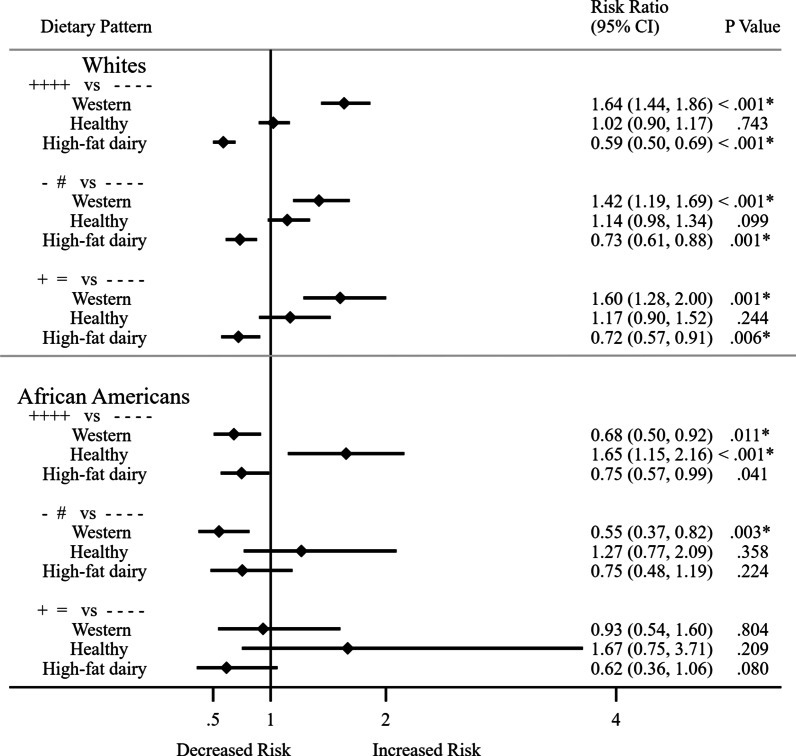
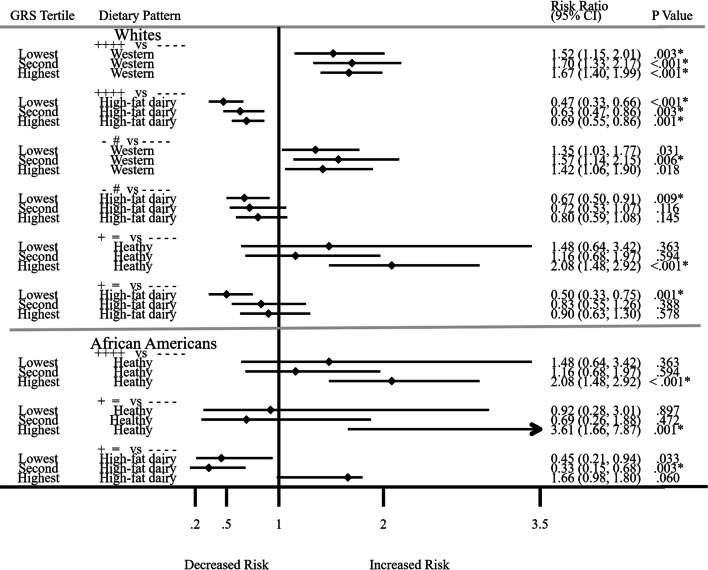
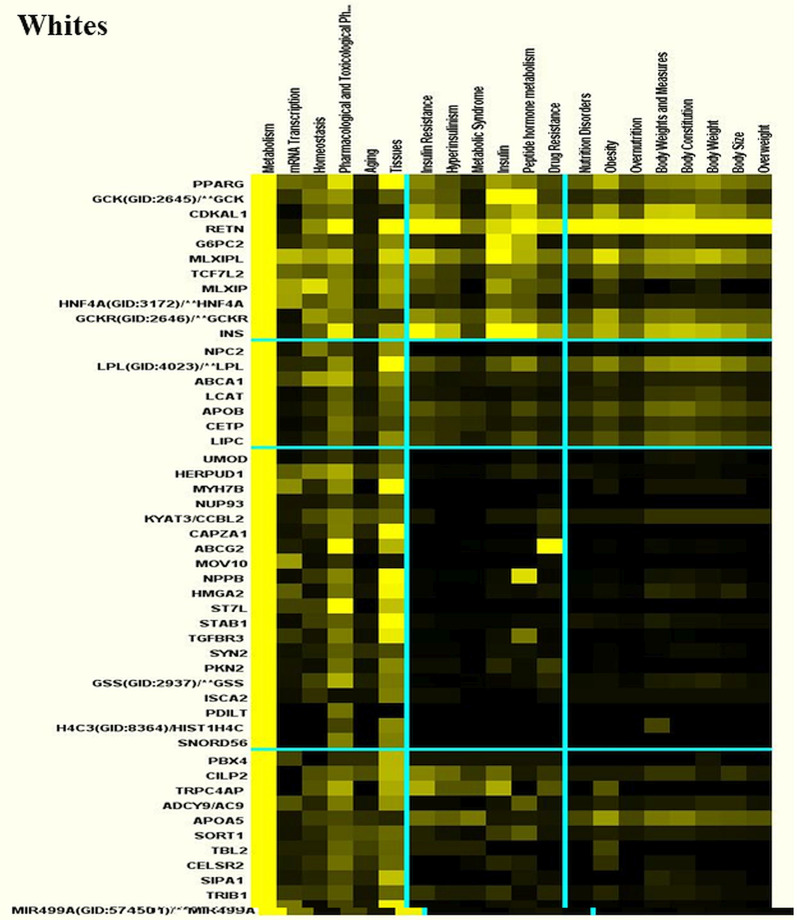
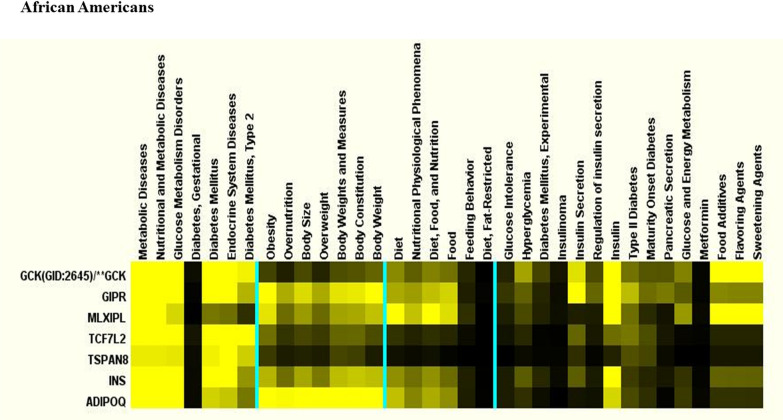
Results: The Western dietary pattern was associated with higher risk for MetS across increasing GRS tertiles among Whites (p < 0.017). The high-fat dairy pattern was protective against MetS, but its impact was most effective in the lowest GRS tertile in Whites (RR = 0.62; CI: 0.52-0.74) and African Americans (RR = 0.67; CI: 0.49-0.91). Among each racial group within GRS tertiles, the Western dietary pattern was associated with development and cycling of MetS status between visits, and the high-fat dairy pattern with being free from MetS (p < 0.017). The healthy dietary pattern was associated with higher risk of MetS among African Americans which may be explained by higher sucrose intake (p < 0.0001). Fewer genes, but more metabolic pathways for obesity, body fat distribution, and lipid and carbohydrate metabolism were identified in African Americans than Whites. Some polymorphisms were linked to the Western and high-fat dairy patterns.
Conclusion: The influence of dietary patterns on MetS risk appears to differ by genetic predisposition and racial ancestry.
Keywords: Ancestry; Dietary patterns; Genetic risk score; Interaction; Metabolic syndrome; Polymorphism; Race.
Conflict of interest statement
The authors declare that they have no competing interests.
Figures
References
-
- Mottillo S, Filion KB, Genest J, Joseph L, Pilote L, Poirier P, et al. The metabolic syndrome and cardiovascular risk a systematic review and meta-analysis. J Am Coll Cardiol. 2010;56(14):1113–1132. - PubMed
-
- Sattar N, McConnachie A, Shaper AG, Blauw GJ, Buckley BM, de Craen AJ, et al. Can metabolic syndrome usefully predict cardiovascular disease and diabetes? Outcome data from two prospective studies. Lancet. 2008;371(9628):1927–1935. - PubMed
-
- Malik S, Wong ND, Franklin SS, Kamath TV, L'Italien GJ, Pio JR, et al. Impact of the metabolic syndrome on mortality from coronary heart disease, cardiovascular disease, and all causes in United States adults. Circulation. 2004;110(10):1245–1250. - PubMed
-
- Grundy SM. Metabolic syndrome update. Trends Cardiovasc Med. 2016;26(4):364–373. - PubMed
-
- Park HS, Oh SW, Cho SI, Choi WH, Kim YS. The metabolic syndrome and associated lifestyle factors among South Korean adults. Int J Epidemiol. 2004;33(2):328–336. - PubMed
MeSH terms
Grants and funding
LinkOut - more resources
Full Text Sources
Other Literature Sources
Medical
Miscellaneous
