. 2021 May 1;18(1):72.
doi: 10.1186/s12984-021-00855-x.

Myoelectric prosthesis users and non-disabled individuals wearing a simulated prosthesis exhibit similar compensatory movement strategies

Affiliations

Myoelectric prosthesis users and non-disabled individuals wearing a simulated prosthesis exhibit similar compensatory movement strategies

Heather E Williams et al. J Neuroeng Rehabil. .

Abstract

Background: Research studies on upper limb prosthesis function often rely on the use of simulated myoelectric prostheses (attached to and operated by individuals with intact limbs), primarily to increase participant sample size. However, it is not known if these devices elicit the same movement strategies as myoelectric prostheses (operated by individuals with amputation). The objective of this study was to address the question of whether non-disabled individuals using simulated prostheses employ the same compensatory movements (measured by hand and upper body kinematics) as individuals who use actual myoelectric prostheses.

Methods: The upper limb movements of two participant groups were investigated: (1) twelve non-disabled individuals wearing a simulated prosthesis, and (2) three individuals with transradial amputation using their custom-fitted myoelectric devices. Motion capture was used for data collection while participants performed a standardized functional task. Performance metrics, hand movements, and upper body angular kinematics were calculated. For each participant group, these measures were compared to those from a normative baseline dataset. Each deviation from normative movement behaviour, by either participant group, indicated that compensatory movements were used during task performance.

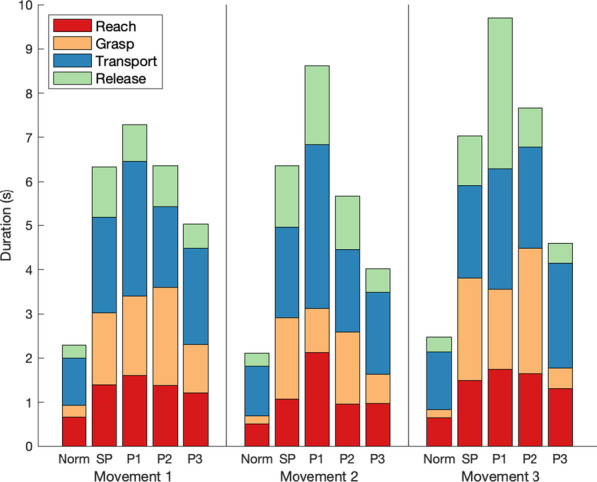
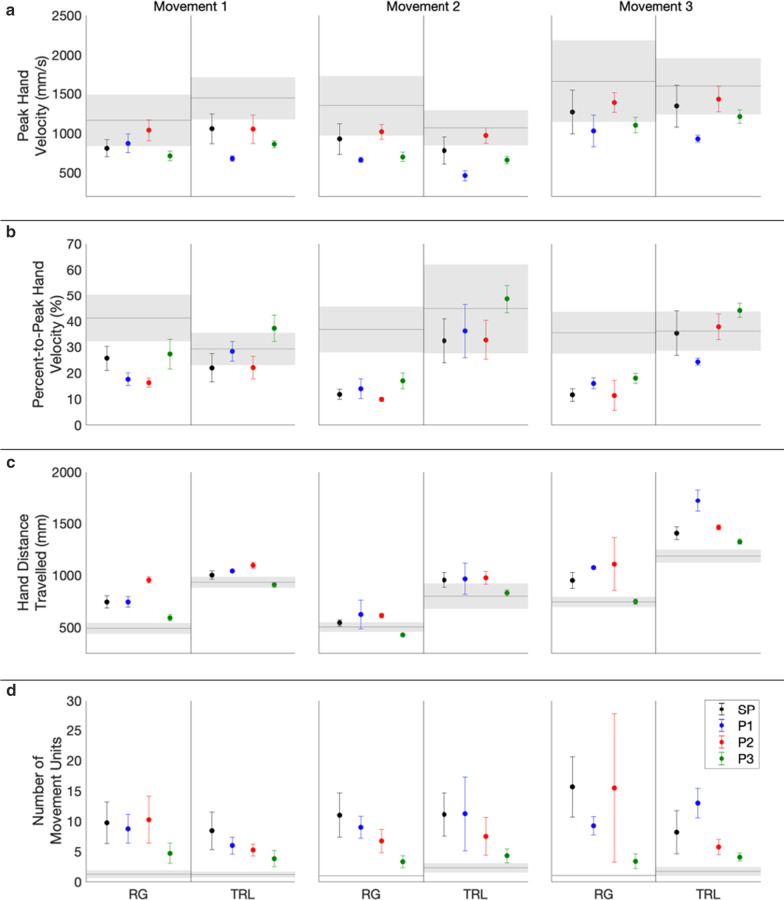
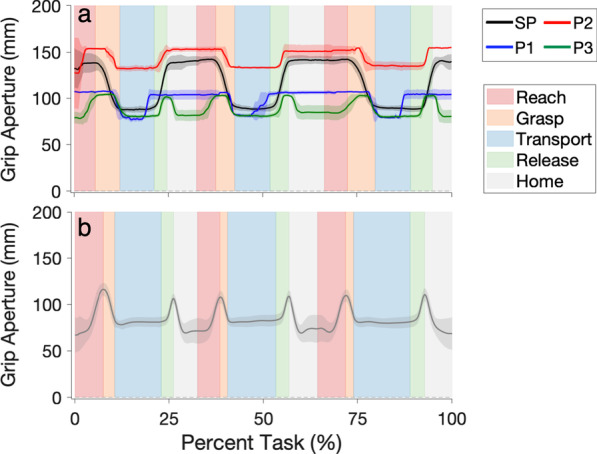
Results: Results show that participants using either a simulated or actual myoelectric prosthesis exhibited similar deviations from normative behaviour in phase durations, hand velocities, hand trajectories, number of movement units, grip aperture plateaus, and trunk and shoulder ranges of motion.

Conclusions: This study suggests that the use of a simulated prosthetic device in upper limb research offers a reasonable approximation of compensatory movements employed by a low- to moderately-skilled transradial myoelectric prosthesis user.

Keywords: Bypass prosthesis; Compensatory movements; Motion capture; Myoelectric prosthesis; Simulated prosthesis; Transradial amputation; Upper body kinematics.


Conflict of interest statement

The authors declare that they have no competing interests.

Figures

Fig. 1
Fig. 1
Pasta Box Task. Sequence of the Pasta Box Task movements (Movements 1, 2, and 3) with the ‘home’ position labelled. Reach-Grasp and Transport-Release movement segments are colour-coded and illustrated with arrows to show direction. Although this figure shows a normative participant wearing an eye tracking device, eye gaze behaviour data were not analyzed in this study. Reproduced from Valevicius et al. [46] with permission
Fig. 2
Fig. 2
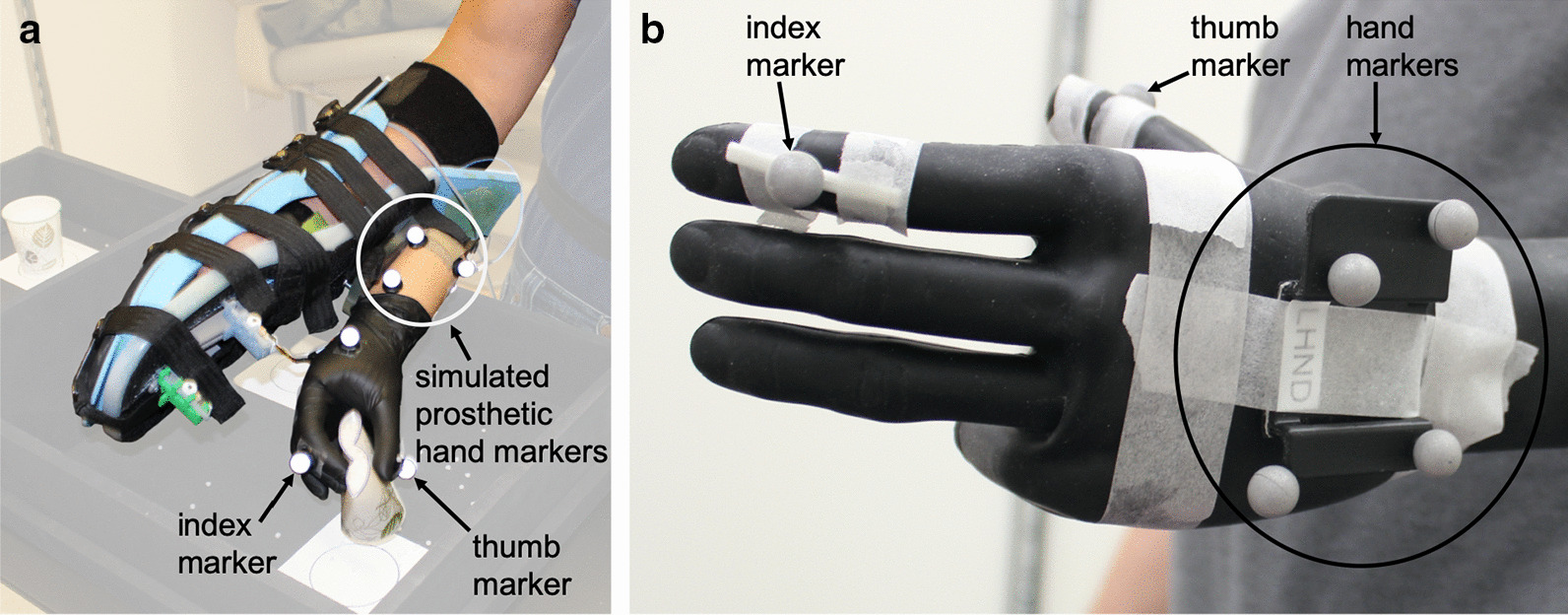
Motion capture marker placement. Placement on the simulated prosthesis (a), and a myoelectric prosthesis (b). The unlabelled marker on the simulated prosthesis in panel (a) was not used for analysis in this study
Fig. 3
Fig. 3
Phase durations. Average Pasta Box Task durations of normative participants (‘Norm’), SP participants, and the three MP participants (P1, P2, P3). These durations are presented for each movement of the task and are divided into Reach, Grasp, Transport, and Release phases, color coded as per legend
Fig. 4
Fig. 4
Hand movement measures. Peak hand velocity (a), percent-to-peak hand velocity (b), hand distance travelled (c), and number of movement units (d) of the SP participants (black) and the MP participants (P1: blue, P2: red, P3: green), for each task movement and movement segment (RG Reach-Grasp, TRL Transport-Release). Dots indicate the average value for each movement segment, and each error bar represents ± 1 standard deviation (between-participant standard deviation is presented for SP participants). The ranges of motion of a normative baseline [47] are presented with grey lines representing the average and with shading representing ± 2 between-participant standard deviations
Fig. 5
Fig. 5
Grip aperture profiles. Profiles of the SP participants (black) and of the MP participants (P1: blue, P2: red, P3: green) (a) and of the normative baseline [46] (grey, b) over the course of the Pasta Box Task (all 3 movements). The solid lines represent averages and the shading represents ± 1 standard deviation (between-participant standard deviation is presented for SP participants). The average (all SP and MP participants) relative durations of each phase (Reach, Grasp, Transport, Release, Home) can be inferred from the width of the corresponding colored bars. Grip aperture profiles were time normalized by phase and resampled using these average relative phase durations. Normative grip aperture plots are shown in a separate panel due to the differences between normative relative phase durations and those of the SP and MP participants
Fig. 6
Fig. 6
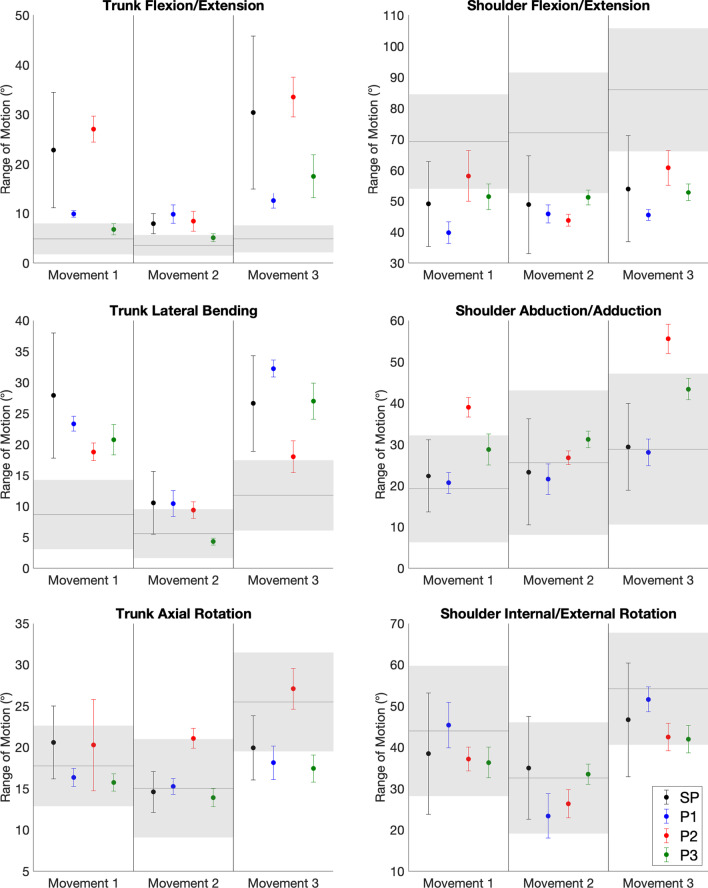
Angular kinematic ranges of motion. Ranges of motion of the SP participants (black) and the MP participants (P1: blue, P2: red, P3: green), for each degree of freedom and each task movement. Dots indicate the average range of motion for each movement, and each error bar represents ± 1 standard deviation (between-participant standard deviation is presented for SP participants). The ranges of motion of a normative baseline [47] are presented with grey lines representing the average and with shading representing ± 2 between-participant standard deviation

References

    1. Cordella F, Ciancio AL, Sacchetti R, Davalli A, Cutti AG, Guglielmelli E, et al. Literature review on needs of upper limb prosthesis users. Front Neurosci. 2016;10:209. - PMC - PubMed
    1. Hebert JS, Boser QA, Pilarski PM, Valevicius AM, Vette AH, Tanikawa H, et al. Quantitative eye gaze and movement differences in visuomotor adaptations to varying task demands among upper-extremity prosthesis users. JAMA Netw Open. 2019;2(9):e1911197. - PMC - PubMed
    1. Metzger AJ, Dromerick AW, Holley RJ, Lum PS. Characterization of compensatory trunk movements during prosthetic upper limb reaching tasks. Arch Phys Med Rehabil. 2012;93(11):2029–2034. - PubMed
    1. Hussaini A, Zinck A, Kyberd P. Categorization of compensatory motions in transradial myoelectric prosthesis users. Prosthet Orthot Int. 2017;41(3):286–293. - PubMed
    1. Biddiss E, Chau T. Upper-limb prosthetics: critical factors in device abandonment. Am J Phys Med Rehabil. 2007;86(12):977–987. - PubMed

Publication types