


Disease Burden Attributable to the First Wave of COVID-19 in China and the Effect of Timing on the Cost-Effectiveness of Movement Restriction Policies
- PMID: 33933229
- PMCID: PMC7897405
- DOI: 10.1016/j.jval.2020.12.009
Disease Burden Attributable to the First Wave of COVID-19 in China and the Effect of Timing on the Cost-Effectiveness of Movement Restriction Policies
Abstract
Objectives: Movement restriction policies (MRPs) are effective in preventing/delaying COVID-19 transmission but are associated with high societal cost. This study aims to estimate the health burden of the first wave of COVID-19 in China and the cost-effectiveness of early versus late implementation of MRPs to inform preparation for future waves.
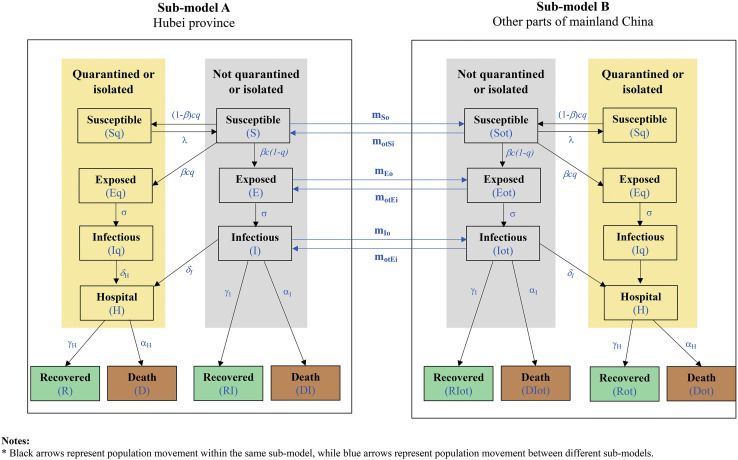
Methods: The SEIR (susceptible, exposed, infectious, and recovered) modeling framework was adapted to simulate the health and cost outcomes of initiating MRPs at different times: rapid implementation (January 23, the real-world scenario), delayed by 1 week, delayed by 2 weeks, and delayed by 4 weeks. The end point was set as the day when newly confirmed cases reached zero. Two costing perspectives were adopted: healthcare and societal. Input data were obtained from official statistics and published literature. The primary outcomes were disability-adjusted life-years, cost, and net monetary benefit. Costs were reported in both Chinese renminbi (RMB) and US dollars (USD) at 2019 values.
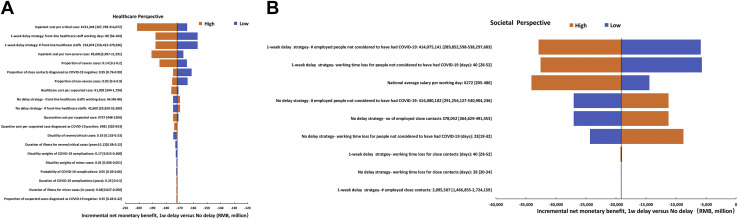
Results: The first wave of COVID-19 in China resulted in 38 348 disability adjusted life-years lost (95% CI 19 417-64 130) and 2639 billion RMB losses (95% CI 1347-4688). The rapid implementation strategy dominated all other delayed strategies. This conclusion was robust to all scenarios tested. At a willingness-to-pay threshold of 70 892 RMB (the national annual GDP per capita) per disability-adjusted life-year saved, the probability for the rapid implementation to be the optimal strategy was 96%.
Conclusions: Early implementation of MRPs in response to COVID-19 reduced both the health burden and societal cost and thus should be used for future waves of COVID-19.
Keywords: COVID-19; DALY; cost-effectiveness analysis; disease burden; movement restriction policies; timing.
Copyright © 2021 ISPOR–The Professional Society for Health Economics and Outcomes Research. Published by Elsevier Inc. All rights reserved.
Figures
References
-
- Worldometers. World Population https://www.worldometers.info/
-
- Hou C., Chen J., Zhou Y. The effectiveness of quarantine of Wuhan city against the corona virus disease 2019 (COVID-19): a well-mixed SEIR model analysis. J Med Virol. 2020 - PubMed
Publication types
MeSH terms
LinkOut - more resources
Full Text Sources
Other Literature Sources
Medical
