


Cannabis use disorder, anger, and violence in Iraq/Afghanistan-era veterans
- PMID: 33933928
- PMCID: PMC8954688
- DOI: 10.1016/j.jpsychires.2021.04.018
Cannabis use disorder, anger, and violence in Iraq/Afghanistan-era veterans
Abstract
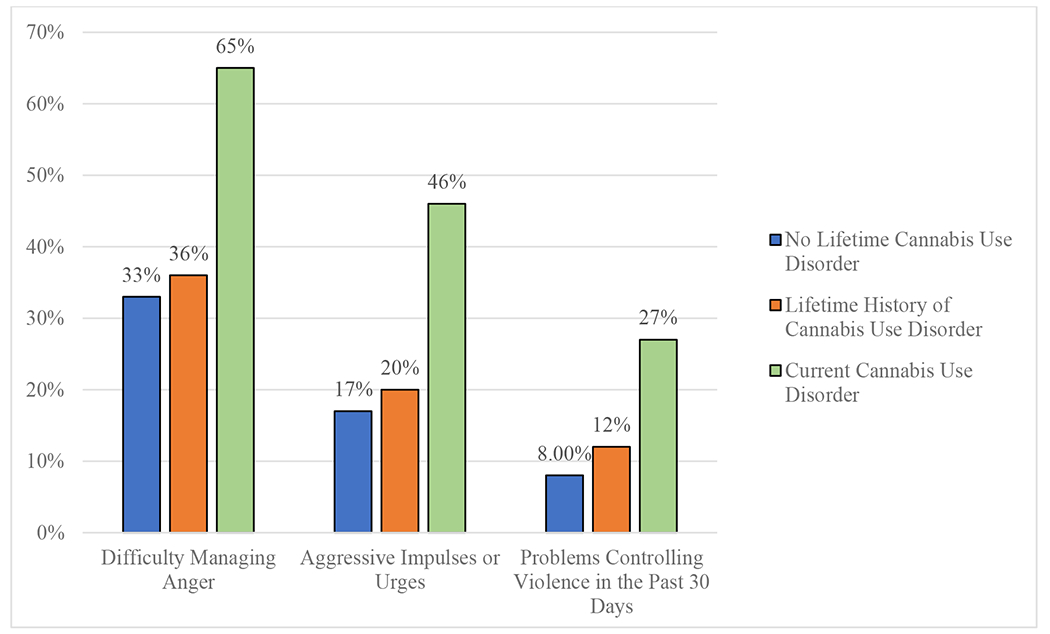
An association has been found between cannabis use disorder (CUD) and violence in several clinical populations, including veterans with posttraumatic stress disorder (PTSD), and there is evidence that CUD has been increasing among veterans since September 11, 2001. There is also evidence that some veterans may be attempting to self-medicate psychological problems including PTSD and aggression with cannabis, despite the lack of safety and efficacy data supporting this use. To date, however, the association between CUD and aggression has yet to be examined in a large, non-clinic sample of veterans. The present study examined the association between cannabis use disorder, anger, aggressive urges, and difficulty controlling violence in a large sample of Iraq/Afghanistan-era veterans (N = 3028). Results of multivariate logistic regressions indicated that current CUD was significantly positively associated with difficulty managing anger (OR = 2.93, p < .05), aggressive impulses/urges (OR = 2.74, p < .05), and problems controlling violence in past 30 days (OR = 2.71, p < .05) even accounting for demographic variables, comorbid symptoms of depression and PTSD, and co-morbid alcohol and substance use disorders. Lifetime CUD was also uniquely associated with problems controlling violence in the past 30 days (OR = 1.64, p < .05), but was not significantly associated with difficulty managing anger or aggressive impulses/urges. Findings indicated that the association between CUD and aggression needs to be considered in treatment planning for both CUD and problems managing anger and aggressive urges, and point to a critical need to disentangle the mechanism of the association between CUD and violence in veterans.
Keywords: Aggression; Anger; Cannabis use disorder; Veterans; Violence.
Published by Elsevier Ltd.
Figures
References
-
- Beck AT, & Steer RA, & Brown GK (1996). Manual for the Beck Depression Inventory—II. San Antonio, TX: Psychological Corporation.
-
- Brancu M, Wagner HR, Morey RA, Beckham JC, Calhoun PS, Tupler LA, & McDonald SD (2017). The Post-Deployment Mental Health (PDMH) study and repository: A multi-site study of US Afghanistan and Iraq era veterans. International Journal of Methods in Psychiatric Research, 26, e1570. 10.1002/mpr.1570 - DOI - PMC - PubMed
Publication types
MeSH terms
Grants and funding
LinkOut - more resources
Full Text Sources
Other Literature Sources
Medical
Miscellaneous
