


Identifying opportunities for strengthening advice to enhance vegetable liking in the early years of life: qualitative consensus and triangulation methods
- PMID: 33934739
- PMCID: PMC9991732
- DOI: 10.1017/S1368980021001907
Identifying opportunities for strengthening advice to enhance vegetable liking in the early years of life: qualitative consensus and triangulation methods
Abstract
Objective: To prioritise and refine a set of evidence-informed statements into advice messages to promote vegetable liking in early childhood, and to determine applicability for dissemination of advice to relevant audiences.
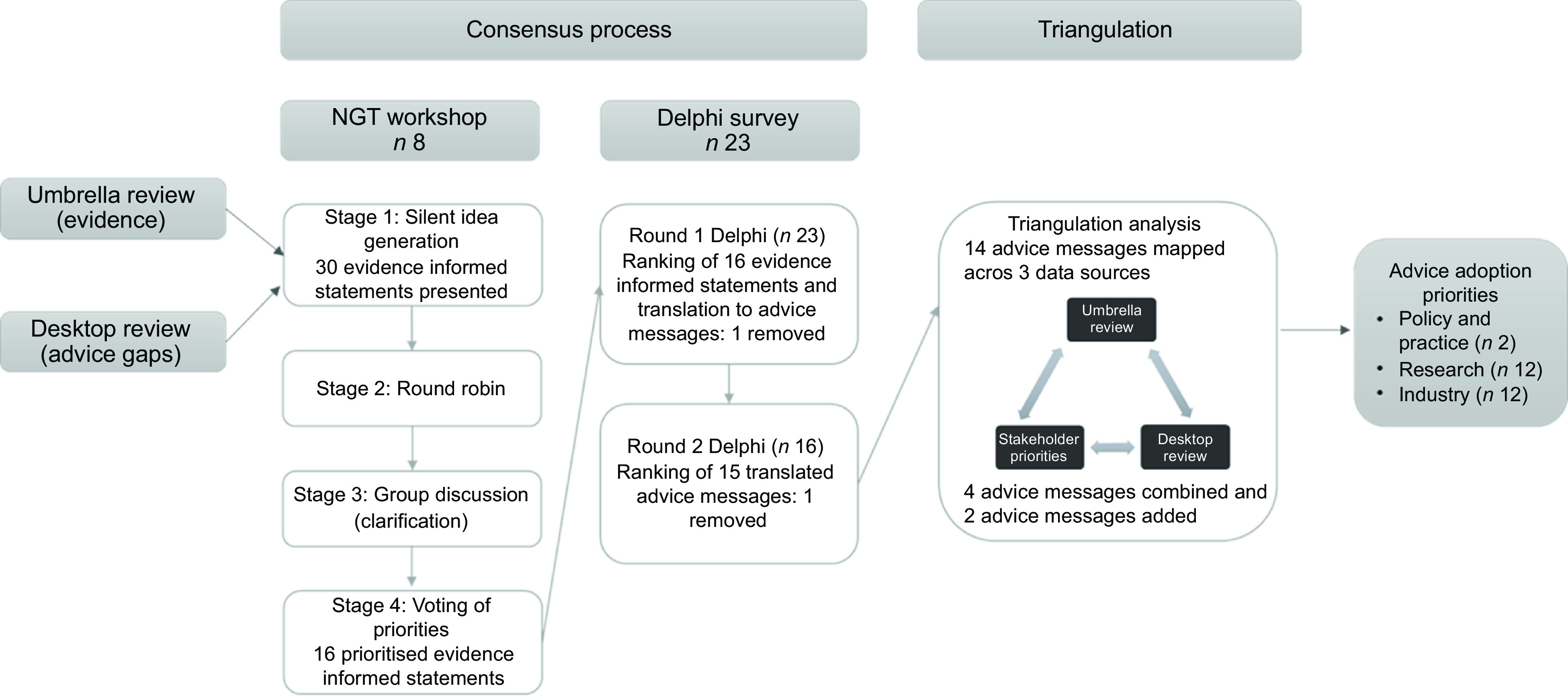
Design: A nominal group technique (NGT) workshop and a Delphi survey were conducted to prioritise and achieve consensus (≥70 % agreement) on thirty evidence-informed maternal (perinatal and lactation stage), infant (complementary feeding stage) and early years (family diet stage) vegetable-related advice messages. Messages were validated via triangulation analysis against the strength of evidence from an Umbrella review of strategies to increase children's vegetable liking, and gaps in advice from a Desktop review of vegetable feeding advice.
Setting: Australia.
Participants: A purposeful sample of key stakeholders (NGT workshop, n 8 experts; Delphi survey, n 23 end users).
Results: Participant consensus identified the most highly ranked priority messages associated with the strategies of: 'in-utero exposure' (perinatal and lactation, n 56 points) and 'vegetable variety' (complementary feeding, n 97 points; family diet, n 139 points). Triangulation revealed two strategies ('repeated exposure' and 'variety') and their associated advice messages suitable for policy and practice, twelve for research and four for food industry.
Conclusions: Supported by national and state feeding guideline documents and resources, the advice messages relating to 'repeated exposure' and 'variety' to increase vegetable liking can be communicated to families and caregivers by healthcare practitioners. The food industry provides a vehicle for advice promotion and product development. Further research, where stronger evidence is needed, could further inform strategies for policy and practice, and food industry application.
Keywords: Children; Delphi; Guidelines; Nominal Group Technique; Stakeholders.
Figures
References
-
- Australian Bureau of Statistics (ABS) (2018) National Health Survey: First Results, 2017–18. https://www.abs.gov.au/ausstats/abs@.nsf/Lookup/by%20Subject/4364.0.55.0... (accessed September 2019).
-
- World Health Organization (2019) Increasing fruit and vegetable consumption to reduce the risk of noncommunicable diseases. https://www.who.int/elena/bbc/fruit_vegetables_ncds/en/ (accessed September 2019).
-
- Spence AC, Campbell KJ, Lioret S et al. (2018) Early childhood vegetable, fruit, and discretionary food intakes do not meet dietary guidelines, but do show socioeconomic differences and tracking over time. J Academy Nutr Diet 118, 1634–1643. - PubMed
-
- Birch LL (1999) Development of food preferences. Annu Rev Nutr 19, 41–62. - PubMed
-
- Birch LL (1998) Development of food acceptance patterns in the first years of life. Proc Nutr Soc 57, 617–624. - PubMed
LinkOut - more resources
Full Text Sources
Other Literature Sources
