


Effects of Non-directional Mechanical Trauma on Gastrointestinal Tract Injury in Rats
- PMID: 33935802
- PMCID: PMC8081863
- DOI: 10.3389/fphys.2021.649554
Effects of Non-directional Mechanical Trauma on Gastrointestinal Tract Injury in Rats
Abstract
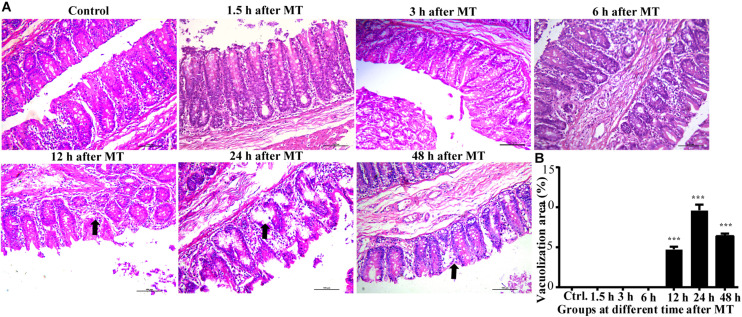
Mechanical trauma can (MT) cause secondary injury, such as cardiomyocyte apoptosis and cardiac dysfunction has been reported. However, the effects of mechanical trauma on gastrointestinal tract is unclear. This study aims to observe the main location and time of gastrointestinal tract injury caused by non-directional trauma and explain the reason of the increase of LPS in blood caused by mechanical injury. Morphological changes in the stomach, ileum and cecum at different time points after MT were observed in this experiment. The results reveal that the injury to the cecal mucosa in the rats was more obvious than that in the ileum and the stomach. The cecal epithelial cell junction was significantly widened at 20 min after MT, and the plasma LPS and D-lactic acid concentrations increased significantly at the same time point. In addition, some bacterial structures in the widened intercellular space and near the capillary wall of the cecal mucosa were detected at 12 h after MT. This finding suggests that the main reason for the increase in LPS in plasma after MT is cecal mucosal injury. This study is important for the early intervention of the gastrointestinal tract to prevent secondary injury after MT.
Keywords: D-lactate; LPS; gastrointestinal tract; mechanical trauma; mucosal injury.
Copyright © 2021 Liu, Wen, Gao, Piao, Zhao, Yu, Zhu and Li.
Conflict of interest statement
The authors declare that the research was conducted in the absence of any commercial or financial relationships that could be construed as a potential conflict of interest.
Figures




References
-
- Bicakci N., Karaboga I., Dokmeci A. H., Guzel S., Fidanol Erboga Z. (2019). Cardioprotective effect of caffeic acid phenethyl ester on cardiac contusion following blunt chest trauma in rats. Biotech. Histochem. 94 442–448. - PubMed
LinkOut - more resources
Full Text Sources
Other Literature Sources
