


CSF and Serum Biomarkers of Cerebral Damage in Autoimmune Epilepsy
- PMID: 33935944
- PMCID: PMC8085401
- DOI: 10.3389/fneur.2021.647428
CSF and Serum Biomarkers of Cerebral Damage in Autoimmune Epilepsy
Abstract
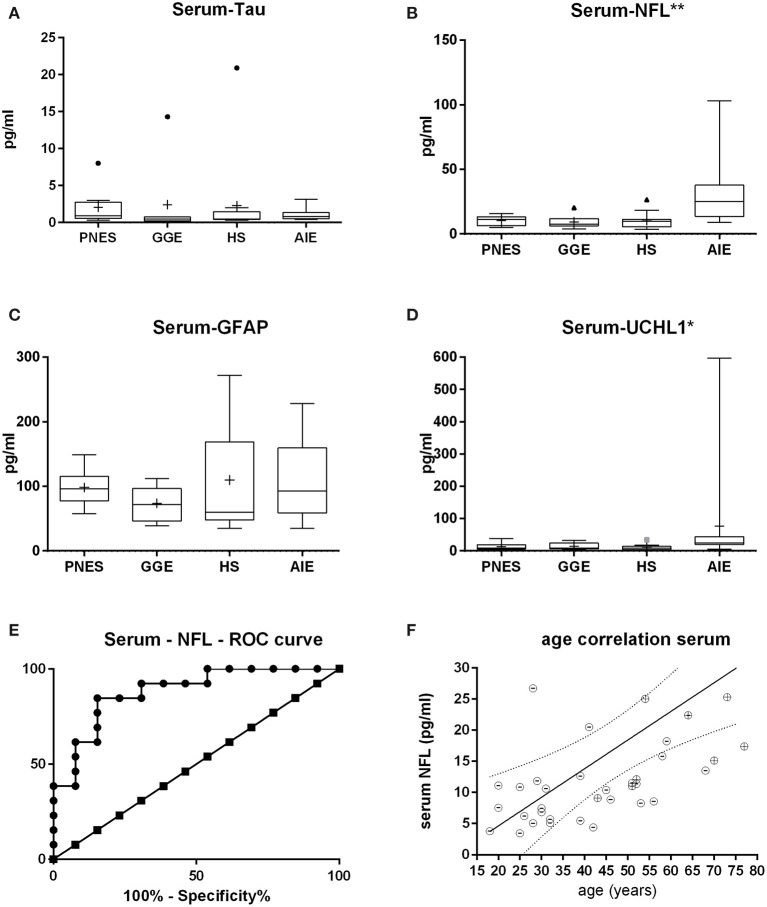
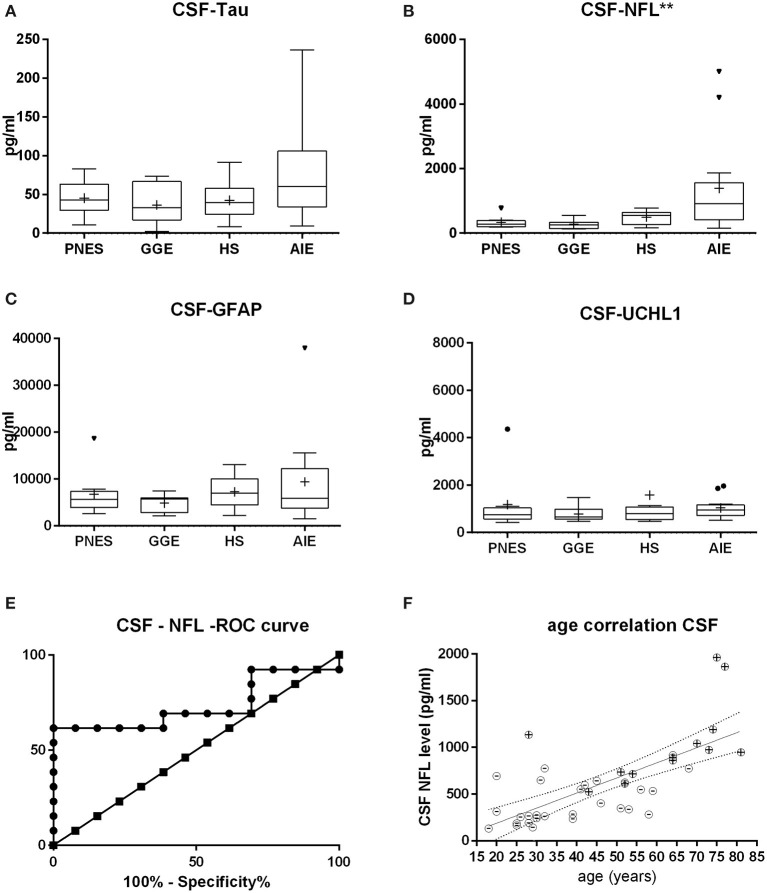
Introduction: Our goal was to investigate whether biomarkers of cerebral damage are found in autoimmune-mediated epilepsy (AIE) and whether these can differentiate AIE from other seizure disorders. Methods: We retrospectively searched our cerebrospinal fluid (CSF) database for patients with definite AIE, hippocampal sclerosis due to other causes (HS), genetic generalized epilepsy (GGE), and psychogenic, non-epileptic seizures (PNES). We measured serum and CSF tau, neurofilament 1 (NFL), glial fibrillary acid protein (GFAP), and ubiquitin-carboxy-terminal hydrolase L1 with a single-molecule array. Results: We identified suitable samples from patients with AIE (n = 13) with different antibodies and compared them to HS (n = 13), GGE (n = 7), and PNES (n = 8). The NFL levels were significantly elevated in the serum (p = 0.0009) and CSF (p < 0.0019) of AIE patients. The AIE group was significantly older, while the disease duration was significantly shorter than in the control groups. NFL correlated significantly with age in all groups, and the NFL levels of AIE patients were hardly higher than those of healthy elderly people published elsewhere. Conclusions: Our data indicate that the elevated NFL levels in AIE patients are most likely due to the higher age in this group and not due to the underlying inflammation. Unless larger prospective studies with intra-individual, longitudinal analyses and treatment responses would contradict our findings, NFL in serum might yet become a biomarker for disease activity and differential diagnosis.
Keywords: CSF; GFAP; NFL; UCHL-1; epilepsy; neurofilament; serum; tau.
Copyright © 2021 Nass, Akgün, Dague, Elger, Reichmann, Ziemssen and Surges.
Conflict of interest statement
RN has received fees as speaker from Eisai. KA received personal compensation for oral presentation and consulting service from Biogen Idec, Merck, Sanofi, and Roche. CE has served as a paid consultant for Desitin, Pfizer, and UCB Pharma. He was an employee of the Life and Brain Institute Bonn. HR was acting on advisory boards, gave lectures, and received research grants from Abbott, Abbvie, Bayer Health Care, Bial, Boehringer/Ingelheim, Brittania, Cephalon, Desitin, GSK, Lundbeck, Medtronic, Merck-Serono, Novartis, Orion, Pfizer, TEVA, UCB Pharma, Valeant, and Zambon. TZ received personal compensation from Almirall Biogen, Bayer, Celgene, Novartis, Roche, Sanofi, and Teva for consulting services and received additional financial support for research activities from BAT, Biogen, Novartis, Roche, Teva, and Sanofi Aventis. RS has received fees as speaker or consultant from Bial, Cyberonics, Desitin, EISAI, LivaNova, Novartis, and UCB Pharma. The remaining author declares that the research was conducted in the absence of any commercial or financial relationships that could be construed as a potential conflict of interest.
Figures
References
LinkOut - more resources
Full Text Sources
Other Literature Sources
Miscellaneous
