


Impact of Minimally Invasive Aesthetic Procedures on the Psychological and Social Dimensions of Health
- PMID: 33936919
- PMCID: PMC8081460
- DOI: 10.1097/GOX.0000000000003578
Impact of Minimally Invasive Aesthetic Procedures on the Psychological and Social Dimensions of Health
Abstract
Background: The impact on psychosocial health of injectable facial treatments such as hyaluronic acid fillers and botulinum toxin type A remains poorly defined. The aim of this study was to measure changes in psychosocial health following aesthetic intervention with injectables in routine clinical practice using the validated FACE-Q patient-reported outcome measure.
Methods: This was a prospective assessment of patients presenting at a single center for the first time for aesthetic treatment of the face with injectables in February 2020. Participants completed 3 FACE-Q scales at the baseline and again 2 weeks posttreatment: Psychological Function; Social Function; and Appearance-related Psychosocial Distress.
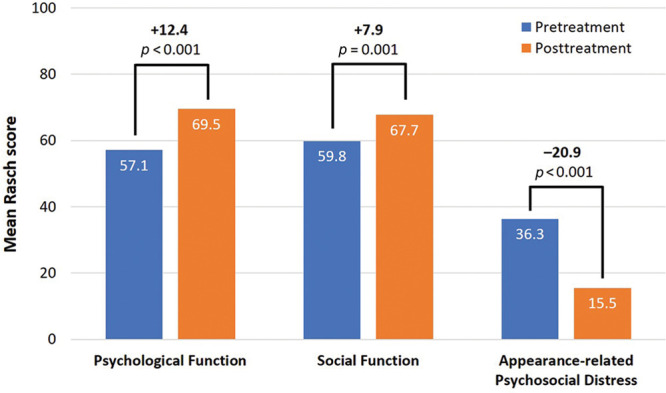
Results: Complete data were available for 35 individuals (n = 32 women [91%]; mean age: 45.9 ± 13.8 years). Twenty-nine (83%) were treated with hyaluronic acid filler (mean: 2.3 ± 1.3 syringes), and 12 (34%) received onabotulinumtoxinA (mean: 2.0 ± 0.7 areas of the upper face). There were significant improvements on each FACE-Q scale posttreatment: mean change in Psychological Function score was +12.4 [95% CI: 7.9, 16.9; P < 0.001; standardized effect size by Cohen's d: 0.93]; mean change in Social Function score was +7.9 (95% CI: 3.3, 12.5; P = 0.001; effect size: 0.50); and mean change in Appearance-related Psychosocial Distress score was -20.9 (95% CI: -27.4, -14.3; P < 0.001; effect size: 1.27).
Conclusions: Aesthetic treatment with injectables was associated with significant improvements in patient-reported psychological and social functioning and reductions in appearance-related distress. This change underlines the value of these therapies for improving psychosocial health in well-selected patients.
Copyright © 2021 The Author. Published by Wolters Kluwer Health, Inc. on behalf of The American Society of Plastic Surgeons.
Conflict of interest statement
Disclosure: DJM has been a consultant for Allergan.
Figures
References
-
- American Society of Plastic Surgeons. 2018 plastic surgery statistics report. Available at www.plasticsurgery.org/documents/News/Statistics/2018/plastic-surgery-st.... Published 2019. Accessed January 4, 2021.
-
- Abduljabbar MH, Basendwh MA. Complications of hyaluronic acid fillers and their managements. J Dermatol Derm Surg. 2016;20:100–106.
-
- Beleznay K, Carruthers JDA, Humphrey S, et al. Update on avoiding and Treating blindness from fillers: a recent review of the world literature. Aesthet Surg J. 2019;39:662–674. - PubMed
LinkOut - more resources
Full Text Sources
Other Literature Sources