


Primary Care Physician Recognition and Documentation of Depressive Symptoms Among Chinese and Latinx Patients During Routine Visits: A Cross-Sectional Study
- PMID: 33937610
- PMCID: PMC8082035
- DOI: 10.1089/heq.2020.0104
Primary Care Physician Recognition and Documentation of Depressive Symptoms Among Chinese and Latinx Patients During Routine Visits: A Cross-Sectional Study
Abstract
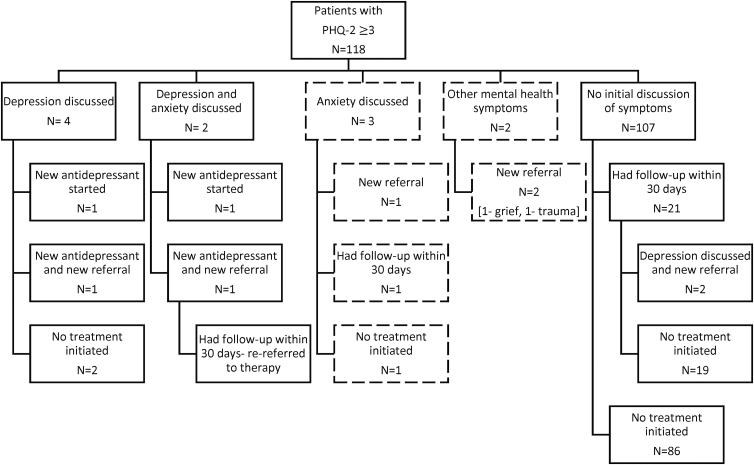
Purpose: Asian and Latinx individuals have a high burden of untreated depression. Under-recognition of depressive symptoms may contribute to existing disparities in depression treatment. The objective of this cross-sectional study was to determine whether physicians recognize and treat depressive symptoms for Chinese and Latinx patients during routine primary care visits. Methods: We analyzed data from 1171 Chinese and Latinx patients who were interviewed within 1 week after a primary care visit in a large academic practice, which had not yet implemented universal depression screening. We included participants with depressive symptoms (defined as a Patient Health Questionaire-2 score ≥3) and no prior history of depression (N=118). We investigated whether patients perceived having a mental health need in the prior year and conducted chart reviews to assess provider recognition of depressive symptoms, defined as documentation of symptoms, antidepressant initiation, or mental health referral within 30 days of the visit. We further examined differences by race/ethnicity and language preference. Results: Among the 118 patients with depressive symptoms and no prior depression diagnosis (mean age 68), 71 (61%) reported a mental health need in the prior 12 months; however, providers recognized depressive symptoms in only 8/118 patients (7%). The number of patients with recognized symptoms was small across race/ethnicity and language preference groups and we found no significant differences. Conclusion: Physicians recognized and documented depressive symptoms for 1 in 10 Chinese and Latinx patients during routine primary care visits. Targeted efforts are needed to address under-recognition of symptoms and improve depression care for these populations.
Keywords: depression recognition; depression treatment; depressive symptoms; language barriers; limited English proficiency.
© Maria E. Garcia et al., 2021; Published by Mary Ann Liebert, Inc.
Conflict of interest statement
The authors certify that they have no affiliation with or involvement in any organization or entity with any financial interest, or nonfinancial interest (such as personal or professional relationships, affiliations, knowledge, or beliefs) in the subject matter or materials discussed in this article.
Figures
References
-
- Egede LE. Major depression in individuals with chronic medical disorders: prevalence, correlates and association with health resource utilization, lost productivity and functional disability. Gen Hosp Psychiatry. 2007;29:409–416 - PubMed
-
- Egede LE. Diabetes, major depression, and functional disability among U.S. adults. Diabetes Care. 2004;27:421–428 - PubMed
-
- Egede LE, Zheng D, Simpson K. Comorbid depression is associated with increased health care use and expenditures in individuals with diabetes. Diabetes Care. 2002;25:464–470 - PubMed