


Monitoring of human coronaviruses in Belgian primary care and hospitals, 2015-20: a surveillance study
- PMID: 33937883
- PMCID: PMC8064766
- DOI: 10.1016/S2666-5247(20)30221-4
Monitoring of human coronaviruses in Belgian primary care and hospitals, 2015-20: a surveillance study
Abstract
Background: Seasonal human coronaviruses (hCoVs) broadly circulate in humans. Their epidemiology and effect on the spread of emerging coronaviruses has been neglected thus far. We aimed to elucidate the epidemiology and burden of disease of seasonal hCoVs OC43, NL63, and 229E in patients in primary care and hospitals in Belgium between 2015 and 2020.
Methods: We retrospectively analysed data from the national influenza surveillance networks in Belgium during the winter seasons of 2015-20. Respiratory specimens were collected through the severe acute respiratory infection (SARI) and the influenza-like illness networks from patients with acute respiratory illness with onset within the previous 10 days, with measured or reported fever of 38°C or greater, cough, or dyspnoea; and for patients admitted to hospital for at least one night. Potential risk factors were recorded and patients who were admitted to hospital were followed up for the occurrence of complications or death for the length of their hospital stay. All samples were analysed by multiplex quantitative RT-PCRs for respiratory viruses, including seasonal hCoVs OC43, NL63, and 229E. We estimated the prevalence and incidence of seasonal hCoV infection, with or without co-infection with other respiratory viruses. We evaluated the association between co-infections and potential risk factors with complications or death in patients admitted to hospital with seasonal hCoV infections by age group. Samples received from week 8, 2020, were tested for severe acute respiratory syndrome coronavirus 2 (SARS-CoV-2).
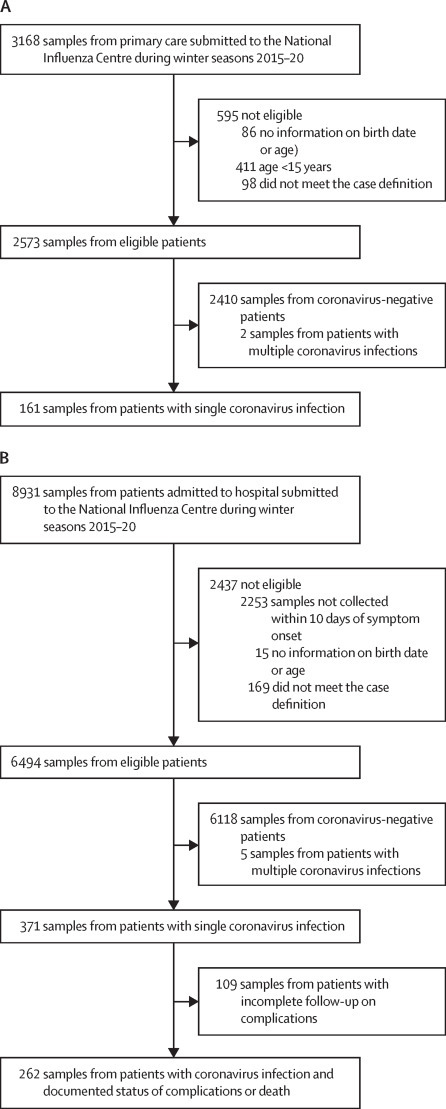
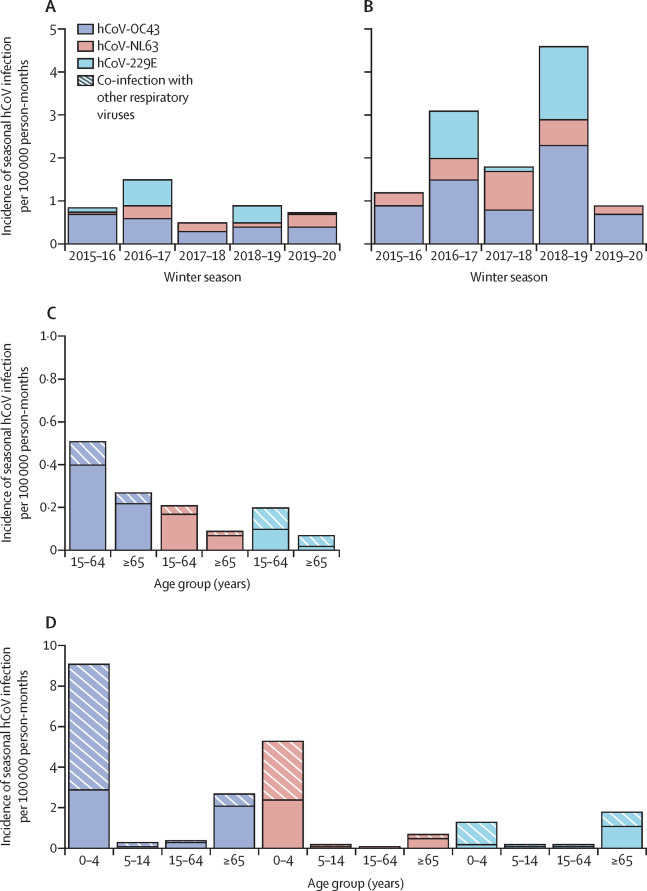
Findings: 2573 primary care and 6494 hospital samples were included in the study. 161 (6·3%) of 2573 patients in primary care and 371 (5·7%) of 6494 patients admitted to hospital were infected with a seasonal hCoV. OC43 was the seasonal hCoV with the highest prevalence across age groups and highest incidence in children admitted to hospital who were younger than 5 years (incidence 9·0 [95% CI 7·2-11·2] per 100 000 person-months) and adults older than 65 years (2·6 [2·1-3·2] per 100 000 person-months). Among 262 patients admitted to hospital with seasonal hCoV infection and with complete information on potential risk factors, 66 (73·3%) of 90 patients who had complications or died also had at least one potential risk factor (p=0·0064). Complications in children younger than 5 years were associated with co-infection (24 [36·4%] of 66; p=0·017), and in teenagers and adults (≥15 years), more complications arose in patients with a single hCoV infection (49 [45·0%] of 109; p=0·0097). In early 2020, the Belgian SARI surveillance detected the first SARS-CoV-2-positive sample concomitantly with the first confirmed COVID-19 case with no travel history to China.
Interpretation: The main burden of severe seasonal hCoV infection lies with children younger than 5 years with co-infections and adults aged 65 years and older with pre-existing comorbidities. These age and patient groups should be targeted for enhanced observation when in medical care and in possible future vaccination strategies, and co-infections in children younger than 5 years should be considered during diagnosis and treatment. Our findings support the use of national influenza surveillance systems for seasonal hCoV monitoring and early detection, and monitoring of emerging coronaviruses such as SARS-CoV-2.
Funding: Belgian Federal Public Service Health, Food Chain Safety, and Environment; Belgian National Insurance Health Care (Institut national d'assurance maladie-invalidité/Rijksinstituut voor ziekte-en invaliditeitsverzekering); and Regional Health Authorities (Flanders Agentschap zorg en gezondheid, Brussels Commission communautaire commune, Wallonia Agence pour une vie de qualité).
© 2021 The Author(s). Published by Elsevier Ltd. This is an Open Access article under the CC BY-NC-ND 4.0 license.
Figures
References
-
- WHO Weekly operational update on COVID-19. 2021. https://www.who.int/publications/m/item/weekly-operational-update-on-cov...
Publication types
MeSH terms
LinkOut - more resources
Full Text Sources
Other Literature Sources
Medical
Research Materials
Miscellaneous
