


The Association of Microaggressions with Depressive Symptoms and Institutional Satisfaction Among a National Cohort of Medical Students
- PMID: 33939079
- PMCID: PMC8811096
- DOI: 10.1007/s11606-021-06786-6
The Association of Microaggressions with Depressive Symptoms and Institutional Satisfaction Among a National Cohort of Medical Students
Abstract
Background: Despite substantial research on medical student mistreatment, there is scant quantitative data on microaggressions in US medical education.
Objective: To assess US medical students' experiences of microaggressions and how these experiences influenced students' mental health and medical school satisfaction.
Design and participants: We conducted a cross-sectional, online survey of US medical students' experiences of microaggressions.
Main measures: The primary outcome was a positive depression screen on the 2-item Patient Health Questionnaire (PHQ-2). Medical school satisfaction was a secondary outcome. We used logistic regression to model the association between respondents' reported microaggression frequency and the likelihood of a positive PHQ-2 screen. For secondary outcomes, we used the chi-squared statistic to test associations between microaggression exposure and medical school satisfaction.
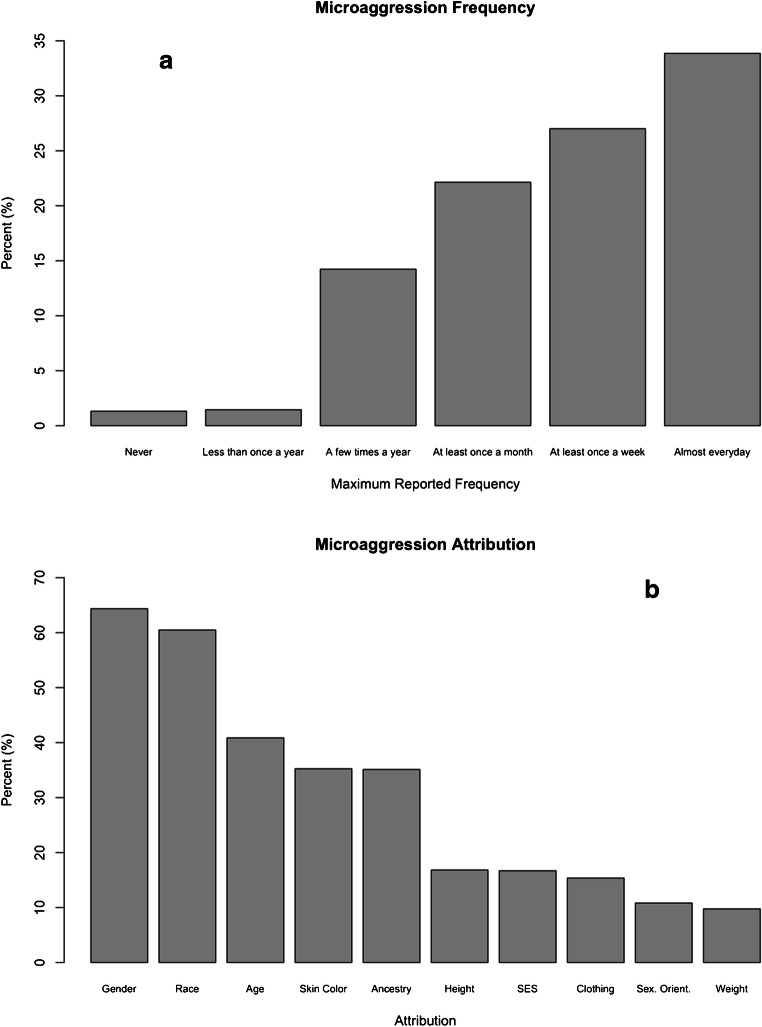
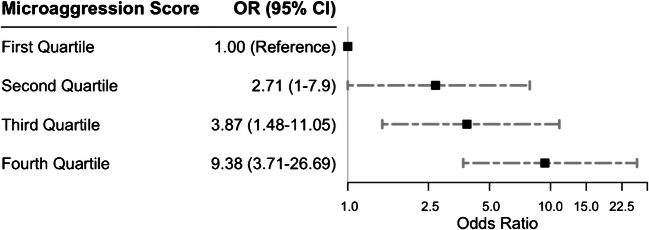
Key results: Out of 759 respondents, 61% experienced at least one microaggression weekly. Gender (64.4%), race/ethnicity (60.5%), and age (40.9%) were the most commonly cited reasons for experiencing microaggressions. Increased microaggression frequency was associated with a positive depression screen in a dose-response relationship, with second, third, and fourth (highest) quartiles of microaggression frequency having odds ratios of 2.71 (95% CI: 1-7.9), 3.87 (95% CI: 1.48-11.05), and 9.38 (95% CI: 3.71-26.69), relative to the first quartile. Medical students who experienced at least one microaggression weekly were more likely to consider medical school transfer (14.5% vs 4.7%, p<0.001) and withdrawal (18.2% vs 5.7%, p<0.001) and more likely to believe microaggressions were a normal part of medical school culture (62.3% vs 32.1%) compared to students who experienced microaggressions less frequently.
Conclusions: To our knowledge, this is the largest study on the experiences and influences of microaggressions among a national sample of US medical students. Our major findings were that microaggressions are frequent occurrences and that the experience of microaggressions was associated with a positive depression screening and decreased medical school satisfaction.
Keywords: diversity and inclusion; medical education; mental health; microaggressions; physician burnout; physician workforce.
© 2021. Society of General Internal Medicine.
Conflict of interest statement
The authors declare that they do not have a conflict of interest.
Figures
References
MeSH terms
Grants and funding
LinkOut - more resources
Full Text Sources
Other Literature Sources
