


Increased ozone pollution alongside reduced nitrogen dioxide concentrations during Vienna's first COVID-19 lockdown: Significance for air quality management
- PMID: 33940341
- PMCID: PMC9757913
- DOI: 10.1016/j.envpol.2021.117153
Increased ozone pollution alongside reduced nitrogen dioxide concentrations during Vienna's first COVID-19 lockdown: Significance for air quality management
Abstract
Background: Lockdowns amid the COVID-19 pandemic have offered a real-world opportunity to better understand air quality responses to previously unseen anthropogenic emission reductions.
Methods and main objective: This work examines the impact of Vienna's first lockdown on ground-level concentrations of nitrogen dioxide (NO2), ozone (O3) and total oxidant (Ox). The analysis runs over January to September 2020 and considers business as usual scenarios created with machine learning models to provide a baseline for robustly diagnosing lockdown-related air quality changes. Models were also developed to normalise the air pollutant time series, enabling facilitated intervention assessment.
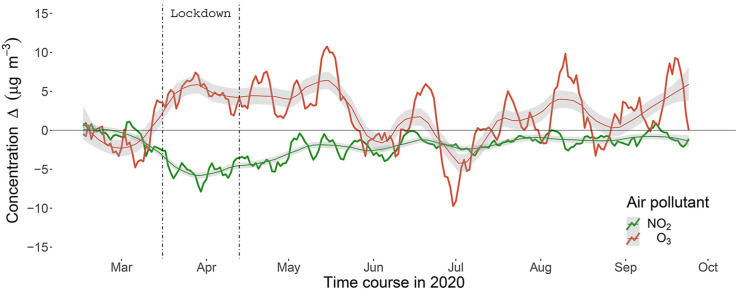
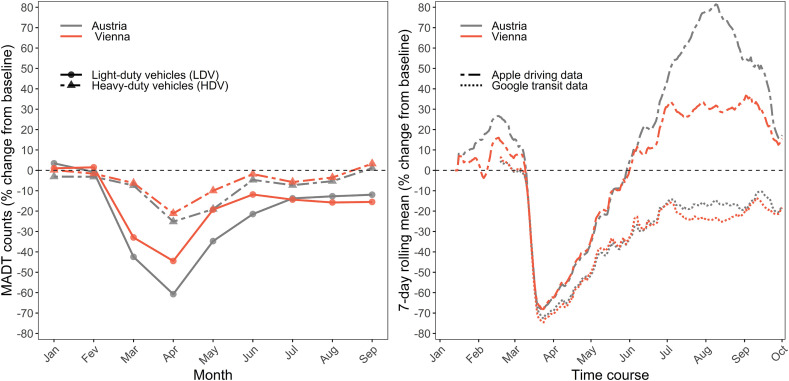
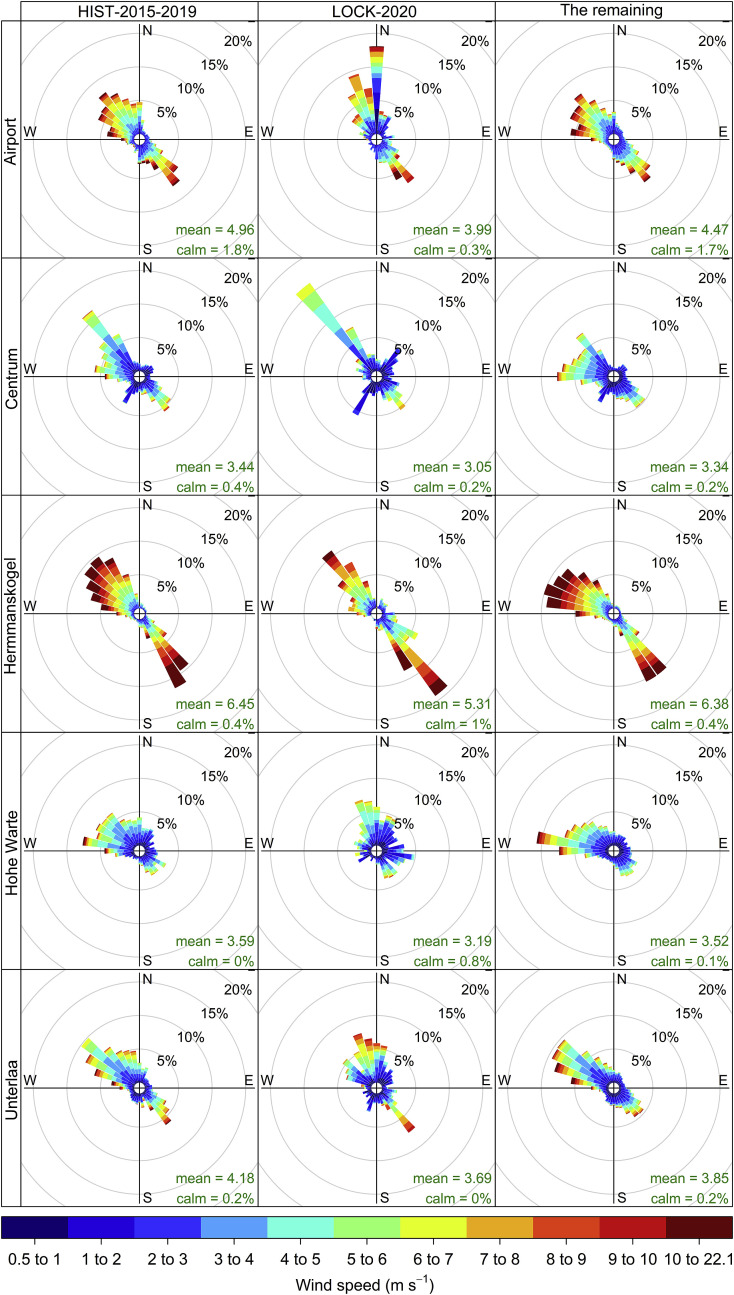
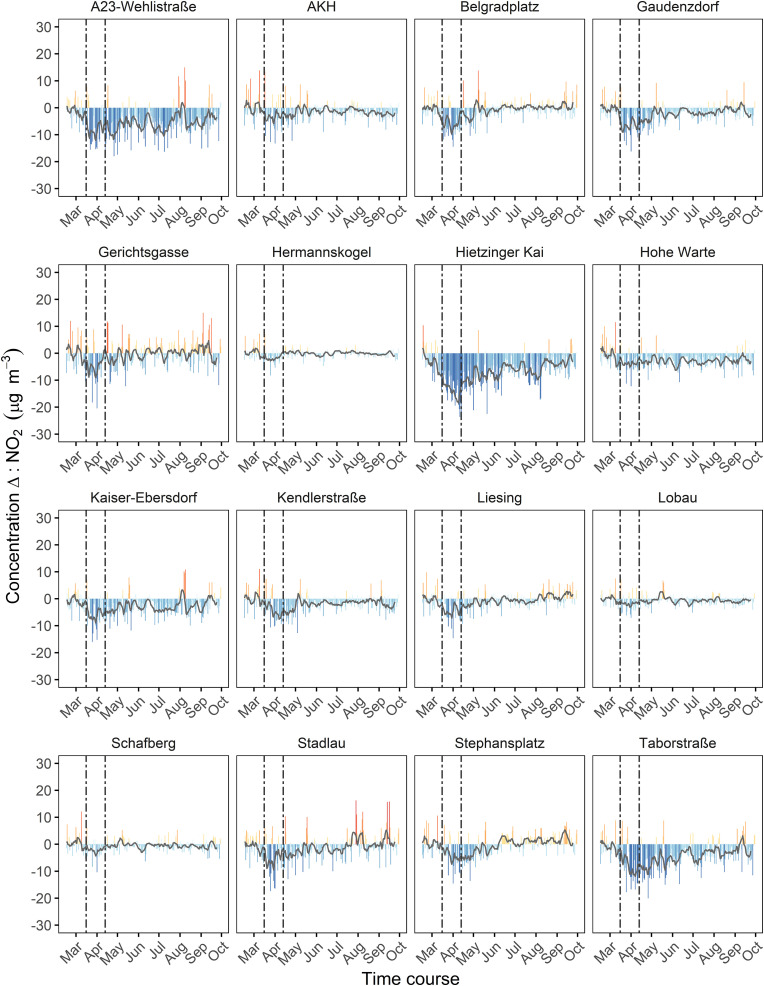
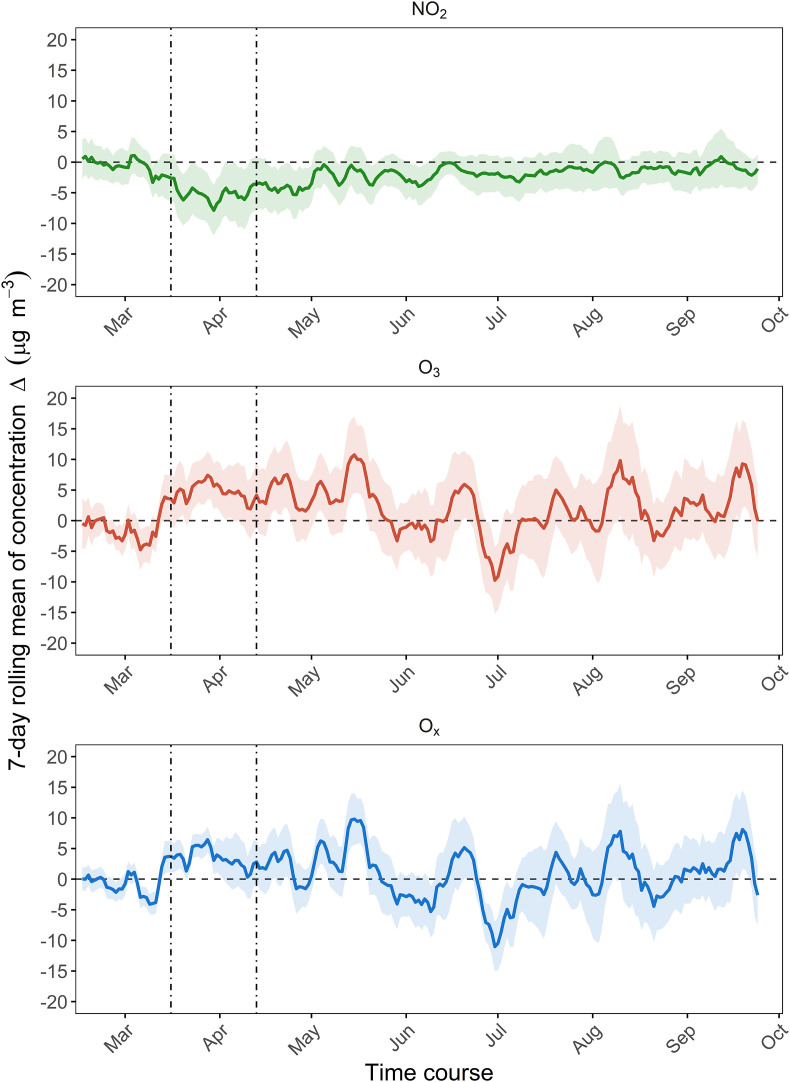
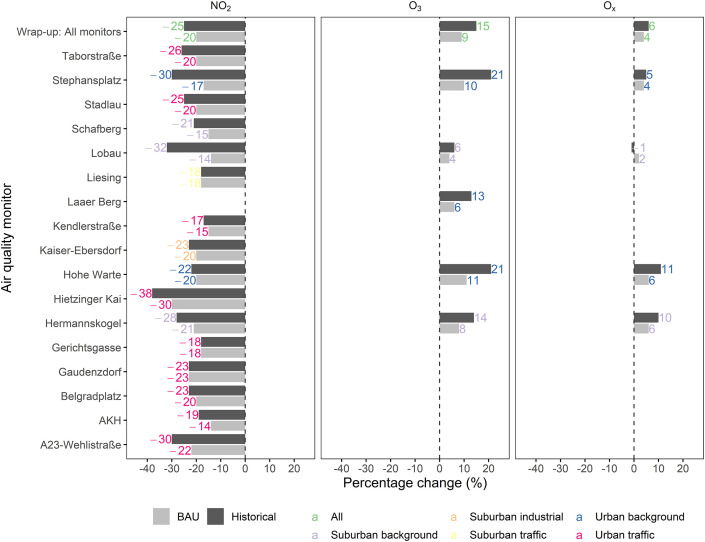
Core findings: NO2 concentrations were on average -20.1% [13.7-30.4%] lower during the lockdown. However, this benefit was offset by amplified O3 pollution of +8.5% [3.7-11.0%] in the same period. The consistency in the direction of change indicates that the NO2 reductions and O3 increases were ubiquitous over Vienna. Ox concentrations increased slightly by +4.3% [1.8-6.4%], suggesting that a significant part of the drops in NO2 was compensated by gains in O3. Accordingly, 82% of lockdown days with lowered NO2 were accompanied by 81% of days with amplified O3. The recovery shapes of the pollutant concentrations were depicted and discussed. The business as usual-related outcomes were broadly consistent with the patterns outlined by the normalised time series. These findings allowed to argue further that the detected changes in air quality were of anthropogenic and not of meteorological reason. Pollutant changes on the machine learning baseline revealed that the impact of the lockdown on urban air quality were lower than the raw measurements show. Besides, measured traffic drops in major Austrian roads were more significant for light-duty than for heavy-duty vehicles. It was also noted that the use of mobility reports based on cell phone movement as activity data can overestimate the reduction of emissions for the road transport sector, particularly for heavy-duty vehicles. As heavy-duty vehicles can make up a large fraction of the fleet emissions of nitrogen oxides, the change in the volume of these vehicles on the roads may be the main driver to explain the change in NO2 concentrations.
Interpretation and implications: A probable future with emissions of volatile organic compounds (VOCs) dropping slower than emissions of nitrogen oxides could risk worsened urban O3 pollution under a VOC-limited photochemical regime. More holistic policies will be needed to achieve improved air quality levels across different regions and criteria pollutants.
Keywords: Air quality data; Atmospheric composition; COVID-19 lockdown; Machine learning; Meteorology.
Copyright © 2021 The Author. Published by Elsevier Ltd.. All rights reserved.
Conflict of interest statement
The author declares no known competing financial interests or personal relationships that could have appeared to influence the work reported in this paper.
Figures



References
-
- Anderl M., Haider S., Krutzler T., Lampert C., Poupa S., Purzner M., Schieder W., Storch A., Stranner G., Titz M., Zechmeister A. REP-0689. Umweltbundesamt; Vienna: 2019. Austria’s national air emission projections 2019 for 2020, 2025 and 2030. Pollutants: NOx, SO2, NMVOC, NH3 and PM2.5. Scenario: with Existing Measures (WEM)
-
- Anderl M., Haider S., Lampert C., Perl D., Pinterits M., Poupa S., Purzner M., Schieder W., Schmidt G., Schodl B., Titz M., Wieser M. REP-0760. Umweltbundesamt; Vienna: 2021. Austria‘s Annual Air Emission Inventory 1990—2019. Emissions of SO2 , NOx, NMVOC, NH3 and PM2,5.
-
- Apple Mobility Trends Reports. 2021. https://covid19.apple.com/mobility 1.5.21.
-
- Archibald A.T., Neu J.L., Elshorbany Y.F., Cooper O.R., Young P.J., Akiyoshi H., Cox R.A., Coyle M., Derwent R.G., Deushi M., Finco A., Frost G.J., Galbally I.E., Gerosa G., Granier C., Griffiths P.T., Hossaini R., Hu L., Jöckel P., Josse B., Lin M.Y., Mertens M., Morgenstern O., Naja M., Naik V., Oltmans S., Plummer D.A., Revell L.E., Saiz-Lopez A., Saxena P., Shin Y.M., Shahid I., Shallcross D., Tilmes S., Trickl T., Wallington T.J., Wang T., Worden H.M., Zeng G. Tropospheric Ozone Assessment Report: a critical review of changes in the tropospheric ozone burden and budget from 1850 to 2100. Elem. Sci. Anthr. 2020;8 doi: 10.1525/elementa.2020.034. - DOI
MeSH terms
Substances
Grants and funding
LinkOut - more resources
Full Text Sources
Other Literature Sources
Medical
Research Materials
