


Inhalational Gases for Neuroprotection in Traumatic Brain Injury
- PMID: 33940933
- PMCID: PMC8820834
- DOI: 10.1089/neu.2021.0053
Inhalational Gases for Neuroprotection in Traumatic Brain Injury
Abstract
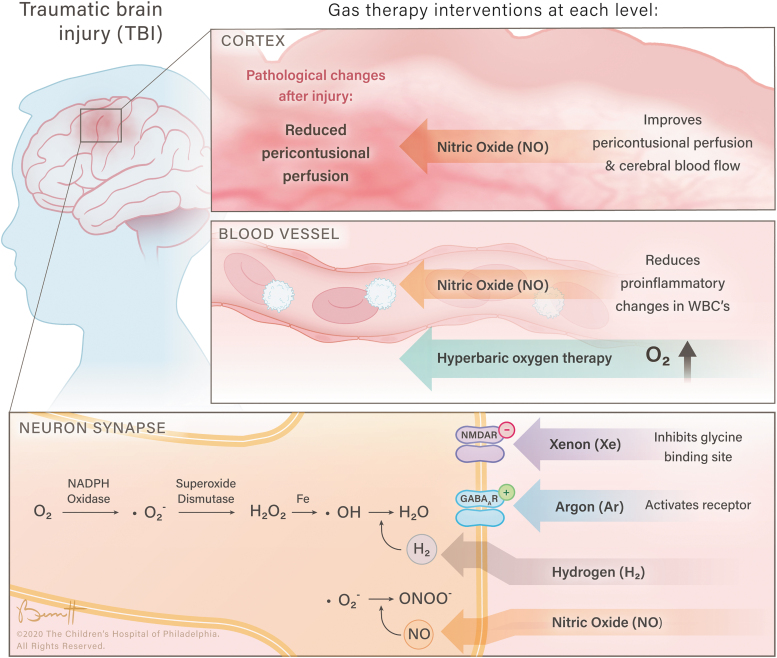
Despite multiple prior pharmacological trials in traumatic brain injury (TBI), the search for an effective, safe, and practical treatment of these patients remains ongoing. Given the ease of delivery and rapid absorption into the systemic circulation, inhalational gases that have neuroprotective properties will be an invaluable resource in the clinical management of TBI patients. In this review, we perform a systematic review of both pre-clinical and clinical reports describing inhalational gas therapy in the setting of TBI. Hyperbaric oxygen, which has been investigated for many years, and some of the newest developments are reviewed. Also, promising new therapies such as hydrogen gas, hydrogen sulfide gas, and nitric oxide are discussed. Moreover, novel therapies such as xenon and argon gases and delivery methods using microbubbles are explored.
Keywords: head trauma; oxidative stress; traumatic brain injury.
Conflict of interest statement
No competing financial interests exist.
Figures
References
-
- Abdelmalik, P.A., Draghic, N., and Ling, G.S.F. (2019). Management of moderate and severe traumatic brain injury. Transfusion 59, 1529–1538. - PubMed
-
- Godoy, D.A., Lubillo, S., and Rabinstein, A.A. (2018). Pathophysiology and management of intracranial hypertension and tissular brain hypoxia after severe traumatic brain injury: an integrative approach. Neurosurg. Clin. N. Am. 29, 195–212. - PubMed
-
- Bouma, G.J., Muizelaar, J.P., Stringer, W.A., Choi, S.C., Fatouros, P., and Young, H.F. (1992). Ultra-early evaluation of regional cerebral blood flow in severely head-injured patients using xenon-enhanced computerized tomography. J. Neurosurg. 77, 360–368. - PubMed
-
- Diringer, M.N., Zazulia, A.R., and Powers, W.J. (2011). Does ischemia contribute to energy failure in severe TBI? Transl. Stroke Res. 2, 517–523. - PubMed
Publication types
MeSH terms
Substances
Grants and funding
LinkOut - more resources
Full Text Sources
Other Literature Sources
Medical
