


Cognitive Behavioral Therapy for Prodromal Stage of Psychosis-Outcomes for Transition, Functioning, Distress, and Quality of Life: A Systematic Review and Meta-analysis
- PMID: 33944949
- PMCID: PMC8781350
- DOI: 10.1093/schbul/sbab044
Cognitive Behavioral Therapy for Prodromal Stage of Psychosis-Outcomes for Transition, Functioning, Distress, and Quality of Life: A Systematic Review and Meta-analysis
Abstract
Objective: This study aimed to provide insight into the efficacy of cognitive-behavioral therapy for psychosis (CBTp) in patients with "clinical high risk of psychosis (CHR-P)".
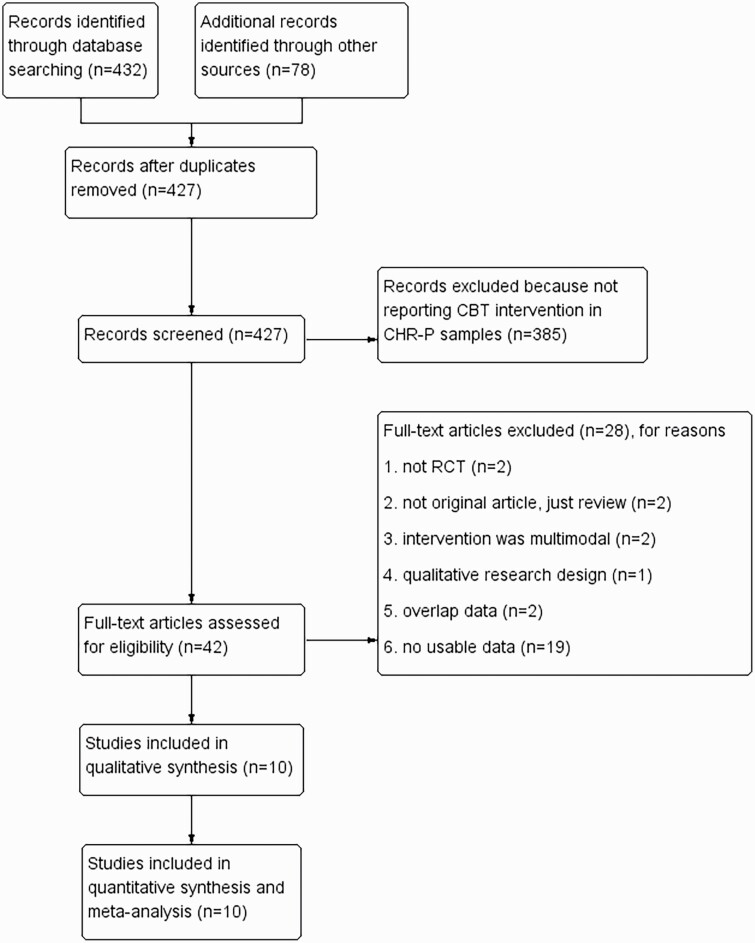
Methods: Major scientific databases were searched up to April 17, 2020. Randomized controlled trials in CHR-P individuals, comparing CBTp with needs-based interventions (NBI, including treatment as usual or nonspecific control treatment) were included, following PRISMA guidelines. The primary outcome (efficacy) was transition to psychosis by 6 months, 12 months, 24 months, and over 24 months. Secondary outcomes were change in attenuated psychotic symptoms, depression, distress, improvements in functioning, and quality of life.
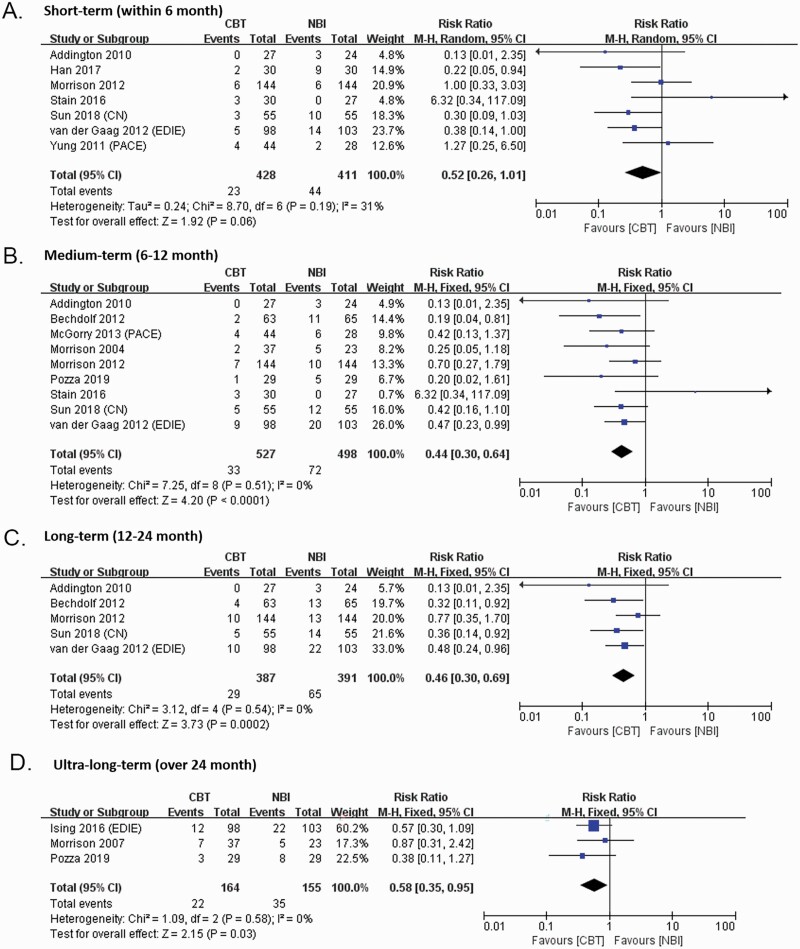
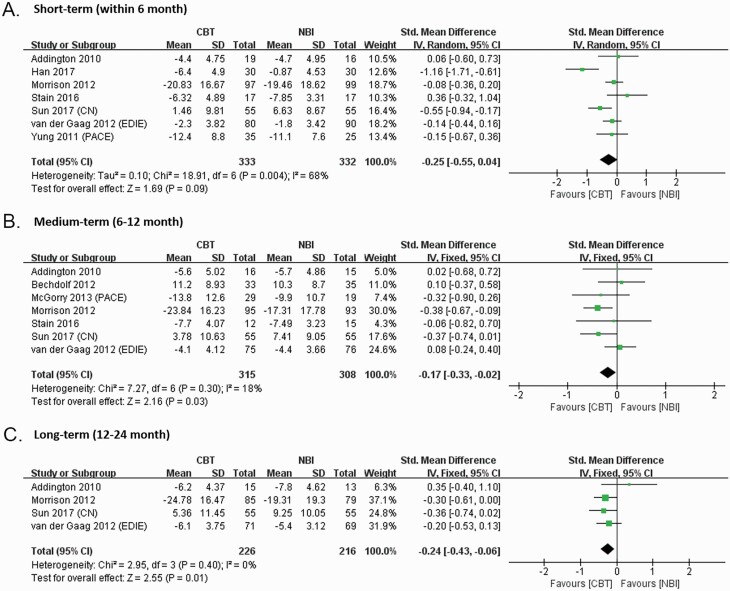
Results: Ten randomized controlled studies met inclusion criteria. The comparisons included 1128 participants. CBTp was significantly more efficacious in reducing rate of transition to psychosis by 6 months (after post-hoc sensitivity analysis) (relative risk [RR] = 0.44, 95% confidence interval [CI]: 0.26, 0.73), 12 months (RR = 0.44, 95% CI: 0.30, 0.64), 12 months (RR = 0.46, 95%CI: 0.30, 0.69), and over 24 months (RR = 0.58, 95% CI: 0.35, 0.95) after treatment, compared with those receiving NBI. CBTp was also associated with more reduced attenuated psychotic symptoms by 12 months (SMD = -0.17, 95% CI: -0.33, -0.02) and by 24 months (SMD = -0.24, 95% CI: -0.43, -0.06). No beneficial effects on functioning, depression, quality of life, or distress were observed favoring CBTp.
Conclusions: CBTp is effective in reducing both psychosis transition rates and attenuated psychotic symptoms for the prodromal stage of psychosis. It is a promising intervention at the preventative stage.
Keywords: CBTp; clinical high risk; cognitive-behavioral therapy; distress; functioning; meta-analysis; psychosis; quality of life; systematic review.
© The Author(s) 2021. Published by Oxford University Press on behalf of the Maryland Psychiatric Research Center. All rights reserved. For permissions, please email: journals.permissions@oup.com.
Figures
Comment in
-
Overoptimistic Literature and Methodological Biases Favoring Cognitive Behavioral Therapy for the Prevention of Psychosis.Schizophr Bull. 2022 Jan 21;48(1):1-3. doi: 10.1093/schbul/sbab129. Schizophr Bull. 2022. PMID: 34757422 Free PMC article. No abstract available.
References
-
- Fusar-Poli P, Cappucciati M, Borgwardt S, et al. Heterogeneity of psychosis risk within individuals at clinical high risk: a meta-analytical stratification. JAMA Psychiatry. 2016;73(2):113–120. - PubMed
-
- EPGW G. Australian Clinical Guidelines for Early Psychosis. 2nd ed. Melbourne, Australia: Orygen: The National Centre of Excellence in Youth Mental Health; 2010.
-
- National Collaborating Centre for Mental Health (UK). Psychosis and Schizophrenia in Adults: Treatment and Management: Updated Edition 2014. London, UK: National Institute for Health and Care Excellence; 2014. - PubMed
Publication types
MeSH terms
LinkOut - more resources
Full Text Sources
Other Literature Sources
Medical
Miscellaneous
