


Influence of Cognitive Impairment on the Recovery of Subjects with Subacute Stroke Undergoing Upper Limb Robotic Rehabilitation
- PMID: 33946452
- PMCID: PMC8147141
- DOI: 10.3390/brainsci11050587
Influence of Cognitive Impairment on the Recovery of Subjects with Subacute Stroke Undergoing Upper Limb Robotic Rehabilitation
Abstract
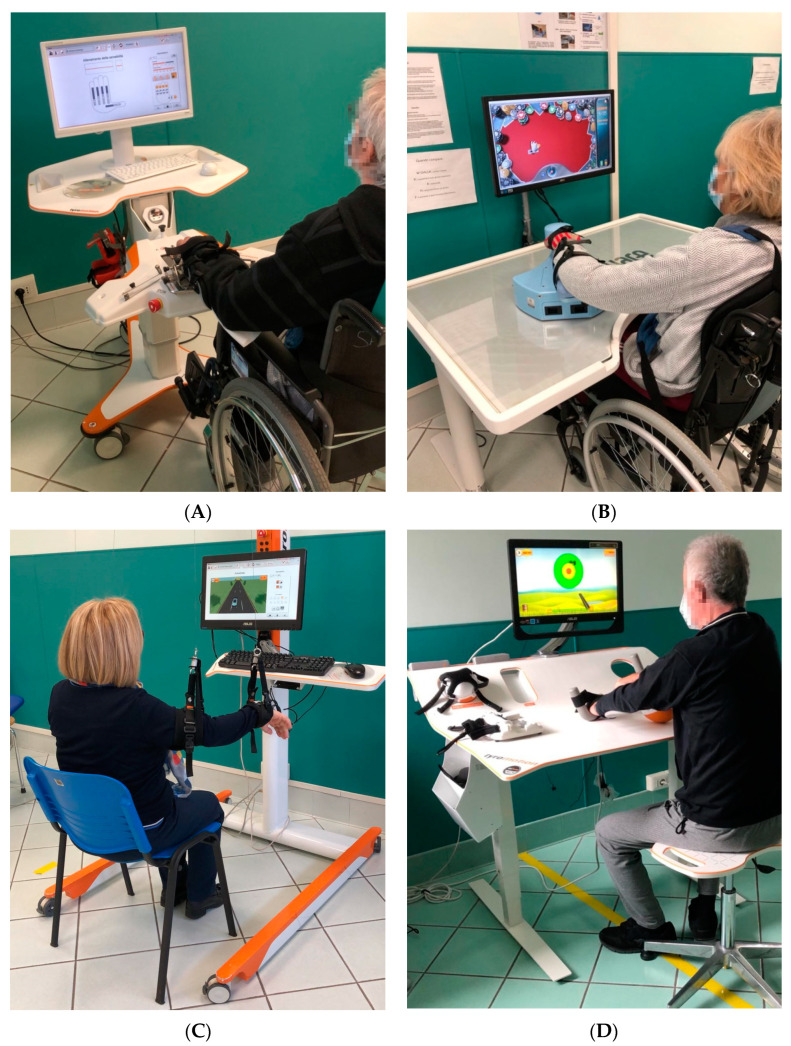
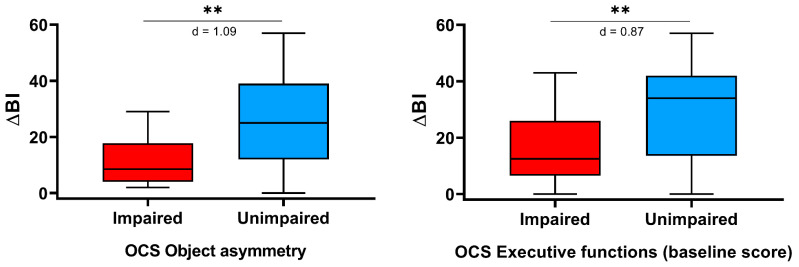
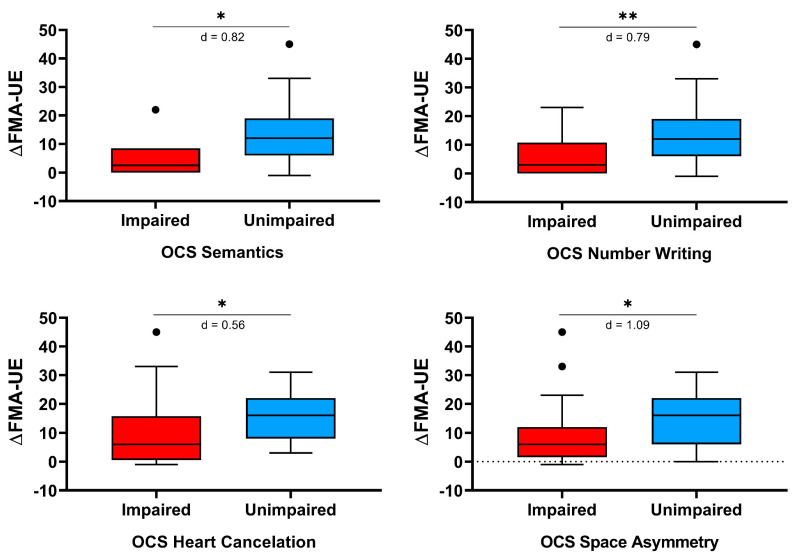
Cognitive decline is often present in stroke survivors, with a significant impact on motor recovery. However, how specific cognitive domains could impact motor recovery after robotic rehabilitation in patients with stroke is still not well understood. In this study, we analyzed the relationship between cognitive impairment and the outcome of a robot-mediated upper limb rehabilitation intervention in a sample of 51 subacute stroke patients. Participants were enrolled and treated with a set of robotic and sensor-based devices. Before the intervention, patients underwent a cognitive assessment by means of the Oxford Cognitive Screen. To assess the effect of the 30-session rehabilitation intervention, patients were assessed twice with the following outcome measures: the Fugl-Meyer Assessment for Upper Extremity (FMA-UE), to evaluate motor function; the Upper limb Motricity Index (MI), to evaluate upper limb muscle strength; the Modified Barthel Index (mBI), to evaluate activities of daily living and mobility. We found that deficits in spatial attention and executive functions impacted the mBI improvement, while language, number processing, and spatial attention deficits reduced the gains in the FMA-UE. These results suggest the importance to evaluate the cognitive functions using an adequate tool in patients with stroke undergoing a robotic rehabilitation intervention.
Keywords: attention; executive function; memory; rehabilitation; robotics; stroke.
Conflict of interest statement
The authors declare no conflict of interest.
Figures
References
-
- Mehrholz J., Pohl M., Platz T., Kugler J., Elsner B. Electromechanical and robot-assisted arm training for improving activities of daily living, arm function, and arm muscle strength after stroke. Cochrane Database Syst. Rev. 2018;9:CD006876. doi: 10.1002/14651858.CD006876.pub5. - DOI - PMC - PubMed
-
- Rodgers H., Bosomworth H., Krebs H.I., van Wijck F., Howel D., Wilson N., Aird L., Alvarado N., Andole S., Cohen D.L., et al. Robot assisted training for the upper limb after stroke (RATULS): A multicentre randomised controlled trial. Lancet. 2019;394:51–62. doi: 10.1016/S0140-6736(19)31055-4. - DOI - PMC - PubMed
-
- Aprile I., Germanotta M., Cruciani A., Loreti S., Pecchioli C., Cecchi F., Montesano A., Galeri S., Diverio M., Falsini C., et al. Upper Limb Robotic Rehabilitation after Stroke: A Multicenter, Randomized Clinical Trial. J. Neurol. Phys. Ther. 2020;44:3–14. doi: 10.1097/NPT.0000000000000295. - DOI - PubMed
LinkOut - more resources
Full Text Sources
Medical
