Review
. 2021 Apr 29;22(9):4709.
doi: 10.3390/ijms22094709.

Recent Advances in Effector-Triggered Immunity in Plants: New Pieces in the Puzzle Create a Different Paradigm

Affiliations
Review

Recent Advances in Effector-Triggered Immunity in Plants: New Pieces in the Puzzle Create a Different Paradigm

Quang-Minh Nguyen et al. Int J Mol Sci. .

Abstract

Plants rely on multiple immune systems to protect themselves from pathogens. When pattern-triggered immunity (PTI)-the first layer of the immune response-is no longer effective as a result of pathogenic effectors, effector-triggered immunity (ETI) often provides resistance. In ETI, host plants directly or indirectly perceive pathogen effectors via resistance proteins and launch a more robust and rapid defense response. Resistance proteins are typically found in the form of nucleotide-binding and leucine-rich-repeat-containing receptors (NLRs). Upon effector recognition, an NLR undergoes structural change and associates with other NLRs. The dimerization or oligomerization of NLRs signals to downstream components, activates "helper" NLRs, and culminates in the ETI response. Originally, PTI was thought to contribute little to ETI. However, most recent studies revealed crosstalk and cooperation between ETI and PTI. Here, we summarize recent advancements in our understanding of the ETI response and its components, as well as how these components cooperate in the innate immune signaling pathways. Based on up-to-date accumulated knowledge, this review provides our current perspective of potential engineering strategies for crop protection.

Keywords: ETI; NLR; PTI; effector; pathogen; plant immunity.


Conflict of interest statement

The authors declare no conflict of interest.

Figures
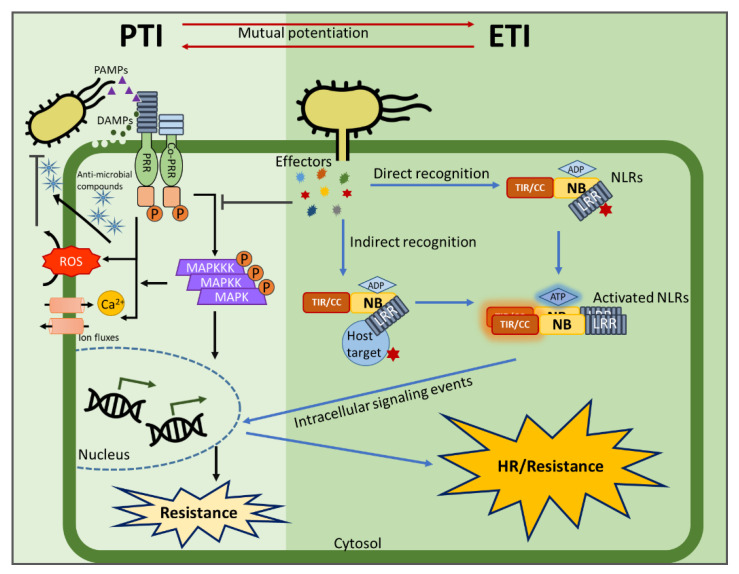
Figure 1
Figure 1
Schematic view of pattern-triggered immunity (PTI) and effector-triggered immunity (ETI) in plants. The first layer of induced immunity, called PTI (indicated by black arrows), is activated by the recognition of pathogen-associated molecular patterns (PAMPs) or damage-associated molecular patterns (DAMPs) through pattern recognition receptors (PRRs). Several PTI signaling events occur, such as activation of the mitogen-activated protein kinases (MAPK) kinase cascades, an influx of Ca2+ into the cytosol, and production of reactive oxygen species (ROS). Antimicrobial compounds are produced and the defense genes are activated. However, to suppress PTI, the pathogens deploy effectors. When they are recognized by nucleotide-binding (NB) and leucine-rich-repeat (LRR)-containing receptors (NLRs), the second immune layer, called ETI (indicated by blue arrows), takes place. NLRs directly or indirectly perceive pathogenic effectors, leading to a conformational change, which together with several intracellular signaling events, ultimately trigger the hypersensitive response (HR) or other defense responses. Surprisingly, the most recent studies reported that PTI and ETI are mutually linked and together potentiate the immune response (indicated by red arrows).
Figure 2
Figure 2
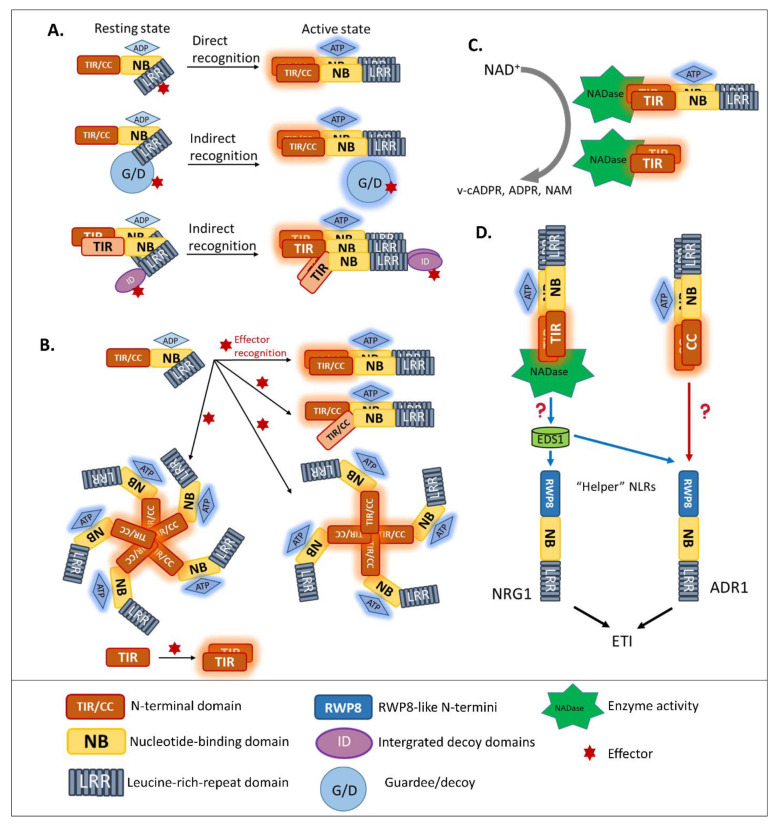
Diverse roles of nucleotide-binding and leucine-rich-repeat-containing receptors (NLRs) in immune signaling. (A) The evolution of NLR effector recognition systems. A common NLR consists of a diverse N-terminal domain, a central nucleotide-binding (NB) domain, and a C-terminal leucine-rich repeat (LRR) domain. NLRs are classified into two groups, depending on the N-terminus—toll interleukin-1-receptor (TIR) NLR (TNL) and coiled-coil (CC) NLR (CNL). NLRs recognize pathogen effectors directly through the LRR domain or indirectly through a host guardee/decoy protein. During coevolution, some NLRs acquired unusual integrated decoy (ID) domains for pathogen recognition. (B) The molecular switch of NLRs during effector recognition leads to NLR homo/hetero/oligomerization (the NLR “resistosome”). In response to pathogen effectors, the open-lid form of NLRs is formed. ADP–ATP exchange occurs, leading to NLR activation. The associations of NLRs, such as homodimerization, heterodimerization, and oligomerization, are important for downstream signaling. (C) After the formation of an NLR resistosome, the enzymatic activity of plant TIR produces nicotinamide adenine dinucleotide (NAD) derivatives. (D) Downstream components, ENHANCED DISEASE SUSCEPTIBILITY 1 (EDS1) and “helper NLRs” (N REQUIREMENT GENE 1 (NRG1) and ACTIVATED DISEASE RESISTANCE PROTEIN 1 (ADR1)), are required for NLR signaling. While CNLs depend on helper ADR1 to function (indicated by red arrow), TNLs activate NADase and require EDS1 (indicated by blue arrows) and both helpers (ADR1 and NRG1) for signal transduction. NRG1 and ADR1 mediate effector-triggered immunity (ETI) (indicated by black arrows). Question marks indicate the unknown mechanisms in NLR-triggered immunity.
Figure 3
Figure 3
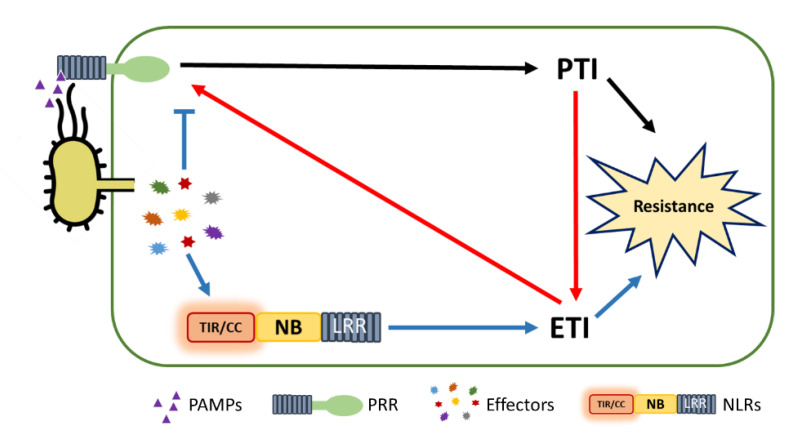
The integration of pattern-triggered immunity (PTI) and effector-triggered immunity (ETI) in plant immunity. In response to pathogens, an induced defense response is turned on by pattern recognition receptors (PRRs)-mediated PTI (indicated by black arrows) and nucleotide-binding and leucine-rich-repeat-containing receptors (NLRs)-mediated ETI (indicated by blue arrows). Recent reports indicate that there is substantial crosstalk between PTI and ETI (indicated by red arrows). ETI functions through PTI components and potentiates PTI signaling. Synergistically, PTI also enhances the ETI response. The cooperation of PTI and ETI mutually contributes to plant innate immunity.

References

    1. Dangl J.L., Horvath D.M., Staskawicz B.J. Pivoting the plant immune system from dissection to deployment. Science. 2013;341:746–751. doi: 10.1126/science.1236011. - DOI - PMC - PubMed
    1. Pascale A., Proietti S., Pantelides I.S., Stringlis I.A. Modulation of the Root Microbiome by Plant Molecules: The Basis for Targeted Disease Suppression and Plant Growth Promotion. Front. Plant. Sci. 2019;10:1741. doi: 10.3389/fpls.2019.01741. - DOI - PMC - PubMed
    1. Lapin D., Van den Ackerveken G. Susceptibility to plant disease: More than a failure of host immunity. Trends Plant Sci. 2013;18:546–554. doi: 10.1016/j.tplants.2013.05.005. - DOI - PubMed
    1. Staskawicz B.J. Genetics of plant-pathogen interactions specifying plant disease resistance. Plant Physiol. 2001;125:73–76. doi: 10.1104/pp.125.1.73. - DOI - PMC - PubMed
    1. Jones J.D., Dangl J.L. The plant immune system. Nature. 2006;444:323–329. doi: 10.1038/nature05286. - DOI - PubMed

MeSH terms

LinkOut - more resources