Review
. 2021 Apr 29;22(9):4704.
doi: 10.3390/ijms22094704.

Sucrose Utilization for Improved Crop Yields: A Review Article

Affiliations
Review

Sucrose Utilization for Improved Crop Yields: A Review Article

Oluwaseun Olayemi Aluko et al. Int J Mol Sci. .

Abstract

Photosynthetic carbon converted to sucrose is vital for plant growth. Sucrose acts as a signaling molecule and a primary energy source that coordinates the source and sink development. Alteration in source-sink balance halts the physiological and developmental processes of plants, since plant growth is mostly triggered when the primary assimilates in the source leaf balance with the metabolic needs of the heterotrophic sinks. To measure up with the sink organ's metabolic needs, the improvement of photosynthetic carbon to synthesis sucrose, its remobilization, and utilization at the sink level becomes imperative. However, environmental cues that influence sucrose balance within these plant organs, limiting positive yield prospects, have also been a rising issue over the past few decades. Thus, this review discusses strategies to improve photosynthetic carbon assimilation, the pathways actively involved in the transport of sucrose from source to sink organs, and their utilization at the sink organ. We further emphasize the impact of various environmental cues on sucrose transport and utilization, and the strategic yield improvement approaches under such conditions.

Keywords: environmental factors; photosynthetic carbon assimilation; source-to-sink relationship; sucrose transporters; sucrose transports; sucrose utilization.


Conflict of interest statement

The authors declare no conflict of interest.

Figures
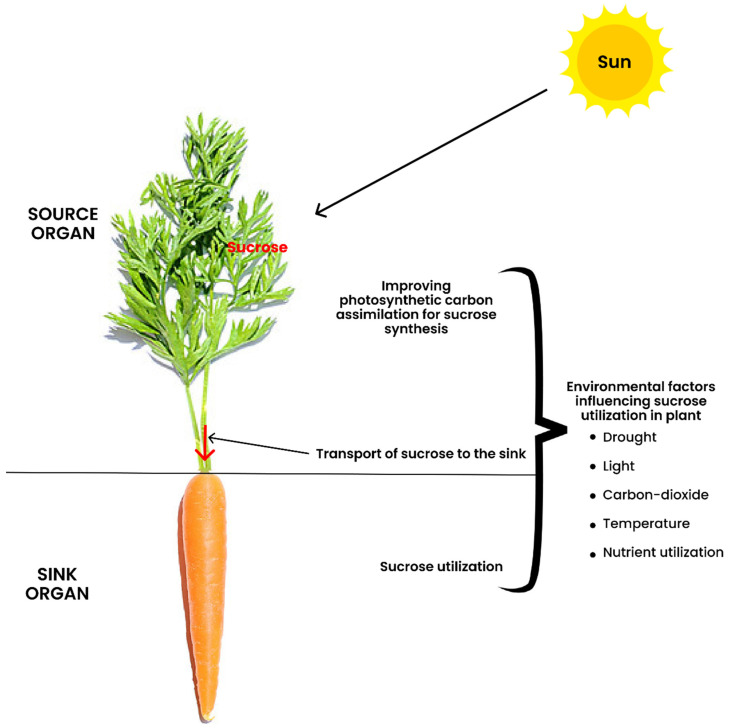
Figure 1
Figure 1
Sucrose utilization at the source and sink level. To fully optimize crop yields through sucrose utilization, improving photosynthetic carbon assimilation for sucrose synthesis, transport of sucrose to the sink, and its utilization at the sink level become imperative. Given the efficient utilization of sucrose, other environmental factors can disrupt sucrose distribution within plant organs.
Figure 2
Figure 2
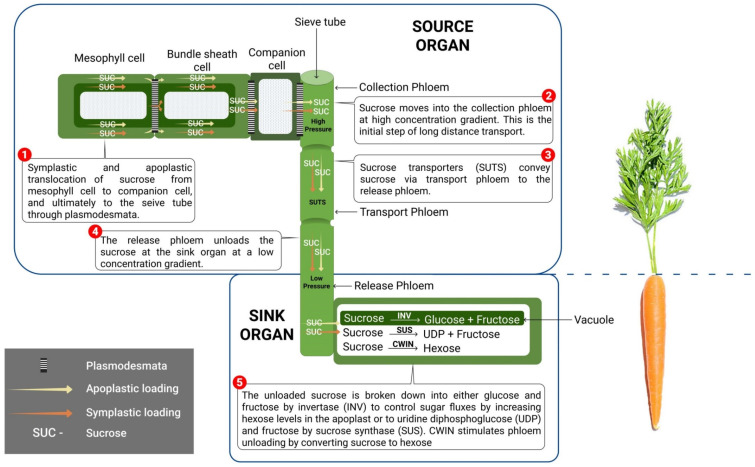
Schematic diagram of symplastic and apoplastic transport of sugar from source to sink organ.
Figure 3
Figure 3
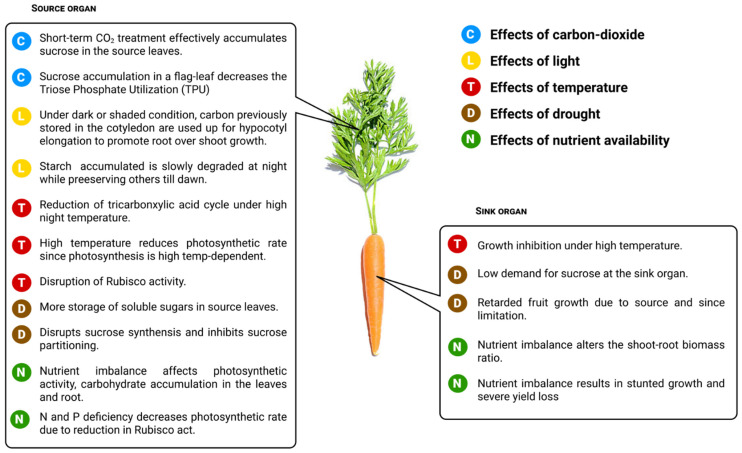
The impact of environmental factors on photo-assimilate transport.
Figure 4
Figure 4
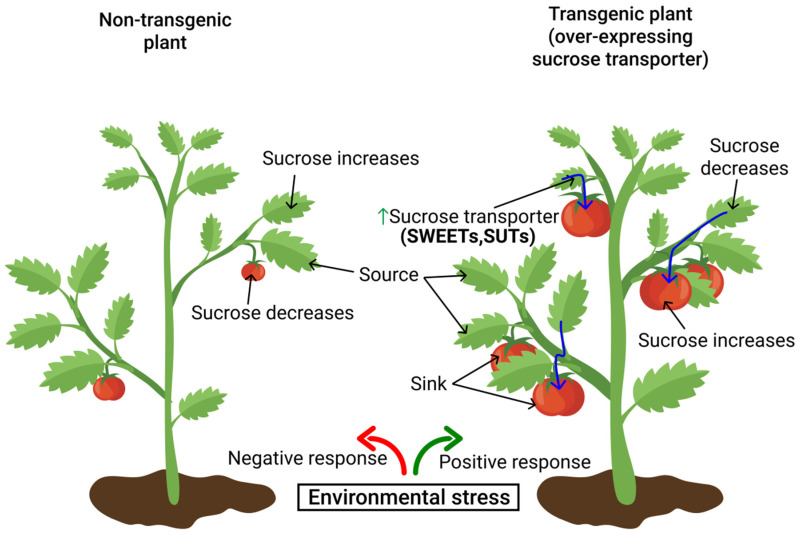
Sugar transporters are involved in environmental stress mitigation. Under stressed conditions, overexpression of sugar transporters (SWEETs, SUTs/SUCs) in plants (right) enhances the transport of soluble sugars, such as sucrose from source leaves to the sink organs for fruit development. Meanwhile, under the same conditions, increased sucrose accumulation in the leaves of nontransgenic plants (left) inhibits sucrose export from the source leaves, limiting sink (fruit) growth and development.

References

    1. Taiz L., Zeiger E., Moller I.M., Murphy A. Plant Physiology and Development. 6th ed. Oxford University Press; New York, NY, USA: 2018. p. 31.
    1. Osorio S., Ruan Y.L., Fernie A.R. An update on source-to-sink carbon partitioning in tomato. Front. Plant Sci. 2014;5:516. doi: 10.3389/fpls.2014.00516. - DOI - PMC - PubMed
    1. Lemoine R. Sucrose transporters in plants: Update on function and structure. Biochim. Biophys. Acta (BBA) Biomembr. 2000;1465:246–262. doi: 10.1016/S0005-2736(00)00142-5. - DOI - PubMed
    1. Kircher S., Schopfer P. Photosynthetic sucrose acts as cotyledon-derived long-distance signal to control root growth during early seedling development in Arabidopsis. Proc. Natl. Acad. Sci. USA. 2012;109:11217–11221. doi: 10.1073/pnas.1203746109. - DOI - PMC - PubMed
    1. Mason M.G., Ross J.J., Babst B.A., Wienclaw B.N., Beveridge C.A. Sugar demand, not auxin, is the initial regulator of apical dominance. Proc. Natl. Acad. Sci. USA. 2014;111:6092–6097. doi: 10.1073/pnas.1322045111. - DOI - PMC - PubMed

LinkOut - more resources