Review
. 2021 Apr 29;10(5):1054.
doi: 10.3390/cells10051054.

Manifestations of Age on Autophagy, Mitophagy and Lysosomes in Skeletal Muscle

Affiliations
Review

Manifestations of Age on Autophagy, Mitophagy and Lysosomes in Skeletal Muscle

Matthew Triolo et al. Cells. .

Abstract

Sarcopenia is the loss of both muscle mass and function with age. Although the molecular underpinnings of sarcopenia are not fully understood, numerous pathways are implicated, including autophagy, in which defective cargo is selectively identified and degraded at the lysosome. The specific tagging and degradation of mitochondria is termed mitophagy, a process important for the maintenance of an organelle pool that functions efficiently in energy production and with relatively low reactive oxygen species production. Emerging data, yet insufficient, have implicated various steps in this pathway as potential contributors to the aging muscle atrophy phenotype. Included in this is the lysosome, the end-stage organelle possessing a host of proteolytic and degradative enzymes, and a function devoted to the hydrolysis and breakdown of defective molecular complexes and organelles. This review provides a summary of our current understanding of how the autophagy-lysosome system is regulated in aging muscle, highlighting specific areas where knowledge gaps exist. Characterization of the autophagy pathway with a particular focus on the lysosome will undoubtedly pave the way for the development of novel therapeutic strategies to combat age-related muscle loss.

Keywords: aging; autophagy; lysosomes; mitophagy; sarcopenia; skeletal muscle.


Conflict of interest statement

The authors declare no conflict of interest.

Figures
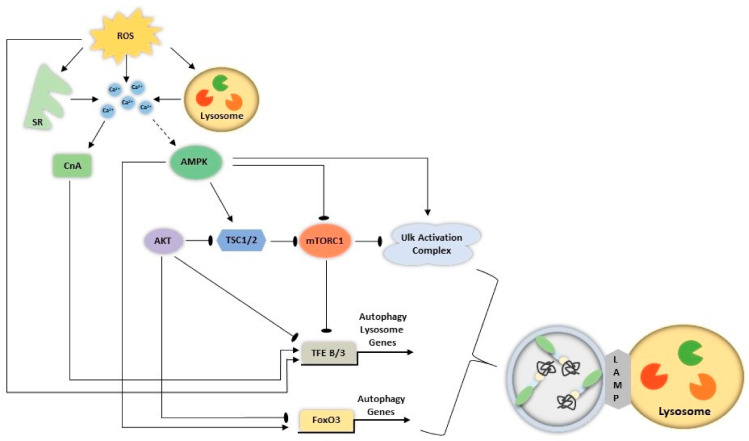
Figure 1
Figure 1
Proposed coordination of pathways that regulate the autophagy-lysosome System (ALS). ROS and cytosolic calcium ([Ca2+]IC) act as upstream signaling mechanisms that converge on the gene expression and protein activation of the ALS. AMPK is activated directly via compromised energy status (increase AMP:ADP), and indirectly through [Ca2+]IC via CaMKII (not shown). Elevated [Ca2+]IC may occur due to the damaging effects of elevated ROS, from mitochondria or other sources, on the sarcoplasmic reticulum and lysosomes. AMPK synchronously activates FoxO3, Tfeb and Tfe3 (Tfeb/3) through (1) direct phosphorylation of FoxO3, (2) activation of TSC1/2 and (3) inhibition of mTORC1. Simultaneously, AMPK activates autophagy induction through the Ulk1 complex and by alleviating mTORC1 inhibition on this complex. In a similar cellular milieu, FoxO3 repression is alleviated via AKT inhibition. Increases in [Ca2+]IC activate the phosphatase CnA, which activates Tfeb/3. ROS also activate Tfeb/3 through oxidation, an added layer of coordination in this autophagy-lysosome system.
Figure 2
Figure 2
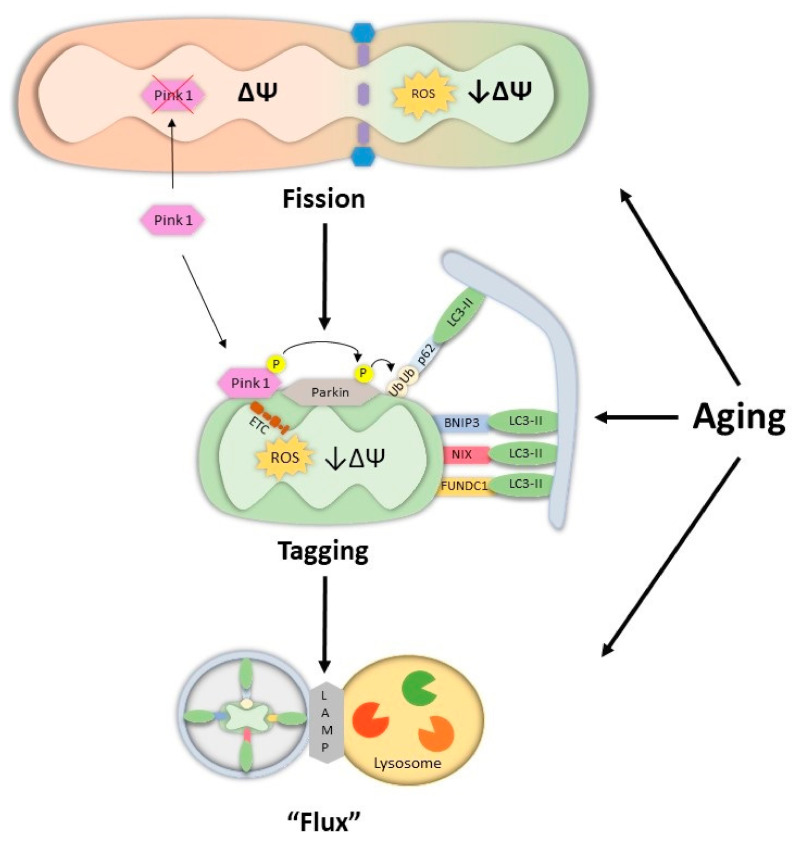
The impact of age on mitophagy in skeletal muscle. When a portion of the mitochondrial reticulum becomes dysfunctional, with a low membrane potential (Ψ) and elevated ROS production, it will undergo fission, mediated by Drp1 and Fis1, depicted as green mitochondria. The fragmented mitochondrion will enter the mitophagy pathway. Pink1, which is normally imported and degraded in the mitochondria, will accumulate on the outer mitochondrial membrane (OMM), and will ultimately recruit and activate the E3-Ligase Parkin. Parkin subsequently poly-ubiquitinates OMM proteins which bind to adapt proteins such as p62. p62 will tether autophagosomal proteins, such as LC3-II. In Ub-independent mitophagy, receptors such as BNIP3, NIX and FUNDC1, found on the OMM, will anchor the mitochondria directly to autophagosomal proteins. Ultimately the autophagosome-bound mitochondria will be shuttled to lysosomes where they will be degraded. Aging muscle exhibits increased mitochondrial fission, autophagy tagging, and flux, to the point of the lysosomes. Evidence, somewhat limited, exists that point to lysosomal dysfunction with age.

References

    1. Janssen I., Heymsfield S.B., Wang Z., Ross R. Skeletal Muscle Mass and Distribution in 468 Men and Women Aged 18–88 Yr. J. Appl. Physiol. 2000;89:81–88. doi: 10.1152/jappl.2000.89.1.81. - DOI - PubMed
    1. Ogata T., Yamasaki Y. Scanning Electron-Microscopic Studies on the Three-Dimensional Structure of Mitochondria in the Mammalian Red, White and Intermediate Muscle Fibers. Cell Tissue Res. 1985;241:251–256. doi: 10.1007/BF00217168. - DOI - PubMed
    1. Hoppeler H. Exercise-Induced Ultrastructural Changes in Skeletal Muscle. Int. J. Sports Med. 1986;7:187–204. doi: 10.1055/s-2008-1025758. - DOI - PubMed
    1. Das G., Shravage B.V., Baehrecke E.H. Regulation and Function of Autophagy during Cell Survival and Cell Death. Cold Spring Harb. Perspect. Biol. 2012;4 doi: 10.1101/cshperspect.a008813. - DOI - PMC - PubMed
    1. Raben N., Hill V., Shea L., Takikita S., Baum R., Mizushima N., Ralston E., Plotz P. Suppression of Autophagy in Skeletal Muscle Uncovers the Accumulation of Ubiquitinated Proteins and Their Potential Role in Muscle Damage in Pompe Disease. Hum. Mol. Genet. 2008;17:3897–3908. doi: 10.1093/hmg/ddn292. - DOI - PMC - PubMed

Publication types

LinkOut - more resources