


Algal Toxic Compounds and Their Aeroterrestrial, Airborne and other Extremophilic Producers with Attention to Soil and Plant Contamination: A Review
- PMID: 33946968
- PMCID: PMC8145420
- DOI: 10.3390/toxins13050322
Algal Toxic Compounds and Their Aeroterrestrial, Airborne and other Extremophilic Producers with Attention to Soil and Plant Contamination: A Review
Abstract
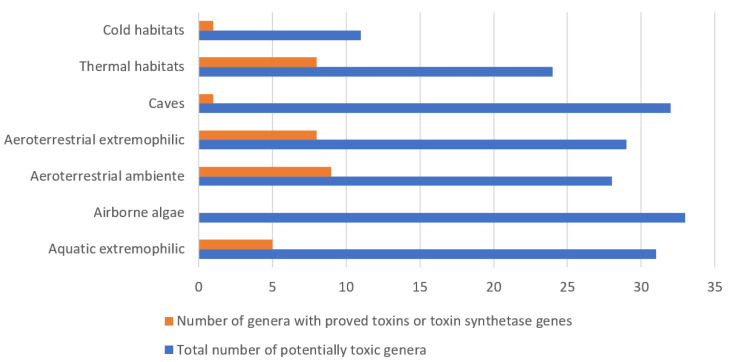
The review summarizes the available knowledge on toxins and their producers from rather disparate algal assemblages of aeroterrestrial, airborne and other versatile extreme environments (hot springs, deserts, ice, snow, caves, etc.) and on phycotoxins as contaminants of emergent concern in soil and plants. There is a growing body of evidence that algal toxins and their producers occur in all general types of extreme habitats, and cyanobacteria/cyanoprokaryotes dominate in most of them. Altogether, 55 toxigenic algal genera (47 cyanoprokaryotes) were enlisted, and our analysis showed that besides the "standard" toxins, routinely known from different waterbodies (microcystins, nodularins, anatoxins, saxitoxins, cylindrospermopsins, BMAA, etc.), they can produce some specific toxic compounds. Whether the toxic biomolecules are related with the harsh conditions on which algae have to thrive and what is their functional role may be answered by future studies. Therefore, we outline the gaps in knowledge and provide ideas for further research, considering, from one side, the health risk from phycotoxins on the background of the global warming and eutrophication and, from the other side, the current surge of interest which phycotoxins provoke due to their potential as novel compounds in medicine, pharmacy, cosmetics, bioremediation, agriculture and all aspects of biotechnological implications in human life.
Keywords: algae; caves; cyanobacteria; cyanopeptides; cyanotoxins; deserts; human health risk; hypersaline habitats; phycotoxins; thermal springs.
Conflict of interest statement
The authors declare no conflict of interest.
Figures
References
-
- Graham L.E., Graham J.M., Wilcox L.W. Algae. 2nd ed. Pearson Education, Inc.; San Francisco, CA, USA: 2009.
-
- Evert R.F., Eichhorn S.E. Raven Biology of Plants. 8th ed. W. H. Freeman and Company; New York, NY, USA: 2012.
-
- Round F.E. The Ecology of Algae. Cambrige University Press; Cambrige, UK: 1981.
Publication types
MeSH terms
Substances
Grants and funding
LinkOut - more resources
Full Text Sources
