


Whole-body vibration training versus conventional balance training in patients with severe COPD-a randomized, controlled trial
- PMID: 33947416
- PMCID: PMC8097810
- DOI: 10.1186/s12931-021-01688-x
Whole-body vibration training versus conventional balance training in patients with severe COPD-a randomized, controlled trial
Abstract
Background: Whole-body vibration training (WBV) performed on a vibration platform can significantly improve physical performance in patients with chronic obstructive pulmonary disease. It has been suggested that an important mechanism of this improvement is based on an improvement in balance. Therefore, the aim of this study was to investigate the effects of WBV compared to conventional balance training.
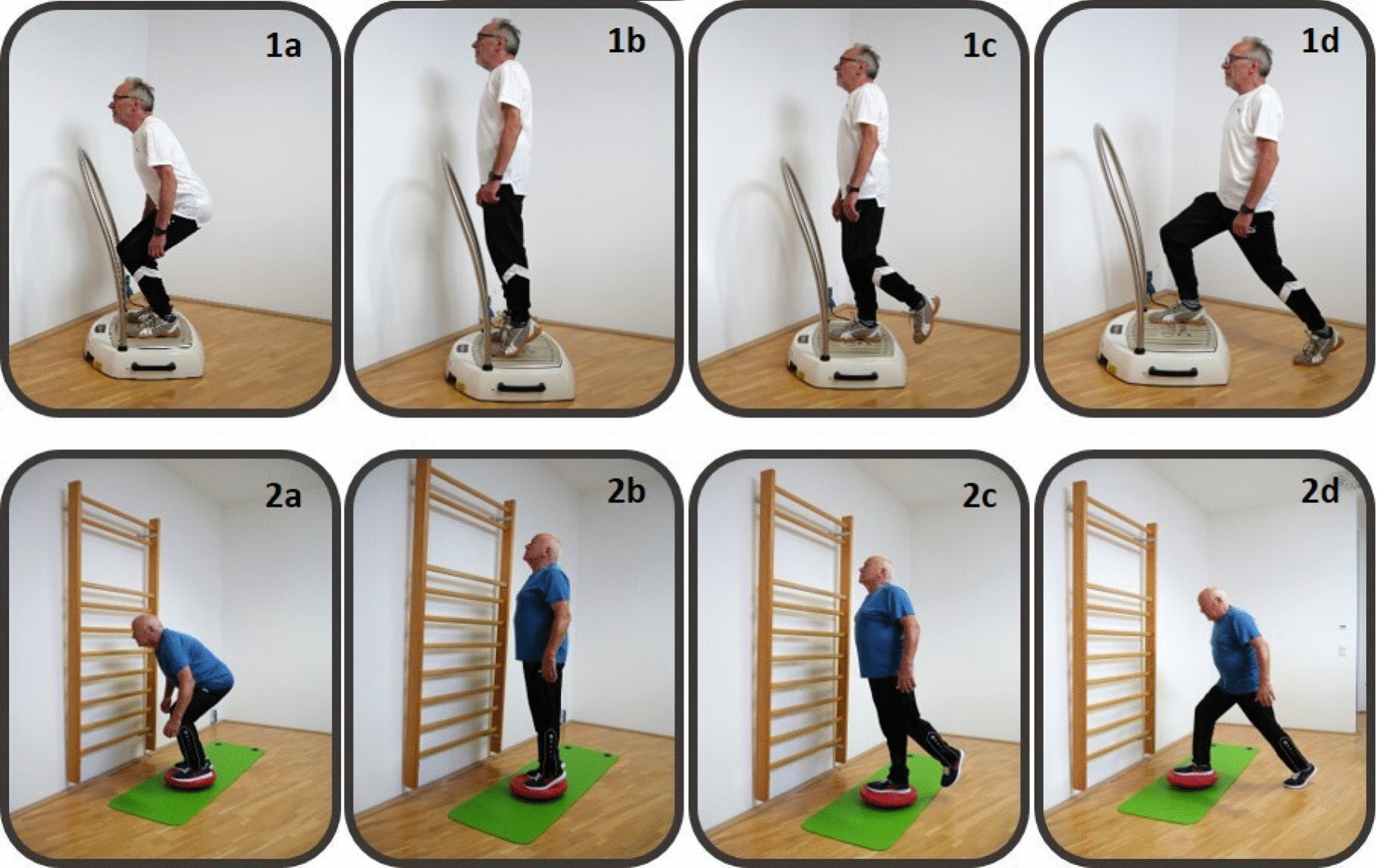
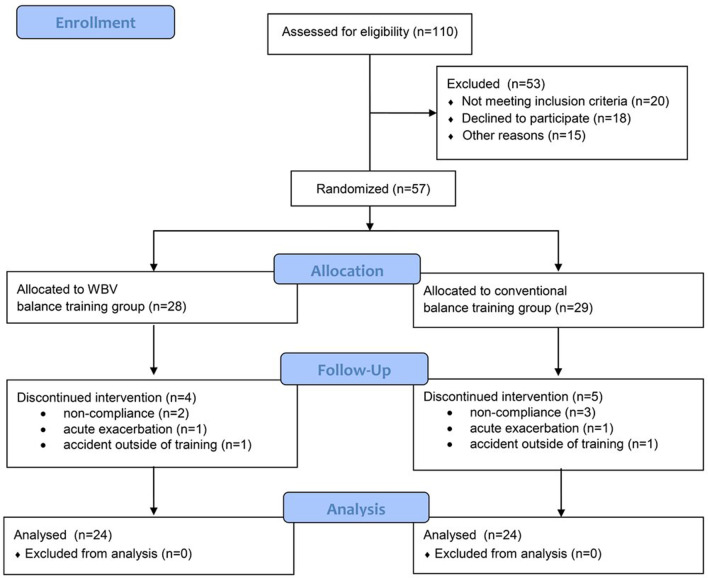
Methods: 48 patients with severe COPD (FEV1: 37 ± 7%predicted) and low exercise performance (6 min walk distance (6MWD): 55 ± 10%predicted) were included in this randomized controlled trial during a 3 week inpatient pulmonary rehabilitation. All patients completed a standardized endurance and strength training program. Additionally, patients performed 4 different balance exercises 3x/week for 2 sets of 1 min each, either on a vibration platform (Galileo) at varying frequencies (5-26 Hz) (WBV) or on a conventional balance board (BAL). The primary outcome parameter was the change in balance performance during a semi tandem stance with closed eyes assessed on a force measurement platform. Muscular power during a countermovement jump, the 6MWD, and 4 m gait speed test (4MGST) were secondary outcomes. Non-parametric tests were used for statistical analyses.
Results: Static balance performance improved significantly more (p = 0.032) in favor of WBV (path length during semi-tandem stand: - 168 ± 231 mm vs. + 1 ± 234 mm). Muscular power also increased significantly more (p = 0.001) in the WBV group (+ 2.3 ± 2.5 W/kg vs. - 0.1 ± 2.0 W/kg). 6MWD improved to a similar extent in both groups (WBV: 48 ± 46 m, p < 0.001 vs. BAL: 38 ± 32 m; p < 0.001) whereas the 4MGST increased significantly only in the WBV-group (0.08 ± 0.14 m/s2, p = 0.018 vs. 0.01 ± 0.11 m/s2, p = 0.71).
Conclusions: WBV can improve balance performance and muscular power significantly more compared to conventional balance training.
Trial registration: Clinical-Trials registration number: NCT03157986; date of registration: May 17, 2017. https://clinicaltrials.gov/ct2/results?cond=&term=NCT03157986&cntry=&state=&city=&dist = .
Keywords: Chronic obstructive pulmonary disease; Exercise; Force measurement platform; Neuromuscular power; Pulmonary rehabilitation; Vibration platform.
Conflict of interest statement
The authors declare that they have no competing interests.
Figures


References
-
- Abercromby AF, Amonette WE, Layne CS, McFarlin BK, Hinman MR, Paloski WH. Variation in neuromuscular responses during acute whole-body vibration exercise. Med Sci Sports Exerc. 2007;39(1642):1650. - PubMed
-
- Ritzmann R, Kramer A, Gruber M, Gollhofer A, Taube W. EMG activity during whole body vibration: motion artifacts or stretch reflexes? Eur J Appl Physiol. 2010;110(143):151. - PubMed
Publication types
MeSH terms
Associated data
LinkOut - more resources
Full Text Sources
Medical
