


Inequality of weight status in urban Cuba: 2001-2010
- PMID: 33947417
- PMCID: PMC8097838
- DOI: 10.1186/s12963-021-00251-6
Inequality of weight status in urban Cuba: 2001-2010
Abstract
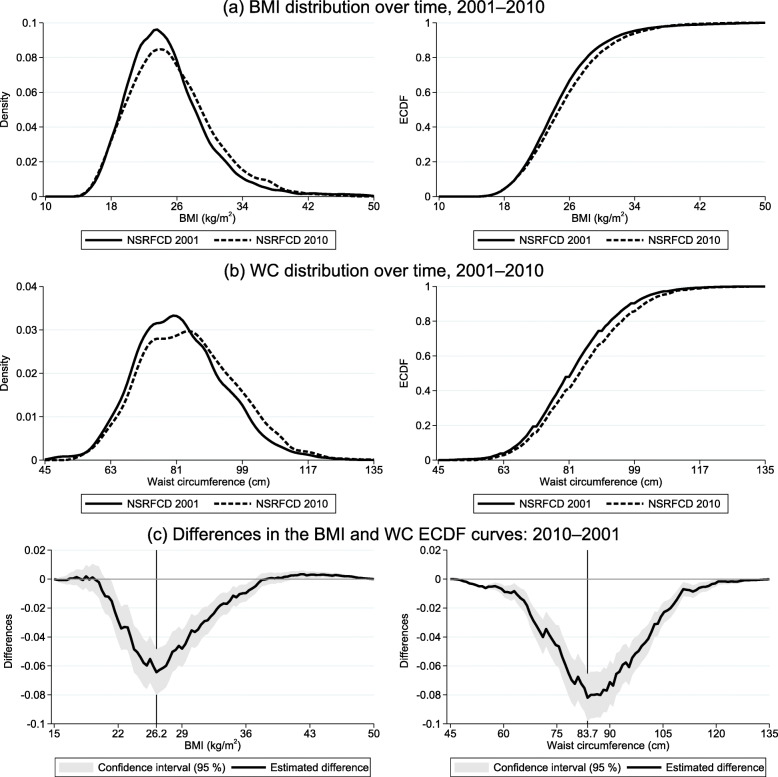
Background: Although understanding changes in the body weight distribution and trends in obesity inequality plays a key role in assessing the causes and persistence of obesity, limited research on this topic is available for Cuba. This study thus analyzed changes in body mass index (BMI) and waist circumference (WC) distributions and obesity inequality over a 9-year period among urban Cuban adults.
Methods: Kolmogorov-Smirnov tests were first applied to the data from the 2001 and 2010 National Survey on Risk Factors and Chronic Diseases to identify a rightward shift in both the BMI and WC distributions over the 2001-2010 period. A Shapley technique decomposed the increase in obesity prevalence into a mean-growth effect and a (re)distributional component. A univariate assessment of obesity inequality was then derived by calculating both the Gini and generalized entropy (GE) measures. Lastly, a GE-based decomposition partitioned overall obesity inequality into within-group and between-group values.
Results: Despite some relatively pronounced left-skewing, both the BMI and WC distributions exhibited a clear rightward shift to which the increases in general and central obesity can be mostly attributed. According to the Gini coefficients, both general and central obesity inequality increased over the 2001-2010 period, from 0.105 [95% confidence interval (CI) = 0.103-0.106] to 0.110 [95% CI = 0.107-0.112] and from 0.083 [95% CI = 0.082-0.084] to 0.085 [95% CI = 0.084-0.087], respectively. The GE-based decomposition further revealed that both types of inequality were accounted for primarily by within-group inequality (93.3%/89.6% and 87.5%/84.8% in 2001/2010 for general/central obesity, respectively).
Conclusions: Obesity inequality in urban Cuba worsened over the 2001-2010 time period, with within-group inequality in overall obesity dominant over between-group inequality. In general, the results also imply that the rise in obesity inequality is immune to health care system characteristics.
Keywords: Body mass index; Decomposition; Inequality; Obesity; Urban Cuba; Waist circumference.
Conflict of interest statement
The authors declare that they have no competing interests.
Figures

References
-
- WHO . Obesity and Overweight. Fact sheet N°311. Geneva: World Health Organization; 2018.
-
- Swinburn BA, Kraak VI, Allender S, Atkins VJ, Baker PI, Bogard JR, Brinsden H, Calvillo A, de Schutter O, Devarajan R, Ezzati M, Friel S, Goenka S, Hammond RA, Hastings G, Hawkes C, Herrero M, Hovmand PS, Howden M, Jaacks LM, Kapetanaki AB, Kasman M, Kuhnlein HV, Kumanyika SK, Larijani B, Lobstein T, Long MW, Matsudo VKR, Mills SDH, Morgan G, Morshed A, Nece PM, Pan A, Patterson DW, Sacks G, Shekar M, Simmons GL, Smit W, Tootee A, Vandevijvere S, Waterlander WE, Wolfenden L, Dietz WH. The global syndemic of obesity, undernutrition, and climate change: the Lancet Commission report. Lancet. 2019;393(10173):791–846. doi: 10.1016/S0140-6736(18)32822-8. - DOI - PubMed
Publication types
MeSH terms
LinkOut - more resources
Full Text Sources
