


Are occlusal splints effective in reducing myofascial pain in patients with muscle-related temporomandibular disorders? A randomized-controlled trial
- PMID: 33948541
- PMCID: PMC8088795
- DOI: 10.5606/tftrd.2021.6615
Are occlusal splints effective in reducing myofascial pain in patients with muscle-related temporomandibular disorders? A randomized-controlled trial
Abstract
Objectives: This study aims to evaluate the effectiveness of upper Michigan occlusal splint (OS) compared to mandibular OS in terms of pain, range of motion (ROM), and muscle activity as assessed by surface electromyography (sEMG) in patients affected by muscle-related temporomandibular disorders (TMD).
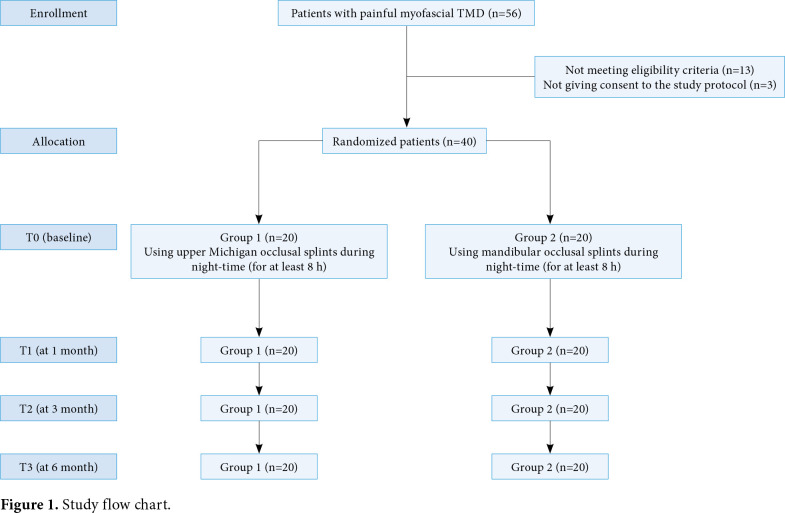
Patients and methods: In this randomized-controlled trial, a total of 40 adult patients (13 males, 27 females; mean age: 47.2±12.8 years; range, 22 to 56 years) with a diagnosis of myofascial pain, lasting from at least three months on at least one masseter muscle. The patients were randomly allocated into two groups: Group 1 (n=20) using upper Michigan OS and Group 2 (n=20) using mandibular OS. At baseline (T0), at one (T1), three (T2), and six months (T3), the following outcomes were assessed: myofascial pain by Visual Analog Scale (VAS) and ROM of mandible movements, activity of the main masticatory muscles through sEMG.
Results: There were no significant intra-group differences in the outcome measures assessed in both groups. However, Group 2 had a significantly higher right lateral mandibular ROM at T2 (7.1±3.1 vs. 9.8±2.3, respectively; p<0.05) and a significantly higher left lateral mandibular ROM at T3 (7.6±3.5 vs. 10.5±2.1, respectively; p<0.05). We found no significant difference in none of the sEMG parameters.
Conclusion: Our study results suggest that OS, independently from being built on the upper or lower arch, seems to not have significant effects in reducing pain over a six-month period in TMD patients.
Keywords: Electromyography; myofascial pain syndrome; occlusal splint; pain management; rehabilitation; temporomandibular joint disorder.
Copyright © 2021, Turkish Society of Physical Medicine and Rehabilitation.
Conflict of interest statement
Conflict of Interest: The authors declared no conflicts of interest with respect to the authorship and/or publication of this article.
References
-
- Schiffman E, Ohrbach R, Truelove E, Look J, Anderson G, Goulet JP, et al. Diagnostic Criteria for Temporomandibular Disorders (DC/TMD) for Clinical and Research Applications: recommendations of the International RDC/TMD Consortium Network* and Orofacial Pain Special Interest Group†. J Oral Facial Pain Headache. 2014;28:6–27. - PMC - PubMed
-
- Aldemir K, Üstüner E, Erdem E, Demiralp AS, Oztuna D. Ultrasound evaluation of masseter muscle changes in stabilization splint treatment of myofascial type painful temporomandibular diseases. Oral Surg Oral Med Oral Pathol Oral Radiol. 2013;116:377–383. - PubMed
LinkOut - more resources
Full Text Sources
Other Literature Sources