. 2021 Apr 20;2(4):100248.
doi: 10.1016/j.xcrm.2021.100248.

IGFBP-2 partly mediates the early metabolic improvements caused by bariatric surgery

Affiliations

IGFBP-2 partly mediates the early metabolic improvements caused by bariatric surgery

Justine Faramia et al. Cell Rep Med. .

Abstract

Insulin-like growth factor-binding protein (IGFBP)-2 is a circulating biomarker of cardiometabolic health. Here, we report that circulating IGFBP-2 concentrations robustly increase after different bariatric procedures in humans, reaching higher levels after biliopancreatic diversion with duodenal switch (BPD-DS) than after Roux-en-Y gastric bypass (RYGB) and sleeve gastrectomy (SG). This increase is closely associated with insulin sensitization. In mice and rats, BPD-DS and RYGB operations also increase circulating IGFBP-2 levels, which are not affected by SG or caloric restriction. In mice, Igfbp2 deficiency significantly impairs surgery-induced loss in adiposity and early improvement in insulin sensitivity but does not affect long-term enhancement in glucose homeostasis. This study demonstrates that the modulation of circulating IGFBP-2 may play a role in the early improvement of insulin sensitivity and loss of adiposity brought about by bariatric surgery.

Keywords: BPD-DS; RYGB; bariatric surgery; binding protein; humans; insulin-like growth factor; metabolism; mice; patients; sleeve gastrectomy; type 2 diabetes.


Conflict of interest statement

A.C.C. has received consultant fees from Janssen (2017 and 2018), Novartis (2018), Novo Nordisk (2018), HLS Therapeutics (2019), and Eli Lilly (2020). A.-M.C. has received consultant fees from Pfizer (2017). A.T. received consulting fees from Novo Nordisk and Bausch Health. A.T. and L.B. are the recipients of research grant support from Johnson & Johnson Medical Companies and Medtronic for studies on bariatric surgery and the Research Chair in Bariatric and Metabolic Surgery, respectively, at l’Institut Universitaire de Cardiologie et de Pneumologie de Québec (IUCPQ) and Laval University. All of the other authors reported no competing financial interests in relation to the work described herein.

Figures

None
Graphical abstract
Figure 1
Figure 1
Upregulation of IGFBP-2 closely correlates with insulin sensitization after bariatric surgery in humans (A) Fasting plasma IGFBP-2 concentrations in patients before and 4, 8, and 12 months after biliopancreatic diversion with duodenal switch (BPD-DS), Roux-en-Y gastric bypass (RYGB), and vertical sleeve gastrectomy (SG) (n = 18–20), ∗∗∗∗p < 0.0001 compared with RYGB and SG. Lines are means ± SEMs. (B) Fasting plasma IGFBP-2 concentrations in patients as corrected by BMI over time; ∗∗∗∗p < 0.0001 compared with RYGB and SG. Lines are means ± SEMs. (C–F) Increases in plasma IGFBP-2 levels at 12 months after surgery compared to baseline values (C). ∗∗∗∗p < 0.0001 compared with RYGB and SG. Individual data were also plotted according to surgery type: BDP-DS (D), RYGB (E), and SG (F). Each point represents 1 individual patient. Lines are means ± SEMs. ∗∗∗∗p < 0.0001 compared with pre-operation levels. (G) Fasting plasma IGFBP-2 concentrations before and 3, 90, and 365 days after BPD-DS in 5 normoglycemic (filled circles) and 11 diabetic (empty circles) patients. Each point represents 1 individual patient, ∗∗∗∗p < 0.0001. Lines are means ± SEMs. (H–L) In these individuals, IGFBP-2 levels were correlated with fasting glycemia (H), insulinemia (I), HOMA-IR (J), and ADIPO-IR (K) indexes of insulin resistance, as well as glucose infusion rate during euglycemic-hyperinsulinemic clamp (L) in patients studied before and at specific time points after the surgery. Correlation curves were analyzed by ANCOVA and multiple regression analyses to take repeated measurements over time into account. p values unadjusted, p∗ values adjusted for BMI; n.s., not significant.
Figure 2
Figure 2
Modulation of hepatic production of IGFBP-2 after bariatric surgery in rodents (A and B) Plasma protein (A) and hepatic mRNA (B) levels of IGFBP-2 were quantified in high-fat (HF)-fed obese rats (n = 6–11) 9 weeks after either sham, SG, DS, or hybrid (BPD-DS) bariatric surgeries, or in sham-operated rats weight matched (WM) to BPD-DS by food restriction. Each point represents 1 individual animal. Lines are means ± SEMs. ∗p < 0.05 compared with ad libitum (Ad Lib)-sham group; $p < 0.05 compared with WM sham group. (C–E) Levels of IGFBP-2 in plasma (C and D) and liver (D and E) in HF-fed mice 21 weeks after undergoing sham or RYGB surgeries or in non-surgical mice weight matched to RYGB by caloric restriction (WM) (n = 4–10). Each point represents 1 individual animal. Lines are means ± SEMs. ∗∗∗p < 0.001 compared to Ad Lib-sham group; $$$p < 0.001 compared to WM group.
Figure 3
Figure 3
Absence of IGFBP-2 partly impairs the impact of RYGB on body weight and adiposity in mice through changes in food intake (A) Absence of IGFBP-2 was confirmed in plasma and liver by immunoblotting 21 weeks after undergoing sham or RYGB surgeries or weight matching by caloric restriction (WM). WT: Igfbp2+/+; knockout (KO): Igfbp2−/− mice. (B–G): Effects of RYGB (green symbols), sham surgery (red symbols), and WM (blue symbols in D–G) in Igfbp2+/+ (open symbols) and Igfbp2−/− (filled symbols) mice on absolute body weight (B), percent change in body weight (C), fat mass (D), lean mass (E), adiposity index (fat mass/lean mass, F), and plasma leptin levels (G). Body weights of WM mice, not shown here for clarity since they are very close to those of RYGB mice, are displayed in Figures S2A and S2B. WT: SHAM (n = 13), RYGB (n = 11), WM (n = 5); KO: SHAM (n = 6), RYGB (n = 9), WM (n = 5). #, RYGB/Igfbp2−/− versus RYGB/Igfbp2+/+, p < 0.05; ˆ, WM/Igfbp2−/− versus WM/Igfbp2+/+, p < 0.05, based on Benjamini-Hochberg-corrected, pairwise t tests. Lines are means ± SEMs. (H and I) In the same animals, intake of food was evaluated over time (H) and at specific periods (I) before and after sham surgery (red), RYGB surgery (green), and in WM (blue) obese Igfbp2+/+ and Igfbp2−/− mice. Data in (H) are means ± SEMs of 2-day averages. Lines in (I) are means ± SEMs. (J–L) Energy expenditure (J), respiratory exchange ratio (K), and physical activity (L) were evaluated in metabolic chambers at thermoneutrality (29°C) 5 weeks after surgery (see gray area in B). WT: SHAM (n = 12), RYGB (n = 10), WM (n = 5); KO: SHAM (n = 6), RYGB (n = 9), WM (n = 5). Energy expenditure was adjusted for lean mass by ANCOVA. Lines are means ± SEMs. All plot panels show individual data points over a box indicating means ± SEMs. Data that do not share the same letters are significantly different from each other (p < 0.05, pairwise t tests with Benjamini-Hochberg correction, false discovery rate [FDR] = 0.05, following ANOVA).
Figure 4
Figure 4
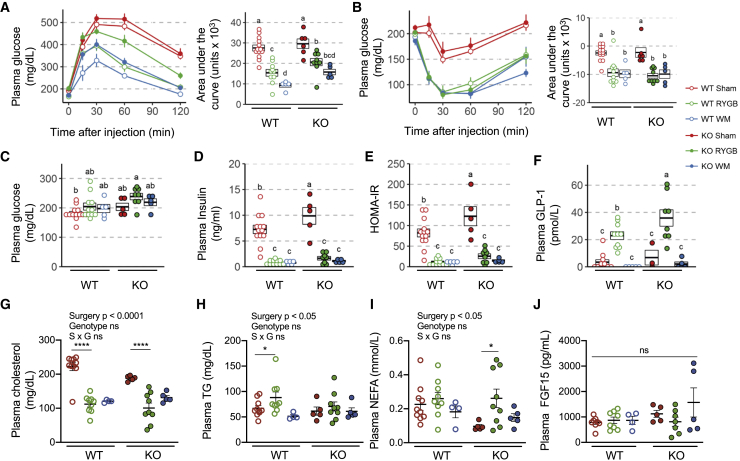
Effects of RYGB on glucose and lipid metabolism in obese Igfbp2+/+ (WT) and Igfbp2−/− (KO) mice (A and B) Excursion and area under the curve of glycemia after intraperitoneal glucose (A) or subcutaneous insulin injections (B) were determined at 3 and 10- weeks post-surgery, respectively, in obese Igfbp2+/+ and Igfbp2−/− mice subjected to sham surgery (red), RYGB surgery (green), or in WM mice (blue). WT: SHAM (n = 13), RYGB (n = 10–11), WM (n = 5); KO: SHAM (n = 6), RYGB (n = 8–9), WM (n = 5). Lines are means ± SEMs. (C–E) Twenty-one weeks post-surgery, at sacrifice, blood was harvested after an overnight fast and used to quantify circulating levels of glucose (C), insulin (D), which were used to calculate HOMA index (E). (F–J) Plasma GLP-1 (F), cholesterol (G), triglycerides (H), non-esterified fatty acid (NEFA) (I), and FGF-15 (J) levels were also quantified at sacrifice. Time course data in (A) and (B) are means ± SEMs. All of the other panels show individual data points over a box indicating means ± SEMs. Data that do not share the same letters are significantly different from each other (p < 0.05; pairwise t tests with Benjamini-Hochberg correction; FDR = 0.05, following ANOVA).

References

    1. Poirier P., Cornier M.A., Mazzone T., Stiles S., Cummings S., Klein S., McCullough P.A., Ren Fielding C., Franklin B.A., American Heart Association Obesity Committee of the Council on Nutrition, Physical Activity, and Metabolism Bariatric surgery and cardiovascular risk factors: a scientific statement from the American Heart Association. Circulation. 2011;123:1683–1701. - PubMed
    1. Rubino F. Bariatric surgery: effects on glucose homeostasis. Curr. Opin. Clin. Nutr. Metab. Care. 2006;9:497–507. - PubMed
    1. Abarca-Gómez L., Abdeen Z.A., Hamid Z.A., Abu-Rmeileh N.M., Acosta-Cazares B., Acuin C., Adams R.J., Aekplakorn W., Afsana K., Aguilar-Salinas C.A., NCD Risk Factor Collaboration (NCD-RisC) Worldwide trends in body-mass index, underweight, overweight, and obesity from 1975 to 2016: a pooled analysis of 2416 population-based measurement studies in 128·9 million children, adolescents, and adults. Lancet. 2017;390:2627–2642. - PMC - PubMed
    1. Harris L.A., Kayser B.D., Cefalo C., Marini L., Watrous J.D., Ding J., Jain M., McDonald J.G., Thompson B.M., Fabbrini E. Biliopancreatic Diversion Induces Greater Metabolic Improvement Than Roux-en-Y Gastric Bypass. Cell Metab. 2019;30:855–864.e3. - PMC - PubMed
    1. Thomas S., Schauer P. Bariatric surgery and the gut hormone response. Nutr. Clin. Pract. 2010;25:175–182. - PubMed

Publication types

Substances