


Theoretical Mediators of Diabetes Risk and Quality of Life Following a Diabetes Prevention Program for Latino Youth With Obesity
- PMID: 33949215
- PMCID: PMC8983113
- DOI: 10.1177/08901171211012951
Theoretical Mediators of Diabetes Risk and Quality of Life Following a Diabetes Prevention Program for Latino Youth With Obesity
Abstract
Purpose: This study tested self-efficacy and social support for activity and dietary changes as mediators of changes in type 2 diabetes related outcomes following a lifestyle intervention among Latino youth.
Setting and intervention: Latino adolescents (14-16 years) with obesity (BMI% = 98.1 ± 1.4) were randomized to a 3-month intervention (n = 67) that fostered self-efficacy and social support through weekly, family-centered sessions or a comparison condition (n = 69).
Measures: Primary outcomes included insulin sensitivity and weight specific quality of life. Mediators included self-efficacy, friend, and family social support for health behaviors. Data was collected at baseline, 3-months, 6-months, and 12-months.
Analysis: Sequential path analysis was used to examine mediators as mechanisms by which the intervention influenced primary outcomes.
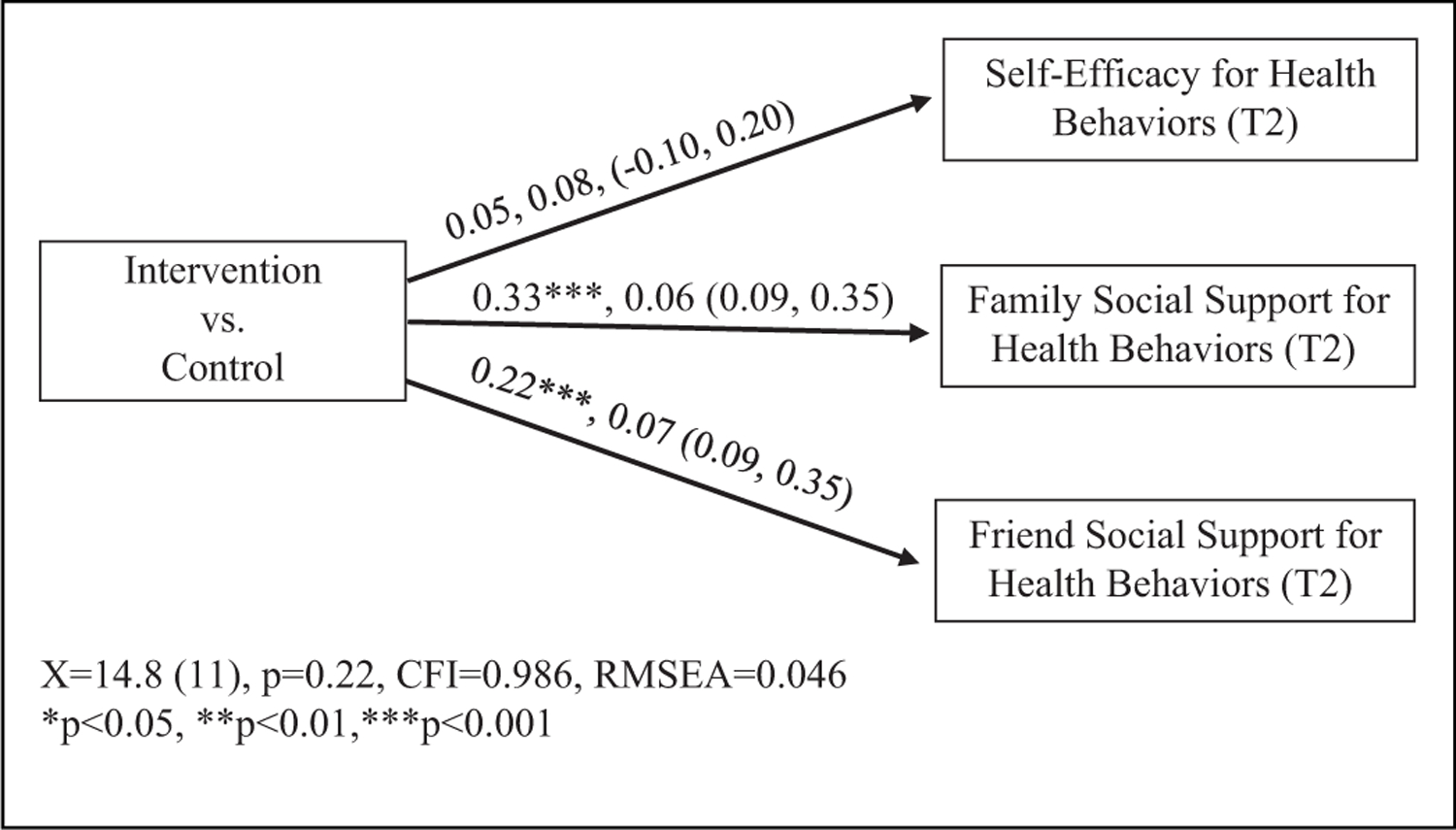
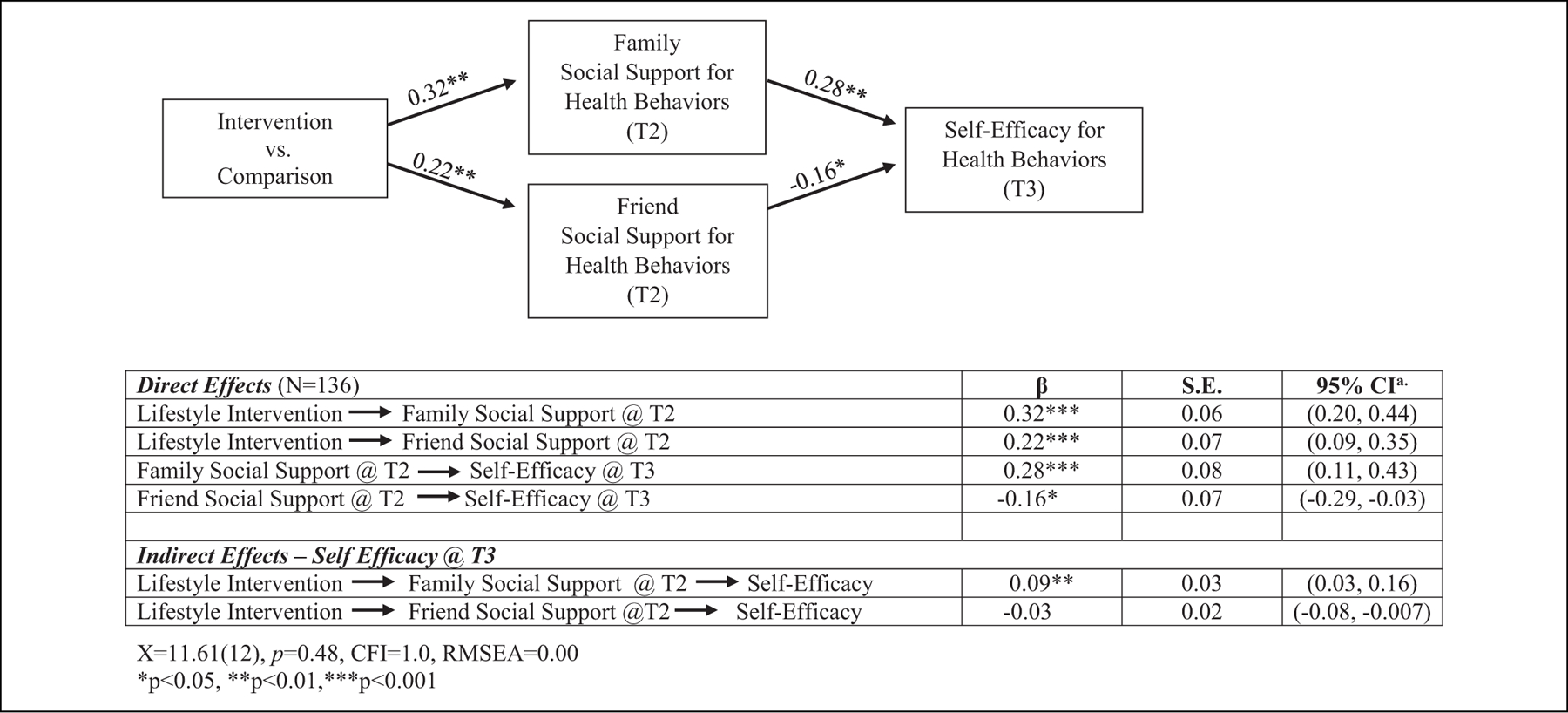
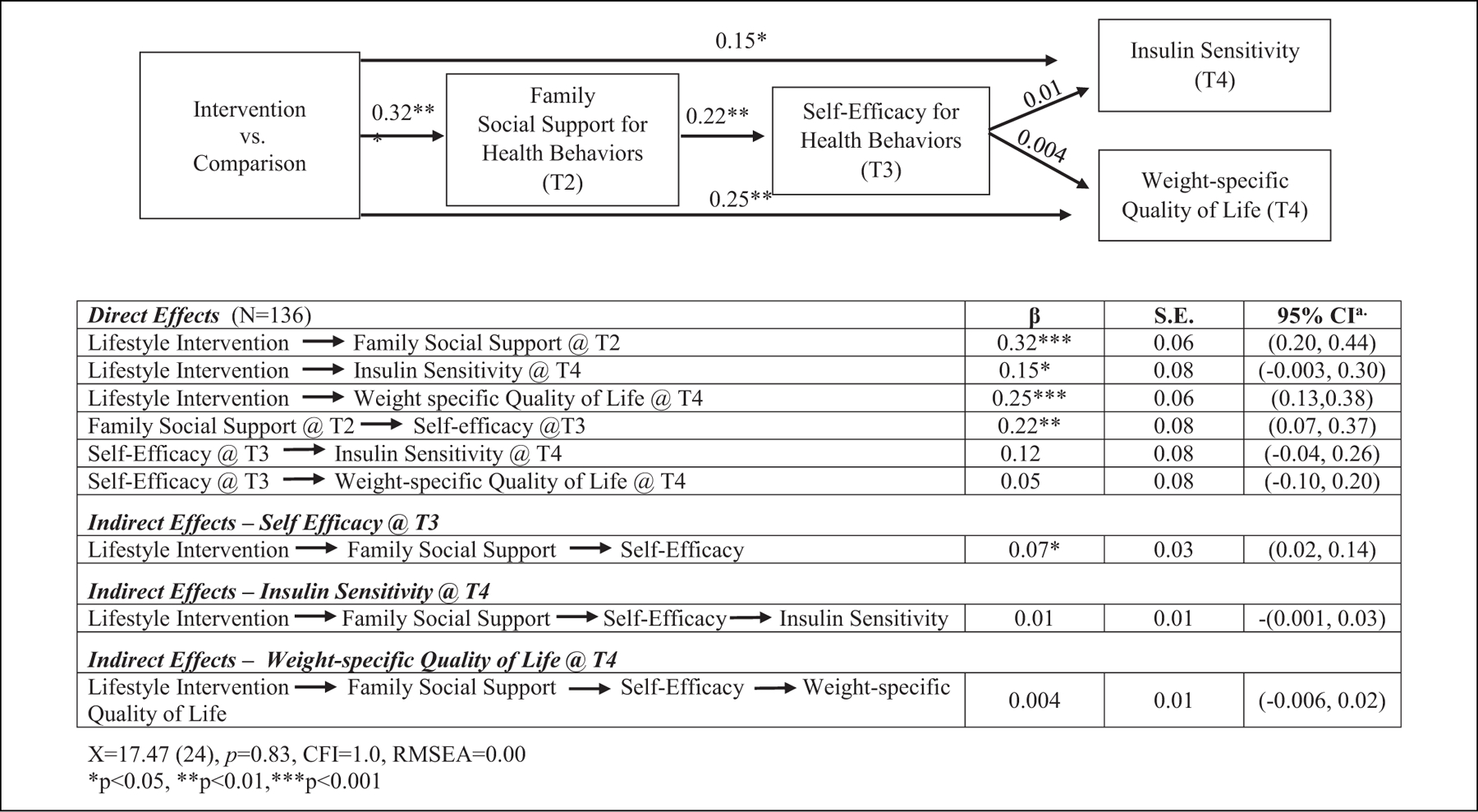
Results: The intervention had a direct effect on family (β = 0.33, P < .01) and friend social support (β = 0.22, P < .001) immediately following the intervention (3-months). Increased family social support mediated the intervention's effect on self-efficacy at 6-months (β = 0.09, P < .01). However, social support and self-efficacy did not mediate long-term changes in primary outcomes (P > .05) at 12-months.
Conclusions: Family social support may improve self-efficacy for health behaviors in high-risk Latino youth, highlighting the important role of family diabetes prevention. Fostering family social support is a critical intervention target and more research is needed to understand family-level factors that have the potential to lead to long-term metabolic and psychosocial outcome in vulnerable youth.
Keywords: Latino health; adolescents; diabetes prevention; family; theory.
Conflict of interest statement
Declaration of Conflicting Interests
The author(s) declared no potential conflicts of interest with respect to the research, authorship, and/or publication of this article.
Figures
Similar articles
-
Culturally-grounded diabetes prevention program for obese Latino youth: Rationale, design, and methods.Contemp Clin Trials. 2017 Mar;54:68-76. doi: 10.1016/j.cct.2017.01.004. Epub 2017 Jan 16. Contemp Clin Trials. 2017. PMID: 28104469 Free PMC article. Clinical Trial.
-
Preventing diabetes in obese Latino youth with prediabetes: a study protocol for a randomized controlled trial.BMC Public Health. 2017 Mar 16;17(1):261. doi: 10.1186/s12889-017-4174-2. BMC Public Health. 2017. PMID: 28302101 Free PMC article. Clinical Trial.
-
Effects of a Community-Based Diabetes Prevention Program for Latino Youth with Obesity: A Randomized Controlled Trial.Obesity (Silver Spring). 2018 Dec;26(12):1856-1865. doi: 10.1002/oby.22300. Epub 2018 Nov 14. Obesity (Silver Spring). 2018. PMID: 30426694 Free PMC article. Clinical Trial.
-
Behavioral lifestyle interventions for the primary prevention of type 2 diabetes and translation to Hispanic/Latino communities in the United States and Mexico.Nutr Rev. 2017 Jan;75(suppl 1):85-93. doi: 10.1093/nutrit/nuw041. Nutr Rev. 2017. PMID: 28049753 Free PMC article. Review.
-
Psychological interventions to improve self-management of type 1 and type 2 diabetes: a systematic review.Health Technol Assess. 2020 Jun;24(28):1-232. doi: 10.3310/hta24280. Health Technol Assess. 2020. PMID: 32568666 Free PMC article.
Cited by
-
Rapid Decline in β-Cell Function and Increasing Adiposity Are Associated With Conversion to Type 2 Diabetes in At-Risk Latino Youth.Diabetes. 2023 Jun 1;72(6):735-745. doi: 10.2337/db22-1034. Diabetes. 2023. PMID: 36972018 Free PMC article.
-
Opportunities to Address Obesity Disparities Among High-Risk Latino Children and Adolescents.Curr Obes Rep. 2021 Sep;10(3):332-341. doi: 10.1007/s13679-021-00445-x. Epub 2021 Jul 14. Curr Obes Rep. 2021. PMID: 34263434 Free PMC article. Review.
-
Technology-Based Obesity Prevention Interventions Among Hispanic Adolescents in the United States: Scoping Review.JMIR Pediatr Parent. 2022 Nov 4;5(4):e39261. doi: 10.2196/39261. JMIR Pediatr Parent. 2022. PMID: 36331547 Free PMC article.
-
Family-Based Obesity Prevention Interventions among Hispanic Children and Families: A Scoping Review.Nutrients. 2021 Aug 3;13(8):2690. doi: 10.3390/nu13082690. Nutrients. 2021. PMID: 34444850 Free PMC article.
References
-
- Menke A, Casagrande S, Geiss L, Cowie CC. Prevalence of and trends in diabetes among adults in the United States, 1988–2012. JAMA. 2015;314(10):1021–1029. - PubMed
-
- Menke A, Casagrande S, Cowie CC. Prevalence of diabetes in adolescents aged 12 to 19 years in the United States, 2005–2014. JAMA. 2016;316(3):344–345. - PubMed
-
- Bandura A Social cognitive theory of self-regulation. Organ Behav Hum Decis Process. 1991;50(2):248–287.
Publication types
MeSH terms
Grants and funding
LinkOut - more resources
Full Text Sources
Other Literature Sources
Medical
