


Implementation of Tele-ICU during the COVID-19 pandemic
- PMID: 33950091
- PMCID: PMC8332846
- DOI: 10.36416/1806-3756/e20200545
Implementation of Tele-ICU during the COVID-19 pandemic
Abstract
Objective: To describe the implementation of a Tele-ICU program during the COVID-19 pandemic, as well as to describe and analyze the results of the first four months of operation of the program.
Methods: This was a descriptive observational study of the implementation of a Tele-ICU program, followed by a retrospective analysis of clinical data of patients with COVID-19 admitted to ICUs between April and July of 2020.
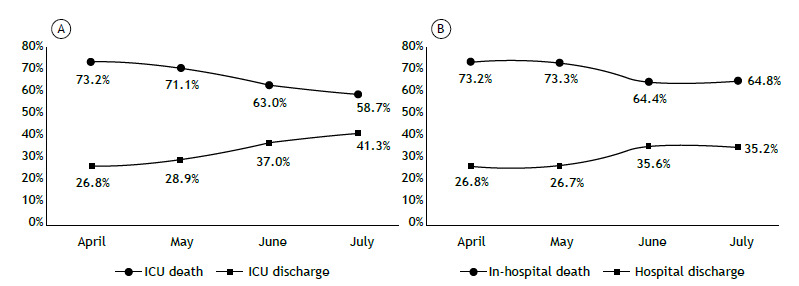
Results: The Tele-ICU program was implemented over a four-week period and proved to be feasible during the pandemic. Participants were trained remotely, and the program had an evidence-based design, the objective being to standardize care for patients with COVID-19. More than 100,000 views were recorded on the free online platforms and the mobile application. During the study period, the cases of 326 patients with COVID-19 were evaluated through the program. The median age was 60 years (IQR, 49-68 years). There was a predominance of males (56%). There was also a high prevalence of hypertension (49.1%) and diabetes mellitus (38.4%). At ICU admission, 83.7% of patients were on invasive mechanical ventilation, with a median PaO2/FiO2 ratio < 150. It was possible to use lung-protective ventilation in 75% of the patients. Overall, in-hospital mortality was 68%, and ICU mortality was 65%.
Conclusions: Our Tele-ICU program provided multidisciplinary training to health care professionals and clinical follow-up for hundreds of critically ill patients. This public health care network initiative was unprecedented and proved to be feasible during the COVID-19 pandemic, encouraging the creation of similar projects that combine evidence-based practices, training, and Tele-ICU.
Objetivo:: Descrever a implantação de um serviço de telemedicina de UTI durante a pandemia de COVID-19, assim como descrever e analisar os resultados dos primeiros quatro meses de funcionamento do programa.
Métodos:: Estudo observacional descritivo da implantação de um serviço de telemedicina de UTI seguido de análise retrospectiva dos dados clínicos de pacientes com COVID-19 internados em UTI entre abril e julho de 2020.
Resultados:: O serviço foi implantado em quatro semanas e mostrou-se viável em meio à pandemia. O treinamento foi desenhado para ser remoto e baseado em evidências, promovendo a padronização do atendimento aos pacientes com COVID-19. Mais de 100.000 visualizações foram registradas nas plataformas on-line de acesso livre e no aplicativo móvel. Durante o período do estudo, os casos de 326 pacientes com COVID-19 foram avaliados no programa. A mediana de idade foi de 60 anos (variação: 49-68 anos). Houve predomínio do sexo masculino (56%) e alta prevalência de hipertensão arterial (49,1%) e diabetes mellitus (38,4%). Na admissão na UTI, 83,7% dos pacientes estavam em ventilação mecânica invasiva, com uma mediana da relação PaO2/FiO2 < 150. Ventilação pulmonar protetora foi possível em 75% dos casos. A mortalidade na UTI foi de 65%, e a mortalidade hospitalar foi de 68%.
Conclusões:: A telemedicina de UTI forneceu treinamento multidisciplinar aos profissionais de saúde e acompanhamento clínico de centenas de pacientes críticos. A iniciativa na rede pública foi pioneira e mostrou-se viável em meio à pandemia de COVID-19, incentivando a criação de projetos semelhantes que combinem práticas baseadas em evidências, treinamento e telemedicina.
Figures

References
-
- Angus DC, Kelley MA, Schmitz RJ, White A, Popovich J., Jr Committee on Manpower for Pulmonary and Critical Care Societies Caring for the critically ill patient. Current and projected workforce requirements for care of the critically ill and patients with pulmonary disease: can we meet the requirements of an aging population?. JAMA. 2000;284(21):2762–2770. doi: 10.1001/jama.284.21.2762. - DOI - PubMed
-
- World Health Organization . Coronavirus Disease (COVID-19) Dashboard. Geneva: World Health Organization; 2020. https://covid19.who.int
-
- Coronavírus Brasil . Painel Coronavírus. Brasília: Ministério da Saúde; 2020. https://covid.saude.gov.br
Publication types
MeSH terms
LinkOut - more resources
Full Text Sources
Medical
Miscellaneous
