Survival After Breast Conservation vs Mastectomy Adjusted for Comorbidity and Socioeconomic Status: A Swedish National 6-Year Follow-up of 48 986 Women
- PMID: 33950173
- PMCID: PMC8100916
- DOI: 10.1001/jamasurg.2021.1438
Survival After Breast Conservation vs Mastectomy Adjusted for Comorbidity and Socioeconomic Status: A Swedish National 6-Year Follow-up of 48 986 Women
Abstract
Importance: Cohort studies show better survival after breast-conserving surgery (BCS) with postoperative radiotherapy (RT) than after mastectomy (Mx) without RT. It remains unclear whether this is an independent effect or a consequence of selection bias.
Objective: To determine whether the reported survival benefit of breast conservation is eliminated by adjustment for 2 pivotal confounders, comorbidity and socioeconomic status.
Design, setting, and participants: Cohort study using prospectively collected national data. Swedish public health care; nationwide clinical data from the National Breast Cancer Quality Register, comorbidity data from Patient Registers at the National Board of Health and Welfare, and individual-level education and income data from Statistics Sweden. The cohort included all women diagnosed as having primary invasive T1-2 N0-2 breast cancer and undergoing breast surgery in Sweden from 2008 to 2017. Data were analyzed between August 19, 2020, and November 12, 2020.
Exposures: Locoregional treatment comparing 3 groups: breast-conserving surgery with radiotherapy (BCS+RT), mastectomy without radiotherapy (Mx-RT), and mastectomy with radiotherapy (Mx+RT).
Main outcomes and measures: Overall survival (OS) and breast cancer-specific survival (BCSS). Main outcomes were determined before initiation of data retrieval.
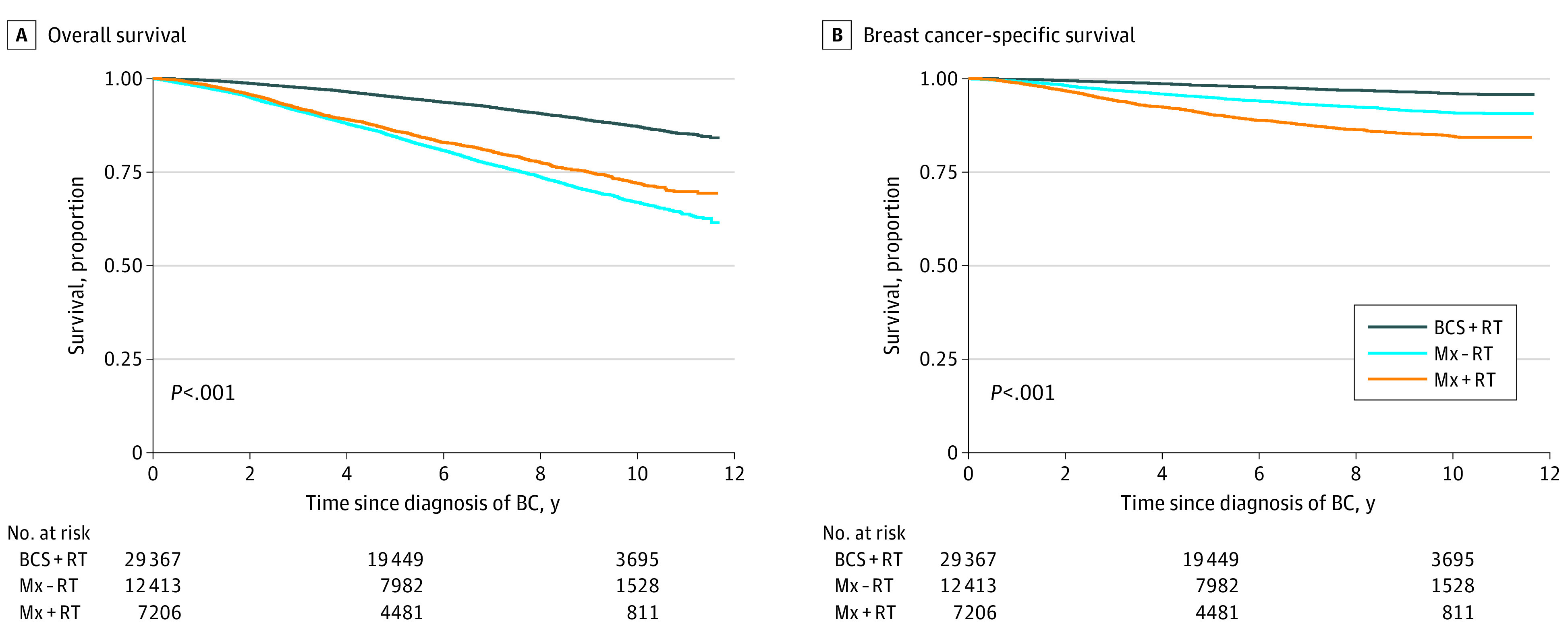
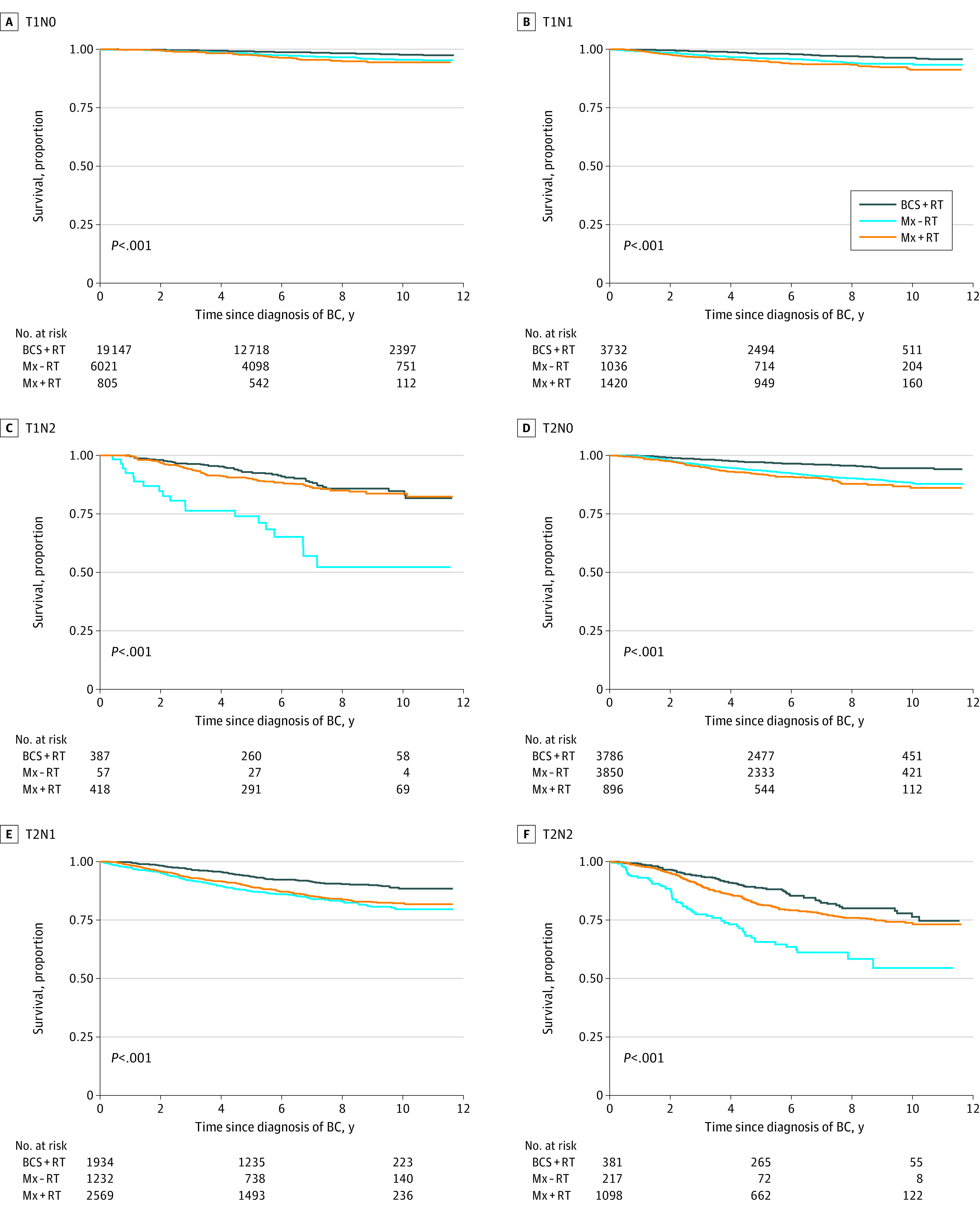
Results: Among 48 986 women, 29 367 (59.9%) had BCS+RT, 12413 (25.3%) had Mx-RT, and 7206 (14.7%) had Mx+RT. Median follow-up was 6.28 years (range, 0.01-11.70). All-cause death occurred in 6573 cases, with death caused by breast cancer in 2313 cases; 5-year OS was 91.1% (95% CI, 90.8-91.3) and BCSS was 96.3% (95% CI, 96.1-96.4). Apart from expected differences in clinical parameters, women receiving Mx-RT were older, had a lower level of education, and lower income. Both Mx groups had a higher comorbidity burden irrespective of RT. After stepwise adjustment for all covariates, OS and BCSS were significantly worse after Mx-RT (hazard ratio [HR], 1.79; 95% CI, 1.66-1.92 and HR, 1.66; 95% CI, 1.45-1.90, respectively) and Mx+RT (HR, 1.24; 95% CI, 1.13-1.37 and HR, 1.26; 95% CI, 1.08-1.46, respectively) than after BCS+RT.
Conclusions and relevance: Despite adjustment for previously unmeasured confounders, BCS+RT yielded better survival than Mx irrespective of RT. If both interventions are valid options, mastectomy should not be regarded as equal to breast conservation.
Conflict of interest statement
Figures
Comment in
-
Safety of Breast-Conserving Surgery in Breast Cancer and Risk of Overtreatment vs Undertreatment.JAMA Surg. 2021 Jul 1;156(7):638. doi: 10.1001/jamasurg.2021.1450. JAMA Surg. 2021. PMID: 33950169 No abstract available.
-
Eradication of Potential In-Transit Metastasis in Breast-Conserving Surgery-Reply.JAMA Surg. 2022 Feb 1;157(2):174-175. doi: 10.1001/jamasurg.2021.5352. JAMA Surg. 2022. PMID: 34705036 No abstract available.
-
Eradication of Potential In-Transit Metastasis in Breast-Conserving Surgery.JAMA Surg. 2022 Feb 1;157(2):174. doi: 10.1001/jamasurg.2021.5349. JAMA Surg. 2022. PMID: 34705047 No abstract available.
References
-
- Abdulkarim BS, Cuartero J, Hanson J, Deschênes J, Lesniak D, Sabri S. Increased risk of locoregional recurrence for women with T1-2N0 triple-negative breast cancer treated with modified radical mastectomy without adjuvant radiation therapy compared with breast-conserving therapy. J Clin Oncol. 2011;29(21):2852-2858. doi:10.1200/JCO.2010.33.4714 - DOI - PMC - PubMed
Publication types
MeSH terms
LinkOut - more resources
Full Text Sources
Other Literature Sources
Medical