Review
. 2021 May 5;30(160):200224.
doi: 10.1183/16000617.0224-2020. Print 2021 Jun 30.

Developments in radiation techniques for thoracic malignancies

Affiliations
Review

Developments in radiation techniques for thoracic malignancies

Tobias Finazzi et al. Eur Respir Rev. .

Abstract

Radiation therapy is a cornerstone of modern lung cancer treatment alongside surgery, chemotherapy, immunotherapy and targeted therapies. Advances in radiotherapy techniques have enhanced the accuracy of radiation delivery, which has contributed to the evolution of radiation therapy into a guideline-recommended treatment in both early-stage and locally advanced nonsmall cell lung cancer. Furthermore, although radiotherapy has long been used for palliation of disease in advanced lung cancer, it is increasingly having a role as a locally ablative treatment in patients with oligometastatic disease.This review provides an overview of recent developments in radiation techniques, particularly for non-radiation oncologists who are involved in the care of lung cancer patients. Technical advances are discussed, and findings of recent clinical trials are highlighted, all of which have led to a changing perception of the role of radiation therapy in multidisciplinary care.


Conflict of interest statement

Conflict of interest: T. Finazzi reports personal fees from AstraZeneca, outside the submitted work. Conflict of interest: F.L. Schneiders has nothing to disclose. Conflict of interest: S. Senan reports grants and personal fees from AstraZeneca and Varian Medical Systems, grants from ViewRay Inc., and personal fees from MSD and Celgene, outside the submitted work.

Figures
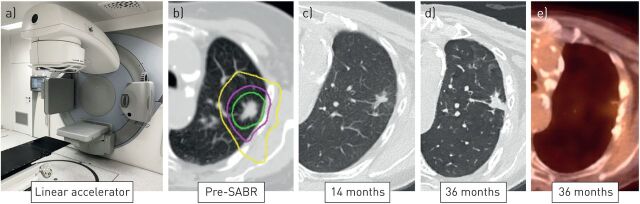
FIGURE 1
FIGURE 1
Serial diagnostic images of a peripheral stage I nonsmall cell lung cancer treated using a) stereotactic ablative radiotherapy (SABR) to a dose of 55 Gy, delivered in five fractions, on a linear accelerator. An on-board cone-beam computed tomography (CT) scan is used for the daily on-couch verification of tumour position. b) The planned dose distribution is illustrated using so-called isodose lines, representing 50% (yellow), 75% (purple) and 100% (green) of the prescribed radiation dose. High-precision dose delivery to the tumour minimises irradiation of surrounding normal tissues. c) Follow-up images at 14 months reveal ground-glass changes and focal fibrosis in the treated region. d, e) At 36 months, residual scarring is present, with a positron emission tomography-CT showing no residual 18F-fluorodeoxyglucose uptake in the lesion.
FIGURE 2
FIGURE 2
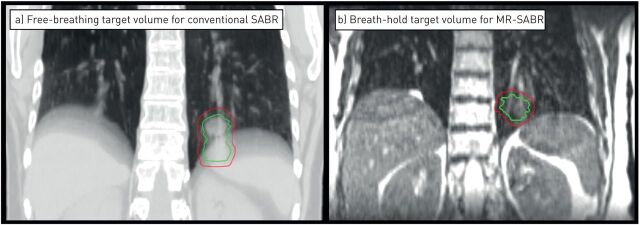
Planning images derived from a patient treated with magnetic resonance-guided stereotactic ablative radiotherapy (SABR) for a left lower lobe tumour. a) A motion-encompassing target volume (red contour) derived from a planning four-dimensional computed tomography scan for free-breathing conventional SABR. b) The actual target volume (red contour) when a pre-treatment breath-hold magnetic resonance (MR) scan was acquired. The smaller target volume for magnetic resonance-guided SABR avoids risk of high-dose delivery to the stomach, and accurate delivery to smaller target volumes is ensured by continuous target tracking and automated beam triggering.
FIGURE 3
FIGURE 3
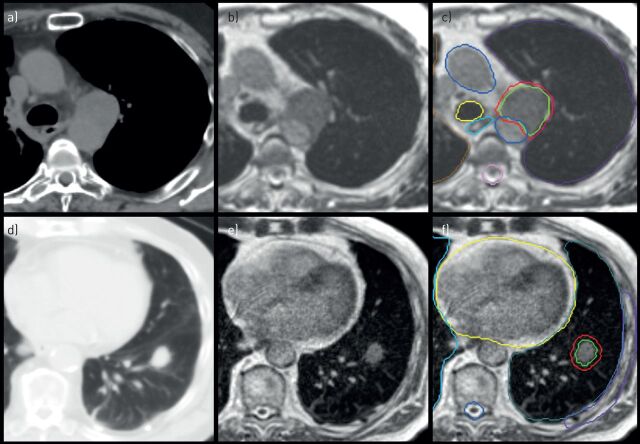
Axial panels of two patients treated using real-time magnetic resonance-guided stereotactic ablative radiotherapy, one for a–c) centrally located recurrence and one for d–f) peripheral early-stage nonsmall cell lung cancer. a, d) Computed tomography imaging represents the standard imaging modality for lung tumours. b, e) Linear accelerators with on-board magnetic resonance imaging allow for improved visualisation of soft tissues. c) The daily adaptation of radiotherapy treatment plans allowed for the minimisation of toxicity risks for a tumour recurrence in the mediastinum, which was treated in eight fractions to 60 Gy. f) A peripheral lung tumour located at a non-critical location, which was treated using a single fraction of 34 Gy.
FIGURE 4
FIGURE 4
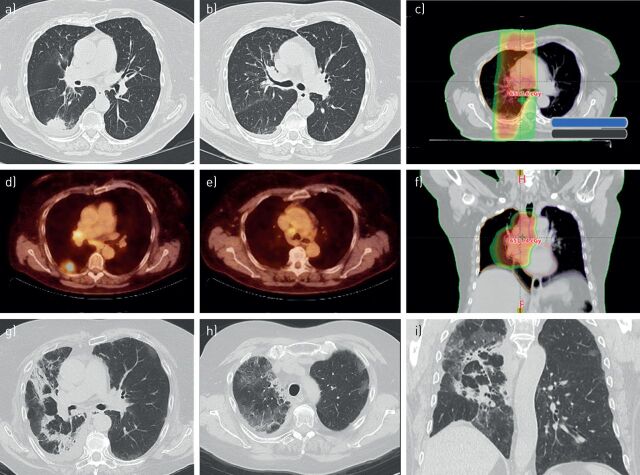
a, b, d, e) Serial images of a 70-year-old female patient with stage III nonsmall cell lung cancer who had completed chemoradiotherapy followed by durvalumab. c, f) The radiotherapy treatment plan with a colour-wash display of regions receiving a radiation dose of 30 Gy or higher. 2 months after commencing durvalumab the patient was diagnosed with a grade 2 radiation pneumonitis based upon diffuse ground-glass changes in the irradiated regions in the right lung. g–i) Subsequently, a diagnosis of coexisting immune checkpoint blockade pneumonitis was made based on the appearance of ground-glass abnormalities in the unirradiated contralateral upper lobe.

References

    1. Sung H, Ferlay J, Siegel RL, et al. Global cancer statistics 2020: GLOBOCAN estimates of incidence and mortality worldwide for 36 cancers in 185 countries. CA Cancer J Clin 2021; in press [ 10.3322/caac.21660]. - DOI - PubMed
    1. Guckenberger M, Andratschke N, Dieckmann K, et al. ESTRO ACROP consensus guideline on implementation and practice of stereotactic body radiotherapy for peripherally located early stage non-small cell lung cancer. Radiother Oncol 2017; 124: 11–17. doi: 10.1016/j.radonc.2017.05.012 - DOI - PubMed
    1. Videtic GMM, Donington J, Giuliani M, et al. Stereotactic body radiation therapy for early-stage non-small cell lung cancer: executive summary of an ASTRO evidence-based guideline. Pract Radiat Oncol 2017; 7: 295–301. doi: 10.1016/j.prro.2017.04.014 - DOI - PubMed
    1. De Ruysscher D, Faivre-Finn C, Moeller D, et al. European Organization for Research and Treatment of Cancer (EORTC) recommendations for planning and delivery of high-dose, high precision radiotherapy for lung cancer. Radiother Oncol 2017; 124: 1–10. doi: 10.1016/j.radonc.2017.06.003 - DOI - PubMed
    1. Postmus PE, Kerr KM, Oudkerk M, et al. Early and locally advanced non-small-cell lung cancer (NSCLC): ESMO Clinical Practice Guidelines for diagnosis, treatment and follow-up. Ann Oncol 2017; 28: iv1–iv21. doi: 10.1093/annonc/mdx222 - DOI - PubMed

MeSH terms