. 2021 May 5;11(1):9586.
doi: 10.1038/s41598-021-89029-2.

Efficient genome editing of an extreme thermophile, Thermus thermophilus, using a thermostable Cas9 variant

Affiliations

Efficient genome editing of an extreme thermophile, Thermus thermophilus, using a thermostable Cas9 variant

Bjorn Thor Adalsteinsson et al. Sci Rep. .

Abstract

Thermophilic organisms are extensively studied in industrial biotechnology, for exploration of the limits of life, and in other contexts. Their optimal growth at high temperatures presents a challenge for the development of genetic tools for their genome editing, since genetic markers and selection substrates are often thermolabile. We sought to develop a thermostable CRISPR-Cas9 based system for genome editing of thermophiles. We identified CaldoCas9 and designed an associated guide RNA and showed that the pair have targetable nuclease activity in vitro at temperatures up to 65 °C. We performed a detailed characterization of the protospacer adjacent motif specificity of CaldoCas9, which revealed a preference for 5'-NNNNGNMA. We constructed a plasmid vector for the delivery and use of the CaldoCas9 based genome editing system in the extreme thermophile Thermus thermophilus at 65 °C. Using the vector, we generated gene knock-out mutants of T. thermophilus, targeting genes on the bacterial chromosome and megaplasmid. Mutants were obtained at a frequency of about 90%. We demonstrated that the vector can be cured from mutants for a subsequent round of genome editing. CRISPR-Cas9 based genome editing has not been reported previously in the extreme thermophile T. thermophilus. These results may facilitate development of genome editing tools for other extreme thermophiles and to that end, the vector has been made available via the plasmid repository Addgene.


Conflict of interest statement

The authors declare no competing interests.

Figures
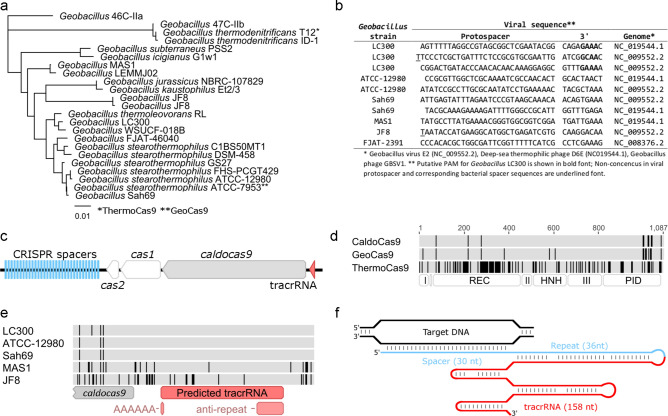
Figure 1
Figure 1
Identification of CaldoCas9 and design of gRNA. (A) Phylogeny of Cas9 enzymes identified in publicly available genomes of Geobacillus strains. Respective strain names are indicated. Scale bar indicates average number of amino acid residue substitutions per site. (B) A list of protospacers identified in viral genomes that are complimentary to spacers extracted from Geobacillus strains. Protospacer sequences and 9 bases downstream of the protospacer are shown. (C) A schematic illustrating organization of the CRISPR-Cas9 genomic region of Geobacillus strain LC300. The putative location of the tracrRNA is indicated, and of genes encoding Cas1, Cas2, and CaldoCas9. (D) Alignment of amino acid residue sequence of CaldoCas9 with the previously characterized enzymes GeoCas9 and ThermoCas9. Scale indicates polypeptide length. Each residue per enzyme is indicated in gray or black color, where gray indicates sequence consensus in all three enzymes, and black indicates non-consensus. At the bottom of the schematic, locations of Cas9 domains are indicated. (E) Genome sequence alignment of five Geobacillus strains, showing an approximately 0.3 kb region upstream of the caldocas9 open reading frame. Each nucleotide is indicated in gray or black color, where gray indicates consensus between sequences and black indicates non-consensus. Location of an CRISPR anti-repeat sequence, a poly-A sequence, and putative tracrRNA are indicated. (F) A schematic illustration of the designed gRNA. Predicted base-pairing is indicated with vertical black bars. The gRNA spans the entire sequence indicated in blue and red.
Figure 2
Figure 2
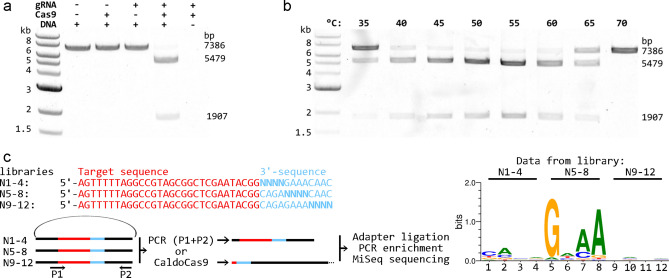
In vitro characterization of CaldoCas9 activity, thermostability and PAM specificity. (A) CaldoCas9, a DNA ‘target’ and gRNA containing a spacer complimentary to the target DNA were incubated in various combinations (top, +  = with, – = without) at 55 °C and the products separated on an agarose gel. Scale on left corresponds to the DNA ladder in the first well of the gel. On far right are indicated the expected band sizes of the uncut (7386 bp) and cut (5479 and 1907 bp) DNA. (B) CaldoCas9, a DNA ‘target’ and gRNA containing a spacer complimentary to the target DNA were incubated together at various temperatures (top) and the products separated on an agarose gel. (C) Top-left: three DNA libraries were prepared that contained a ‘target sequence’ that was common to all three libraries (red font) and a partially randomized sequence (3′- sequence, in blue font, randomized bases indicated as N) downstream of the target sequence. Bottom-left: the DNA libraries (carried on a circular plasmid backbone) were separately PCR amplified (primers indicated as P1 and P2) and incubated with CaldoCas9 and gRNA. The products of each were adapter ligated, PCR enriched and sequenced. Right: PAM sequences permissible for CaldoCas9 cleavage, as revealed by the experiment. The agarose gel images (A,B) have been digitally manipulated for clarity. The original images are provided in supplementary file 5.
Figure 3
Figure 3
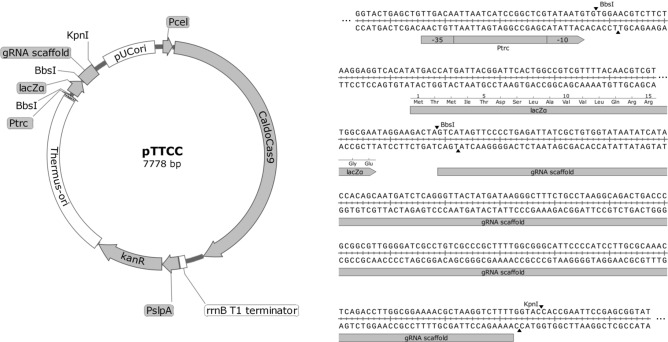
Composition of pTTCC, a CaldoCas9 genome editing system delivery vector. Left: a plasmid map illustrating the composition of pTTCC. The vector contains a gene encoding CaldoCas9 regulated by a cellobiose inducible promoter, Pcel, and a transcription terminator; a gene encoding a thermostable enzyme conferring kanamycin resistance under regulation of a constitutive promoter PslpA; T. Thermophilus and E. coli specific origins of replication; and a construct for cloning gRNA spacers and homology arms for directing gene editing—shown in detail in right panel. Right: pTTCC is constructed such that the vector can be digested by BbsI restriction endonuclease and spacer sequences inserted as annealed oligos via DNA ligation. The BbsI restriction sites flank a gene encoding the LacZα fragment of β-galactosidase and spacer cloning can therefore be combined with blue-white screening. A unique KpnI restriction site can be used for cloning of homologous recombination constructs.
Figure 4
Figure 4
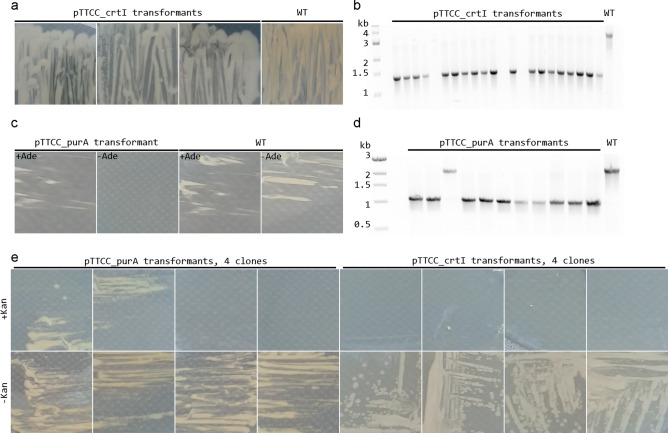
CaldoCas9 based genome editing of T. thermophilus at 65 °C. (A) pTTCC_crtI transformants streaked out on fresh media and grown overnight to reveal pigmentation difference in the transformants and WT cells. (B) Agarose gel electrophoresis of products from colony PCR amplification of the genomic locus containing crtI in T. thermophilus pTTCC_crtI transformants. Expected band size of the KO allele was 1351 bp and of WT allele 2891 bp. (C) pTTCC_purA transformants streaked out on minimal media with and without adenine supplementation (+ Ade − Ade, respectively) to reveal the adenine auxotrophic phenotype. (D) Agarose gel electrophoresis of products from colony PCR amplification of genomic locus containing purA in T. thermophilus pTTCC_purA transformants. Expected band size of the KO allele was 1094 bp and the WT allele 2320 bp. (E) After growth of pTTCC_purA and pTTCC_crtI transformants in media without antibiotic selection, individual colonies were streaked out on media with and without kanamycin (+ Kan, − Kan, respectively) to reveal the presence or absence of the plasmid. The agarose gel images (B,D) have been digitally manipulated for clarity. The original images are provided in supplementary file 5.

References

    1. Barrangou R, et al. CRISPR provides acquired resistance against viruses in prokaryotes. Science. 2007;315:1709–1712. doi: 10.1126/science.1138140. - DOI - PubMed
    1. Garneau JE, et al. The CRISPR/Cas bacterial immune system cleaves bacteriophage and plasmid DNA. Nature. 2010;468:67–71. doi: 10.1038/nature09523. - DOI - PubMed
    1. Mojica FJM, Díez-Villaseñor C, Soria E, Juez G. Biological significance of a family of regularly spaced repeats in the genomes of Archaea, Bacteria and mitochondria. Mol. Microbiol. 2000;36:244–246. doi: 10.1046/j.1365-2958.2000.01838.x. - DOI - PubMed
    1. Jansen R, van Embden JDA, Gaastra W, Schouls LM. Identification of genes that are associated with DNA repeats in prokaryotes. Mol. Microbiol. 2002;43:1565–1575. doi: 10.1046/j.1365-2958.2002.02839.x. - DOI - PubMed
    1. Brouns SJJ, et al. Small CRISPR RNAs guide antiviral defense in prokaryotes. Science. 2008;321:960–964. doi: 10.1126/science.1159689. - DOI - PMC - PubMed

Publication types