Review
. 2021 Apr 29:14:1701-1716.
doi: 10.2147/JIR.S304101. eCollection 2021.

Recent Progress in the Diagnosis and Precise Nanocarrier-Mediated Therapy of Inflammatory Bowel Disease

Affiliations
Review

Recent Progress in the Diagnosis and Precise Nanocarrier-Mediated Therapy of Inflammatory Bowel Disease

Liucan Wang et al. J Inflamm Res. .

Abstract

The effective colon drug delivery remains to be an international frontier research in inflammatory bowel disease (IBD) therapy. The exploration and research of nanocarrier-based nanomedicine with great potential brings new opportunities for IBD therapy and diagnoses. Functional nanocarriers with varying morphology and characteristics can not only effectively avoid the destruction of the complex gastrointestinal (GI) tract microenvironment but also endow drugs with target therapy and improved bioavailability, thus elevating therapeutic efficacy. In this review, we illustrated several challenges in IBD therapy, then emphasis on some latest research progress of nanoparticles based therapy of oral administration, rectal administration and parenteral administration, as well as IBD diagnoses. Finally, we described the future perspective of nanocarriers in the treatment and diagnoses of IBD.

Keywords: diagnose; drug delivery system; gastrointestinal tract microenvironment; inflammatory bowel disease; precise therapy.


Conflict of interest statement

The authors report no conflicts of interest in this work.

Figures

Figure 1
Figure 1
Nanoparticles that is suitable for drug delivery, including lipid nanoparticles, polymer nanoparticles, mesoporous nanoparticles, chitosan nanoparticles, hydrogel nanoparticles and metal nanoparticles.
Figure 2
Figure 2
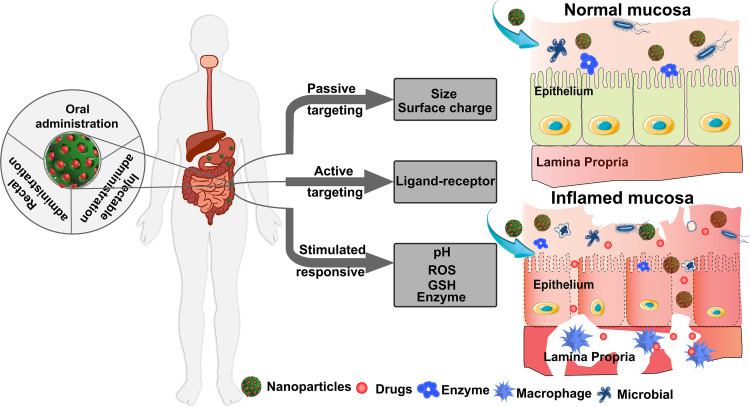
Schematic illustration of GIT microenvironment-based target drug delivery.
Figure 3
Figure 3
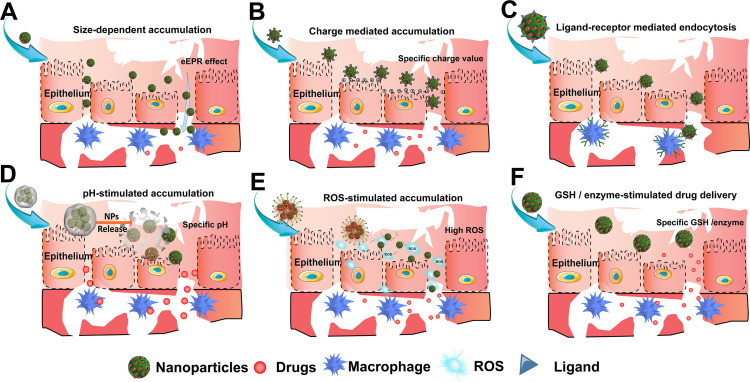
Schematic illustration of the scheme of inflammation-targeting in IBD. Through oral administration and rectal administration (I.V. administration are not depicted here), nanoparticles target the inflamed colon by mechanisms mediated by size (A), charge (B), ligand-receptor (C), pH (D), ROS (E), GSH and enzyme (F).

References

    1. Kaser A, Zeissig S, Blumberg RS. Inflammatory bowel disease. Annu Rev Immunol. 2010;28(1):573–621. doi: 10.1146/annurev-immunol-030409-101225 - DOI - PMC - PubMed
    1. Alhouayek M, Muccioli GG. The endocannabinoid system in inflammatory bowel diseases: from pathophysiology to therapeutic opportunity. Trends Mol Med. 2012;28:615–625. doi: 10.1016/j.molmed.2012.07.009 - DOI - PubMed
    1. Moran CJ, Huang H, Rivas M, et al. Genetic variants in cellular transport do not affect mesalamine response in ulcerative colitis. PLoS One. 2018;13(3):e0192806. doi: 10.1371/journal.pone.0192806 - DOI - PMC - PubMed
    1. Taylor KM, Irving PM. Optimization of conventional therapy in patients with IBD. Nat Rev Gastroenterol Hepatol. 2011;8(11):646. doi: 10.1038/nrgastro.2011.172 - DOI - PubMed
    1. Bryant RV, Brain O, Travis SPL. Conventional drug therapy for inflammatory bowel disease. Scand J Gastroenterol. 2015;50(1)::90–112. doi: 10.3109/00365521.2014.968864 - DOI - PubMed

LinkOut - more resources